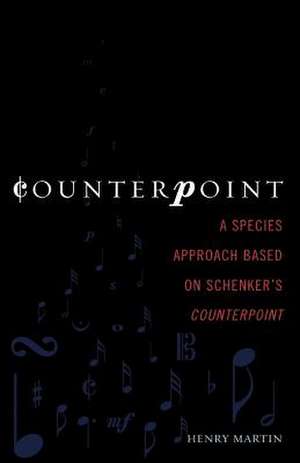
Counterpoint: A Species Approach Based on Schenker's Counterpoint
Autor Henry Martinen Limba Engleză Paperback – 4 ian 2005
The book proceeds by developing species counterpoint in the tradition of Johann Joseph Fux and his famous Gradus ad Parnassum (1725), but with attention to Schenker's more in-depth study. For the sake of brevity, musical examples are available on the Scarecrow Press website (www.scarecrowpress.com), rather than within the text itself.
Everyone from beginning music theory students to composers to graduate composition students will greatly benefit from the methods presented here. Rather than actually teaching a student to compose, working through these exercises will improve musicianship as it applies to both composition and understanding music theory.
Preț: 301.22 lei
Preț vechi: 387.73 lei
-22%
Puncte Express: 452
Carte tipărită la comandă
Livrare economică 09-23 decembrie
Livrare prin curier în România Termenul estimat este afișat lângă disponibilitate.
Transport gratuit de la 400.00 lei Plată online sau ramburs, în funcție de opțiunile comenzii.
Retur gratuit în 14 zile Comandă securizată și suport în română.
Specificații
ISBN-13: 9780810854093
ISBN-10: 0810854090
Pagini: 148
Dimensiuni: 136 x 214 x 12 mm
Greutate: 0.2 kg
Editura: Bloomsbury Publishing
Colecția Scarecrow Press
Locul publicării:New York, United States
ISBN-10: 0810854090
Pagini: 148
Dimensiuni: 136 x 214 x 12 mm
Greutate: 0.2 kg
Editura: Bloomsbury Publishing
Colecția Scarecrow Press
Locul publicării:New York, United States
Cuprins
Part 1 Preface
Part 2 Part One: Two-Part Counterpoint
Chapter 3 1 Exercise Writing and the Cantus Firmus
Chapter 4 2 Two-Part First Species (Note Against Note)
Chapter 5 3 Two-Part Second Species (Two Notes Against One)
Chapter 6 4 Two-Part Third Species (Four Notes Against One)
Chapter 7 5 Two-Part Fourth Species (Syncopation)
Chapter 8 6 Two-Part Fifth Species (Mixed Counterpoint)
Part 9 Part Two: Three-Part Counterpoint
Chapter 10 7 Three-Part First Species
Chapter 11 8 Three-Part Second Species
Chapter 12 9 Combined Counterpoint of the Second Species
Chapter 13 10 Three-Part Third Species
Chapter 14 11 Combined Counterpoint of the Second and Third Species
Chapter 15 12 Three-Part Fourth Species
Chapter 16 13 Three-Part Mixed Species
Chapter 17 14 Combined Species Incorporating Syncopation
Chapter 18 15 Combined Species with the Mixed Species; Imitation
Part 19 Part Three: Free Composition
Chapter 20 16 Modulation (Cadences to New Key Centers)
Chapter 21 17 Two-Part Free Counterpoint to the First Cadence
Chapter 22 18 More on Imitation; First Piece
Chapter 23 19 Invertible Counterpoint (Octave)
Chapter 24 20 More on Invertible Counterpoint
Part 25 Appendices
Chapter 26 1 Four-Part First Species
Chapter 27 2 Four-Part Simple Species (Second, Third, Fourth, Mixed)
Chapter 28 3 Five-, Six-, Seven-, and Eight-Part Counterpoint
Chapter 29 4 Four-Part Combined Counterpoints
Chapter 30 5 Three- or Four-Part Kyrie; Stretto
Part 31 Bibliography
Part 32 Index
Part 33 About the Author
Part 2 Part One: Two-Part Counterpoint
Chapter 3 1 Exercise Writing and the Cantus Firmus
Chapter 4 2 Two-Part First Species (Note Against Note)
Chapter 5 3 Two-Part Second Species (Two Notes Against One)
Chapter 6 4 Two-Part Third Species (Four Notes Against One)
Chapter 7 5 Two-Part Fourth Species (Syncopation)
Chapter 8 6 Two-Part Fifth Species (Mixed Counterpoint)
Part 9 Part Two: Three-Part Counterpoint
Chapter 10 7 Three-Part First Species
Chapter 11 8 Three-Part Second Species
Chapter 12 9 Combined Counterpoint of the Second Species
Chapter 13 10 Three-Part Third Species
Chapter 14 11 Combined Counterpoint of the Second and Third Species
Chapter 15 12 Three-Part Fourth Species
Chapter 16 13 Three-Part Mixed Species
Chapter 17 14 Combined Species Incorporating Syncopation
Chapter 18 15 Combined Species with the Mixed Species; Imitation
Part 19 Part Three: Free Composition
Chapter 20 16 Modulation (Cadences to New Key Centers)
Chapter 21 17 Two-Part Free Counterpoint to the First Cadence
Chapter 22 18 More on Imitation; First Piece
Chapter 23 19 Invertible Counterpoint (Octave)
Chapter 24 20 More on Invertible Counterpoint
Part 25 Appendices
Chapter 26 1 Four-Part First Species
Chapter 27 2 Four-Part Simple Species (Second, Third, Fourth, Mixed)
Chapter 28 3 Five-, Six-, Seven-, and Eight-Part Counterpoint
Chapter 29 4 Four-Part Combined Counterpoints
Chapter 30 5 Three- or Four-Part Kyrie; Stretto
Part 31 Bibliography
Part 32 Index
Part 33 About the Author