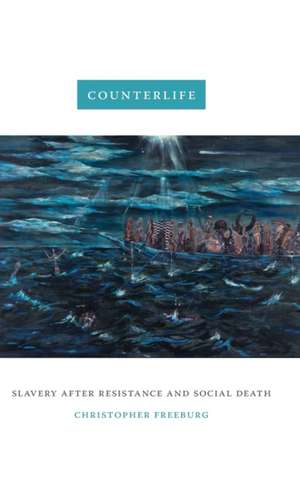
Counterlife
Autor Christopher Freeburgen Limba Engleză Hardback – 18 dec 2020
Preț: 559.48 lei
Preț vechi: 658.22 lei
-15%
Puncte Express: 839
Carte tipărită la comandă
Livrare economică 26 noiembrie-10 decembrie
Livrare prin curier în România Termenul estimat este afișat lângă disponibilitate.
Transport gratuit pentru acest produs Plată online sau ramburs, în funcție de opțiunile comenzii.
Retur gratuit în 14 zile Comandă securizată și suport în română.
Specificații
ISBN-13: 9781478010418
ISBN-10: 147801041X
Pagini: 148
Dimensiuni: 157 x 235 x 14 mm
Greutate: 0.48 kg
Editura: Duke University Press
ISBN-10: 147801041X
Pagini: 148
Dimensiuni: 157 x 235 x 14 mm
Greutate: 0.48 kg
Editura: Duke University Press
Cuprins
Acknowledgments
Introduction: Slavery's Hereafter
1. Sambo's Cloak
2. Kaleidoscope Views
3. Sounds of Blackness
4. The Last Black Hero
Coda: Chasing Ghosts
Notes
Bibliography
Introduction: Slavery's Hereafter
1. Sambo's Cloak
2. Kaleidoscope Views
3. Sounds of Blackness
4. The Last Black Hero
Coda: Chasing Ghosts
Notes
Bibliography
Notă biografică
Christopher Freeburg is Professor of English at the University of Illinois at Urbana-Champaign and author of Black Aesthetics and the Interior Life and Melville and the Idea of Blackness: Race and Imperialism in Nineteenth-Century America.
Descriere
Christopher Freeburg challenges the imperative to study black social life and slavery and its aftereffects through the lenses of freedom, agency, and domination and instead examines how enslaved Africans created meaning through spirituality, thought, and artistic creativity separate and alongside concerns about freedom.