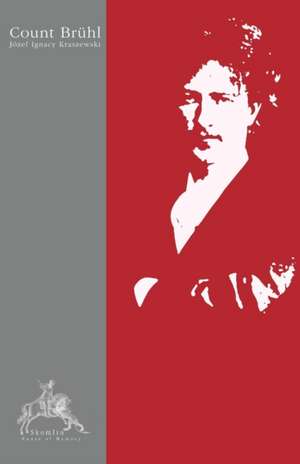
Count Brühl
Autor Józef Ignacy Kraszewskien Limba Engleză Paperback – 10 ian 2017
But his ambition and greed exceeded his political ability and finally left the country bankrupt and utterly unprepared to face the attacks of the Prussian king.
This is the story of the rise and fall of one of history's forgotten legends.
Preț: 146.03 lei
Puncte Express: 219
Carte tipărită la comandă
Livrare economică 18 noiembrie-02 decembrie
Livrare prin curier în România Termenul estimat este afișat lângă disponibilitate.
Transport gratuit de la 400.00 lei Plată online sau ramburs, în funcție de opțiunile comenzii.
Retur gratuit în 14 zile Comandă securizată și suport în română.
Specificații
ISBN-13: 9780987401410
ISBN-10: 0987401416
Pagini: 256
Dimensiuni: 140 x 216 x 16 mm
Greutate: 0.37 kg
Editura: Skomlin
ISBN-10: 0987401416
Pagini: 256
Dimensiuni: 140 x 216 x 16 mm
Greutate: 0.37 kg
Editura: Skomlin
Notă biografică
Kraszewski was one of the most prolific writers of all times. His works fill more than 600 volumes. He wrote over 220 novels, around 150 novellas and short stories, some 20 plays and more than 20 volumes of historical studies (including the 3-volume Historia Wilna ("History of Vilnius") and the 3-volume Polska w czasie trzech rozbiorów 1772-1799 ("Poland during the Three Partitions 1772-1799). He travelled widely and visited the whole of pre-partition Poland and almost all of Europe. He took an active part in political activities and he was sent to prison twice. Kraszewski was born into a noble family whose manor was located in Döhe near Pru¿any (now Belarus) and though he was born in Warsaw (his mother fled there in 1812 in fear of Napoleon's Moscow-bound army) he regarded the Grand Duchy of Lithuania as his homeland. He spent his childhood in his grandmother's mansion in Romanowo in Podlasie, now the site of Kraszewski Museum. After the outbreak of the Warsaw Uprising in November 1830, he and a group of his friends were arrested and he was imprisoned in Russian for more than a year. In 1859 he accepted the the position of editor of the Jewish owned "Gazeta Warszawska" and he moved with his family to Warsaw. The number of "Gazeta" subscribers within half a year rose from 500 to 8000, but at the same time he had to withstand vicious remarks of anti-Semites. At the outbreak of the 1863 Uprising, he was politically active and was designated persona non grata and forced to emigrate, leaving his family in Warsaw. He went to Dresden, where he lived till 1884. In Dresden he became a one-man Polish institution helping the political refugees, and organising literary life and information about Poland. In 1870 as the editor of "Tydzie¿" he expressed his scepticism about the dogma, approved at the 1st Vatican Council, that the pope is infallible as far as questions regarding the faith are concerned. That made him unpopular among the national orthodox church authorities, but he did not lose popularity among his readers. While he was in Dresden he concentrated on historical novels including the so called Saxon series (Hrabina Cosel 1873, Brühl 1874). In 1879 in Kraków week-long celebrations on the 50th anniversary of the beginning of his literary career were held. In 1883 he was arrested in Berlin and charged with collaboration with French military intelligence, and a year later he was sentenced by the tribunal in Leipzig to three and a half years of imprisonment in a fortress. He served the sentence in Magdeburg. As a result of his illness he was temporarily released on bail and went to Italy to improve his health, and after an earthquake there he sought refuge in Geneva in 1886. There, suffering from cancer and pneumonia, he died.