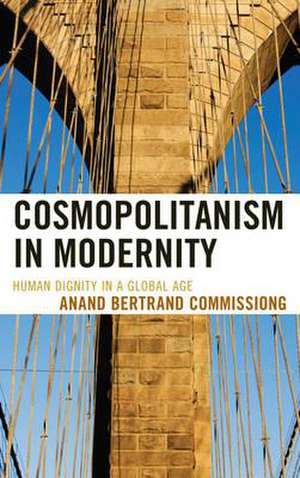
Cosmopolitanism in Modernity: Human Dignity in a Global Age: Logos: Perspectives on Modern Society and Culture
Autor Anand Bertrand Commissiongen Limba Engleză Paperback – 31 mai 2013
Commissiong recommends non-imperialist, accountable, coalitional strategies that set the stage for a different understanding of human beings in our contemporary globalizing world by offering a broad approach that can form coalitions with ideals beyond Western traditions, such as satyagraha, in order to conceive of dynamic human individuality and community that stretches beyond local boundaries. Commissiong makes a powerful argument for a new type of cosmopolitanism that is vital to the establishment of a truly just human existence at institutional, communal, and individual levels.



Preț: 328.05 lei
Preț vechi: 422.43 lei
-22%
Puncte Express: 492
Preț estimativ în valută:
57.99€ • 67.89$ • 50.64£
57.99€ • 67.89$ • 50.64£
Carte tipărită la comandă
Livrare economică 06-20 martie
Preluare comenzi: 021 569.72.76
Specificații
ISBN-13: 9780739165409
ISBN-10: 0739165402
Pagini: 236
Dimensiuni: 156 x 229 x 21 mm
Greutate: 0.38 kg
Editura: Bloomsbury Publishing
Colecția Lexington Books
Seria Logos: Perspectives on Modern Society and Culture
Locul publicării:New York, United States
ISBN-10: 0739165402
Pagini: 236
Dimensiuni: 156 x 229 x 21 mm
Greutate: 0.38 kg
Editura: Bloomsbury Publishing
Colecția Lexington Books
Seria Logos: Perspectives on Modern Society and Culture
Locul publicării:New York, United States
Cuprins
Introduction
Local and Global: Notes from Recent US Elections
"the sigh of the oppressed creature, the sentiment of a heartless world"
The Market Mind-set and the Faith in the Market
Cosmopolitan Ideas in Modernity
Issues of Definition
Part 1: Ancient and Modern Sources and Contexts
1 Ancient and Modern Cosmopolitanisms
Ancient and Early Modern Cosmopolitanisms
Modern and Contemporary Contexts
A Survey of the Varieties of Cosmopolitanism in Modernity
Moral and Political Cosmopolitanism
2 The Rise of Economic Individualism and the Development of the Commercial Community
A Crisis of Conscience: The Crumbling Sacred Canopy and the Changing Sources of Authority
Globalization: The Sheltering Market
The Heart of Empire
Cosmopolitanism vs. Globalization: The Responsibilities of Freedom
Part 2: Contemporary Cosmopolitanisms
3 Martha Nussbaum and the Individual at the Center: Liberties and Capabilities, Theory and Practice
Theory: Stoic Theories of Reason, Association, and Moral Development
Practice: Action and Conflicting Duties
The Capabilities Approach
Universal Values and the Primacy of the Individual
4 Jürgen Habermas and the Individual in Community: Freedom and Responsibility in the Nation-State
"Perpetual Peace": Kant's Cosmopolitan Idea Reconsidered
The Rule of Law and Popular Sovereignty in Modern Democracy
Habermas's Linguistic Turn
Globalization and the Post-National Constellation
Habermas: A Critical Appraisal
5 David Held: Freedom and Accountability Beyond the Nation-State
The Interstate System and Modern Democracy
The Nation-State: Its Uses and Abuses
International Accountability and Enforcement
National and International Public Spheres
Transnational Public Spheres and Transnational Solidarity
Part 3: Restating the Case
6 Cosmopolitan Virtues for a Modern World
Fracturing of the Fatal Circle(s)
Heterogeneity and Solidarity
7 Cosmopolitanism Law
The New New World Order: Unfinished Business
Cosmopolitanism and the Left: The Theory and Practice of Cosmopolitan Law
Stoic Cosmopolitanism Today
8 Conclusion: Our Futures, Together
The One and the Universal
Our Post-National Futures, Unavoidably Side by Side
Bibliography
Local and Global: Notes from Recent US Elections
"the sigh of the oppressed creature, the sentiment of a heartless world"
The Market Mind-set and the Faith in the Market
Cosmopolitan Ideas in Modernity
Issues of Definition
Part 1: Ancient and Modern Sources and Contexts
1 Ancient and Modern Cosmopolitanisms
Ancient and Early Modern Cosmopolitanisms
Modern and Contemporary Contexts
A Survey of the Varieties of Cosmopolitanism in Modernity
Moral and Political Cosmopolitanism
2 The Rise of Economic Individualism and the Development of the Commercial Community
A Crisis of Conscience: The Crumbling Sacred Canopy and the Changing Sources of Authority
Globalization: The Sheltering Market
The Heart of Empire
Cosmopolitanism vs. Globalization: The Responsibilities of Freedom
Part 2: Contemporary Cosmopolitanisms
3 Martha Nussbaum and the Individual at the Center: Liberties and Capabilities, Theory and Practice
Theory: Stoic Theories of Reason, Association, and Moral Development
Practice: Action and Conflicting Duties
The Capabilities Approach
Universal Values and the Primacy of the Individual
4 Jürgen Habermas and the Individual in Community: Freedom and Responsibility in the Nation-State
"Perpetual Peace": Kant's Cosmopolitan Idea Reconsidered
The Rule of Law and Popular Sovereignty in Modern Democracy
Habermas's Linguistic Turn
Globalization and the Post-National Constellation
Habermas: A Critical Appraisal
5 David Held: Freedom and Accountability Beyond the Nation-State
The Interstate System and Modern Democracy
The Nation-State: Its Uses and Abuses
International Accountability and Enforcement
National and International Public Spheres
Transnational Public Spheres and Transnational Solidarity
Part 3: Restating the Case
6 Cosmopolitan Virtues for a Modern World
Fracturing of the Fatal Circle(s)
Heterogeneity and Solidarity
7 Cosmopolitanism Law
The New New World Order: Unfinished Business
Cosmopolitanism and the Left: The Theory and Practice of Cosmopolitan Law
Stoic Cosmopolitanism Today
8 Conclusion: Our Futures, Together
The One and the Universal
Our Post-National Futures, Unavoidably Side by Side
Bibliography
Recenzii
Anand Commissiong provides an insightful and erudite discussion of a crucial topic for all progressive thinkers and activists. All of us will surely benefit from this impressive book.
Locating itself in the broadest reading of the history of political thought, this fine book makes an argument for "cosmopolitan virtue" as the foundation of a political theory cognizant of the unity between the particular and the universal in lived experience. Commissiong (West Texas A&M Univ.) offers this position as an alternative to both of today's dominant conceptions (and practices) of the "good life:" exclusionary fundamentalism and unfettered market neoliberalism. This book is to be commended for two main reasons. First, it offers an erudite, rigorous examination of the literature on cosmopolitanism (especially the work of Martha Nussbaum, Jurgen Habermas, and David Held), which has enjoyed a revival in the last ten or so years. Second, it enriches this debate by probing into its connections not only with the dominant accounts of political life, but also with important critics of these such as Antonio Hardt and Michael Negri. This strategy allows Commissiong to go beyond the more abstract positions of the cosmopolitans to provide an account capable of informing political activists and concerned citizens. The result is an erudite, very readable book that offers a substantially new point of departure for normative discussion and political practice. Summing Up: Highly recommended.
Locating itself in the broadest reading of the history of political thought, this fine book makes an argument for "cosmopolitan virtue" as the foundation of a political theory cognizant of the unity between the particular and the universal in lived experience. Commissiong (West Texas A&M Univ.) offers this position as an alternative to both of today's dominant conceptions (and practices) of the "good life:" exclusionary fundamentalism and unfettered market neoliberalism. This book is to be commended for two main reasons. First, it offers an erudite, rigorous examination of the literature on cosmopolitanism (especially the work of Martha Nussbaum, Jurgen Habermas, and David Held), which has enjoyed a revival in the last ten or so years. Second, it enriches this debate by probing into its connections not only with the dominant accounts of political life, but also with important critics of these such as Antonio Hardt and Michael Negri. This strategy allows Commissiong to go beyond the more abstract positions of the cosmopolitans to provide an account capable of informing political activists and concerned citizens. The result is an erudite, very readable book that offers a substantially new point of departure for normative discussion and political practice. Summing Up: Highly recommended.