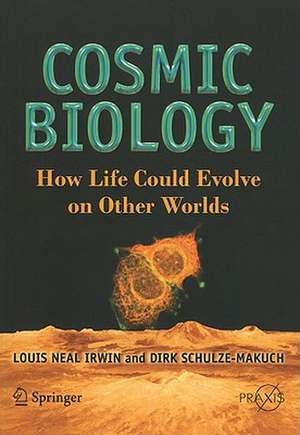
Cosmic Biology: Springer Praxis Books
Autor Louis Neal Irwin, Dirk Schulze-Makuchen Limba Engleză Paperback – 10 dec 2010
Această monografie, publicată în seria Springer Praxis Books, reprezintă un efort analitic de a fundamenta astrobiologia pe baze biologice și chimice riguroase. Remarcăm modul în care autorii, Louis Neal Irwin și Dirk Schulze-Makuch, transcend speculația pură, ghidând cititorul printr-o serie de habitate planetare probabile, de la cele familiare de pe Pământ până la medii exotice identificate în sistemul nostru solar și dincolo de acesta. Comparabil cu Life in the Universe de Dirk Schulze-Makuch în rigoarea științifică, volumul de față se distinge prin încercarea ambițioasă de a schița o taxonomie a vieții cosmice, integrând date despre cele aproximativ 300 de exoplanete cunoscute la momentul publicării ediției. Structura cărții urmărește o progresie logică: primele capitole stabilesc fundamentele chimice și energetice ale vieții, urmate de o explorare detaliată a mediilor extreme — de la „Frozen Desert” (capitolul 5) la „Petrolakes” (capitolul 10). Această abordare sistematică permite cititorului să înțeleagă biocomplexitatea nu ca pe un accident terestru, ci ca pe o posibilitate universală. Spre deosebire de lucrarea anterioară a lui Irwin, Haystack Full of Needles, care se concentra pe mecanismele stocării informației în creier, Cosmic Biology extinde perspectiva asupra sistemelor vii la scară galactică. În final, volumul abordează Paradoxul Fermi, oferind reflecții filosofice asupra locului umanității într-un univers potențial populat de diverse forme de viață. Recomandăm lucrarea pentru densitatea informației și tabelele de date detaliate care susțin fiecare ipoteză evolutivă prezentată.
Din seria Springer Praxis Books
-
 Preț: 249.03 lei
 -
 Preț: 280.40 lei
 -
 Preț: 212.55 lei
 -
 Preț: 208.45 lei
 -
 Preț: 324.12 lei
 -
 Preț: 219.84 lei
 - 15%
 Preț: 400.45 lei
 -
 Preț: 214.84 lei
 -
 Preț: 310.41 lei
 -
 Preț: 320.85 lei
 -
 Preț: 323.74 lei
 - 18%
 Preț: 882.23 lei
 -
 Preț: 221.64 lei
 -
 Preț: 208.77 lei
 -
 Preț: 312.64 lei
 -
 Preț: 204.97 lei
 -
 Preț: 256.19 lei
 -
 Preț: 260.26 lei
 -
 Preț: 291.83 lei
 -
 Preț: 351.38 lei
 -
 Preț: 227.17 lei
 -
 Preț: 281.23 lei
 -
 Preț: 159.75 lei
 - 18%
 Preț: 1216.37 lei
 - 18%
 Preț: 922.84 lei
 - 18%
 Preț: 975.90 lei
 - 18%
 Preț: 1201.76 lei
 - 18%
 Preț: 972.77 lei
 -
 Preț: 208.16 lei
 - 15%
 Preț: 632.63 lei
 -
 Preț: 306.63 lei
 -
 Preț: 306.08 lei
 -
 Preț: 289.80 lei
 -
 Preț: 238.54 lei
 -
 Preț: 213.96 lei
 -
 Preț: 380.74 lei
 -
 Preț: 213.48 lei
 -
 Preț: 245.29 lei
 -
 Preț: 240.36 lei
 -
 Preț: 249.58 lei
 -
 Preț: 340.09 lei
 -
 Preț: 208.76 lei
 -
 Preț: 317.58 lei
 -
 Preț: 322.04 lei
 -
 Preț: 152.20 lei
 -
 Preț: 295.76 lei
 -
 Preț: 314.30 lei
 -
 Preț: 106.06 lei
 - 18%
 Preț: 1178.23 lei
 -
 Preț: 298.45 lei
Preț: 326.45 lei
Carte disponibilă
Livrare economică 18 mai-01 iunie
Specificații
ISBN-10: 1441916466
Pagini: 360
Ilustrații: XXII, 338 p.
Dimensiuni: 168 x 241 x 20 mm
Greutate: 0.61 kg
Ediția:2011
Editura: Praxis
Colecția Springer Praxis Books
Seria Springer Praxis Books
Locul publicării:New York, NY, United States
V-ar putea interesa
-
 Wonders in the SkyChris AubeckPreț: 127.27 lei
 -
 Twilight of the GodsErich Von Däniken-23%Preț: 84.92 lei110.40 lei
 -
 -20%Preț: 77.37 lei96.43 lei
 -
 Odyssey of the GodsErich Von Däniken-24%Preț: 99.64 lei130.37 lei
 -
 UFO Down: The Berwyn Mountain UFO CrashAndy RobertsPreț: 102.35 lei
 -
 The CryptoterrestrialsMac TonniesPreț: 90.17 lei
 -
 Preț: 110.74 lei
 -
 Covert Wars and Breakaway CivilizationsJoseph P. FarrellPreț: 115.56 lei
 -
 Mystery of Egypt: The First TunnelRadu CinamarPreț: 151.14 lei
Public țintă
Popular/generalDe ce să citești această carte
Recomandăm această carte studenților și pasionaților de astronomie care doresc să înțeleagă biologia dincolo de contextul terestru. Cititorul câștigă o perspectivă științifică asupra modului în care viața s-ar putea adapta în medii extreme, precum sateliții înghețați sau planetele cu atmosfere corozive. Este o resursă esențială pentru cei care caută o clasificare teoretică a formelor de viață extraterestre, fundamentată pe legile chimiei și termodinamicii.
Despre autor
Louis Neal Irwin este un cercetător axat pe evoluția sistemelor biologice complexe, cu lucrări anterioare dedicate neuroștiințelor și stocării informației neuronale. Co-autorul său, Dirk Schulze-Makuch, este o autoritate recunoscută în astrobiologie, publicând numeroase lucrări în cadrul editurii Praxis despre habitatele planetare și posibilitatea vieții pe Marte sau Titan. Împreună, aceștia combină expertiza în biologie evoluționistă și geologie planetară pentru a oferi un cadru teoretic coerent studiului vieții în univers, transformând astrobiologia dintr-o disciplină speculativă într-una bazată pe modele predictive solide.
Descriere scurtă
Discussions of the great variety of life forms that could evolve in these diverse environments have become particularly relevant in recent years with the discovery of around 300 exoplanets in orbit around other stars and the possibilities for the existence of life in these planetary systems. The book also posits a taxonomic classification of the various forms of life that might be found, including speculation on the relative abundance of different forms and the generic fate of living systems. The fate and future of life on Earth will also be considered. The closing passages address the Fermi Paradox, and conclude with philosophical reflections on the possible place of Homo sapiens in the potentially vast stream of life across the galaxies.
Cuprins
Recenzii
“Cosmic Biology discusses the feasibility of life in the scorching cloud decks of Venus or within the volcanic violence of lo. … This neat trick holds up a mirror to our own efforts at characterising the extrasolar planets we’re now discovering. … long data tables, information dense diagrams and sections that sometimes read like expanded bullet point lists gives the volume the feel of a textbook. … a great book to push your horizons if you’re already familiar with the themes of astrobiology … .” (Lewis Dartnell, Sky at Night Magazine, August, 2011)
“The text, which is intended for nonscientists, are novel and distinctly important scientifically. … The core of the book covers case history examinations of possible biological planets, moons, and exoplanets. For those who teach about the possibility of life on other planets, this book provides an excellent introduction to these alternative worlds and, in doing so, accomplishes more than the authors’ modestclaims in the preface. Summing Up: Recommended. All levels/libraries.” (P. K. Strother, Choice, Vol. 48 (11), July, 2011)
Notă biografică
Ten years ago, Irwin became a Solar System Educator for NASA, originally in conjunction with the launch of the Cassini-Huygens Mission to Saturn but later as representative for all the robotic exploratory missions managed by the Jet Propulsion Lab. In that capacity he became familiar with the details of space exploration for the purpose of conducting teacher workshops. Soon thereafter, he also began a collaboration with Dirk Schulze-Makuch on research into the definition of life and the plausibility of searching for and finding life onother worlds. As NASA turned its attention to the emerging field of astrobiology, Schulze-Makuch and Irwin began to publish their research in that area, culminating in the joint authorship of "Life in the Universe: Expectations and Constraints," which many regard as the definitive work in the field of astrobiology for the technical specialist.
Dirk Schulze-Makuch
As a trained hydrogeologist Dirk Schulze-Makuch entered the field of astrobiology by studing extremophilic organisms in hot springs. Propelled by a major NASA grant Dirk then joined the Europa Focus Group and some time later the Titan Focus Group of the NASA Astrobiology Institute. Recent interests include nearly all aspects of astrobiology including mission-aligned efforts to detect life on Mars and the search for extraterrestrial intelligence.
Textul de pe ultima copertă
This uniquely authoritative and imaginative book on the possibilties for alien life addresses the intrinsic interest that we have about life on other worlds - reinforcing some of our assumptions and reshaping others. It introduces new possibilties that will enlarge our understanding of the issue overall, in particular the enormous range of environments and planetary conditions within which life might evolve.
Cosmic Biology
-discusses a broad range of possible environments where alien life might have evolved;
-explains why carbon-based, water-borne life is more likely that its alternatives, but is not the only possiblity;
-applies the principles of planetary science and modern biology to evolutionary scenarios on other worlds;
-looks at the future fates of living systems, including those on Earth.