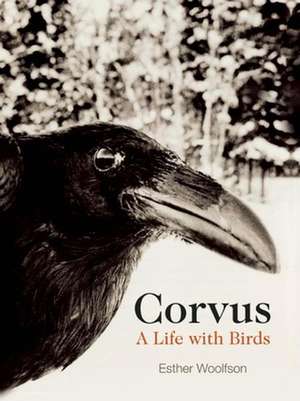
Corvus: A Life with Birds
Autor Esther Woolfsonen Limba Engleză Hardback – 31 mar 2009
Preț: 101.28 lei
Puncte Express: 152
Carte indisponibilă temporar
Doresc să fiu notificat când acest titlu va fi disponibil:
Se trimite...
Specificații
ISBN-13: 9781582434773
ISBN-10: 1582434778
Pagini: 337
Dimensiuni: 161 x 207 x 30 mm
Greutate: 0.53 kg
Editura: Counterpoint Press
ISBN-10: 1582434778
Pagini: 337
Dimensiuni: 161 x 207 x 30 mm
Greutate: 0.53 kg
Editura: Counterpoint Press
Descriere
Ever since her daughter rescued a fledgling rook years ago, Esther Woolfson has been fascinated with corvids, the bird group that includes crows, rooks, magpies, and ravens. Today, the rook, named Chicken, is a member of the Woolfson family, along with a talking magpie named Spike, a baby crow named Ziki, a starling, a parrot, and others. From their elaborate bathing rituals to their springtime broodiness and tendency to cache food in the most unlikely places, these corvids share a bond with humans that one might never have imagined before reading this book.
Letting her experience speak for itself, Woolfson likens the fears and foibles of corvids to those of humans, taking into account the science of bird intelligence, evolution, song, and flight. She highlights their big personalities and capacity for affection: Chicken hates computers and machines, while she loves evening neck scratches on Woolfson’s knee. It is through this intimate lens that Woolfson invites us to reconsider the kind of creature capable of being man’s best friend.
Letting her experience speak for itself, Woolfson likens the fears and foibles of corvids to those of humans, taking into account the science of bird intelligence, evolution, song, and flight. She highlights their big personalities and capacity for affection: Chicken hates computers and machines, while she loves evening neck scratches on Woolfson’s knee. It is through this intimate lens that Woolfson invites us to reconsider the kind of creature capable of being man’s best friend.