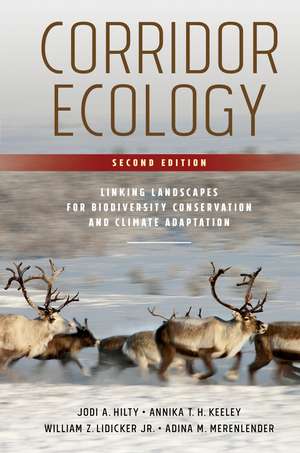
Corridor Ecology, Second Edition: Linking Landscapes for Biodiversity Conservation and Climate Adaptation
Autor Jodi A. Hilty, Annika T.H. Keeley, William Z. Lidicker Jr., Adina M. Merenlenderen Limba Engleză Paperback – 23 apr 2019
Cea de-a doua ediție a lucrării Corridor Ecology reprezintă o actualizare esențială a fundamentelor teoretice și a aplicațiilor practice în domeniul conservării biodiversității. Considerăm că elementul central al acestei noi versiuni este extinderea ariei de studiu dincolo de mediul terestru. Autorii introduc capitole complet noi dedicate conectivității marine, explorând coridoarele pelagice și rolul zonelor de coastă, dar și un concept emergent: coridoarele aeriene. Această abordare tridimensională a conectivității — terestră, marină și aeriană — reflectă progresele științifice din ultimul deceniu și necesitatea unei viziuni integrate asupra ecosistemelor.
Structura volumului este riguros organizată pentru a facilita tranziția de la teorie la implementare. Primele capitole reconstruiesc cadrul ecologic, trecând prin biogeografia insulară și teoria metapopulațiilor, oferind astfel baza necesară pentru a înțelege impactul fragmentării habitatelor. Merită menționat că autorii nu se limitează la descrierea problemelor, ci alocă spații generoase strategiilor de design pentru coridoare, adaptate noilor realități climatice. Textul extinde cadrul propus de Connectivity Conservation de Kevin R. Crooks cu date noi din ultima decadă, punând un accent mai pronunțat pe reziliența ecosistemelor și pe serviciile ecosistemice de care depinde societatea umană. De asemenea, lucrarea completează perspectivele din Connectivity Conservation Management prin introducerea recomandărilor specifice pentru peisajele aflate în schimbare rapidă sub influența încălzirii globale. Tonul este precis și academic, susținut de 50 de ilustrații și fotografii care clarifică modelele de dispersie și demografia extincției, făcând din acest volum un instrument indispensabil pentru planificarea ecologică modernă.
Preț: 319.32 lei
Carte tipărită la comandă
Livrare economică 20 noiembrie-04 decembrie
Livrare express 15-21 octombrie pentru 48.89 lei
Specificații
ISBN-10: 1610919513
Pagini: 368
Ilustrații: 25 photos, 25 illustrations
Dimensiuni: 152 x 229 x 23 mm
Greutate: 0.45 kg
Ediția:Nouă
Editura: Island Press
Colecția Island Press
V-ar putea interesa
-
 LinescapesHugh Warwick-47%Preț: 63.00 lei118.87 lei
 -
 Preț: 189.74 lei
 -
 VanishedSadiah QureshiPreț: 228.65 lei
 -
 -15%Preț: 251.09 lei294.25 lei
 -
 -13%Preț: 131.16 lei151.45 lei
 -
 Preț: 186.04 lei
 -
 Ocean: Earth's Last Wilderness - THE LANDMARK NEW BOOK BY DAVID ATTENBOROUGHSir David AttenboroughPreț: 158.83 lei
 -
 Cornerstones: Wild Forces That Can Change Our WorldBenedict Macdonald-27%Preț: 56.19 lei76.91 lei
 -
 Creature Needs: Writers Respond to the Science of Animal ConservationChristopher KondrichPreț: 109.40 lei
 -
 Wild CrossingsRachel Ip-24%Preț: 49.14 lei65.08 lei
 -
 Wild ServiceNick Hayes-26%Preț: 57.89 lei78.51 lei
 -
 -11%Preț: 397.41 lei446.53 lei
 -
 Preț: 430.30 lei
 -
 Nature's Best Hope: A New Approach to Conservation That Starts in Your YardDouglas W. Tallamy-30%Preț: 134.85 lei191.97 lei
 -
 -28%Preț: 66.38 lei91.58 lei
 -
 Biodiversity Conservation: New ResearchRichard L Nelson-27%Preț: 1248.27 lei1701.73 lei
 -
 Wild Life: A Scientist's Journey from Dreams to PurposeRae Winn-Grant-19%Preț: 90.92 lei112.80 lei
 -
 Future WildRichard NairnPreț: 121.90 lei
 -
 Wildlife CrossingsCatherine Barr-10%Preț: 90.52 lei100.92 lei
 -
 Spatial Ecology and Conservation ModelingJr. Fletcher-15%Preț: 715.25 lei841.47 lei
De ce să citești această carte
Recomandăm această carte specialiștilor în ecologia peisajului și studenților la științele mediului care caută o bază științifică solidă pentru proiectele de conservare. Cititorul câștigă o înțelegere profundă a modului în care fragmentarea habitatelor poate fi combătută prin coridoare biologice, beneficiind de cele mai noi date despre conectivitatea marină și aeriană, esențiale în contextul adaptării la schimbările climatice actuale.
Despre autor
Echipa de autori reunește experți de prestigiu în biologia conservării și ecologie. Jodi A. Hilty este recunoscută pentru activitatea sa în cadrul Wildlife Conservation Society, fiind o autoritate în designul coridoarelor ecologice. William Z. Lidicker Jr. este profesor emerit la University of California, Berkeley, cu o carieră vastă în studiul mamiferelor și al dinamicii populațiilor. Adina M. Merenlender este specialistă în politici de conservare și planificarea utilizării terenurilor, iar Annika T.H. Keeley aduce expertiză în conectivitatea peisajelor și răspunsul speciilor la schimbările de mediu, oferind împreună o perspectivă multidisciplinară asupra conservării moderne.
Descriere scurtă
This new and expanded second edition of Corridor Ecology: Linking Landscapes for Biodiversity Conservation and Climate Adaptation captures the many advances in the field over the past ten years. It builds on concepts presented in the first edition on the importance and practical details of maintaining and restoring land connectivity. New to this edition is a guest-edited chapter on ecological connectivity in oceans, including a detailed discussion on pelagic marine corridors and how coastal corridors can provide critical connectivity between marine protected areas. Another new chapter considers the effects of climate change on habitat and offers recommendations on designing effective corridors as landscapes change with shifting climate conditions. The book also includes a discussion of corridors in the air for migrating flying species, from birds to bats, butterflies, and even plant propagules—a concept so new that a term to describe it has yet to be coined. All chapters are thoroughly revised and updated.
Practitioners as well as serious scholars of landscape ecology and the science of protecting biodiversity will find this new edition of corridor ecology science an indispensable resource.
Notă biografică
Cuprins
Preface
Introduction
Chapter 1. Background: Habit Loss, Fragmentation, and Climate Change
-Human-induced Change and Habitat Loss
-Climate Change Overview
-Limitations to Protected Areas
-Reconnecting Our Planet
-Growth of Connectivity Science and Practice
Chapter 2. The Ecological Framework
-Island Biogeography
-Metapopulation Theory: Conceptual History
-Metapopulation Processes
-Dispersal
-The Demography of Extinction
-Genetic Structuring
-A Longer-Term Perspective
-Metacommunity Theory
-Beyond Metacommunities: Landscape and Ecoscape Concepts
Chapter 3. Understanding Fragmentation
-Natural versus Human-Induced Fragmentation
-Speed and Pattern of Change
-Consequences of Human-Induced Fragmentation
-Changes in Species Composition of Patches
-Genetic Considerations Affecting Species Extinction
-Role of the Matrix
-Edges and Edge Effects
Chapter 4. Approaches to Achieving Habitat Connectivity
-What Is a Corridor
-Types of Corridors
-Riparian Areas
-Corridors for Individual Species Conservation
-Corridor Complexities
-Biological Benefits
-Benefits to Humans
Chapter 5. Corridor Design Objectives
-Focal Species Considerations
-Habitat Requirements
-Dispersal Considerations
-Generalist versus Specialist
-Behavioral Factors
-Sensitivity to Human Activity
-Physical Limitations
-Topography and Microclimate for Climate-Wise Connectivity
-Corridor Quality: Continuity, Composition, and Dimension
-Continuous Corridors
-Stepping-Stone Connectivity
-Habitat Quality
-Corridor Dimensions
-Landscape Configuration
-Riparian Corridors
-Hydrologic Habitat Connectivity: Structural, Functional, and Ecological
-Ecological Networks
Chapter 6. Potential Pitfalls or Disadvantages of Linking Landscapes
-Impacts of Edge Effects
-Corridors as Biotic Filters
-Facilitation of Invasions
-Demographic Impacts
-Social Behavior
-Negative Genetic Effects
-Conflicting Ecological Objectives
-Economic Considerations
Chapter 7. Identifying, Prioritizing, and Assessing Habitat Connectivity
-Establish Collaborations
-Addressing Scale
-Identifying Terrestrial Corridors for Conservation and Restoration
-Prioritization
-Climate Resilience Benefits
-Assessing Corridors
-Caveats
Chapter 8. Climate-Wise Connectivity
-Principles of Climate Space
-Designing Climate-Wise Connectivity
-Including Refugia in Climate-Wise Connectivity Design
-Estimating Range Shifts Using Species Distribution Modeling
-Recommendations
Chapter 9. Ecological Connectivity in the Ocean \ Mark H. Carr and Elliott L. Hazen
-Introduction
-What Constitutes Pelagic Connectivity and Corridors?
-Where Are the Major Pelagic Marine Corridors?
-Threats to Pelagic Corridors and Potential Conservation Approaches
-What Constitutes Connectivity and Corridors in the Coastal Ocean?
-Threats to Coastal Species, Ecosystems, and Their Connectivity
-Implications of Coastal Corridors for Species and Biodiversity Conservation: Marine Protected Area Networks
Chapter 10. Protecting and Restoring Corridors
-Opportunities and Challenges
-Law and Policy Mechanisms
-Stewardship of Working Lands
-Private Land Conservation
-Types of Agreements
-Restoring Land
-Lessons from Corridor Projects
Conclusion
References
About the Authors
Index