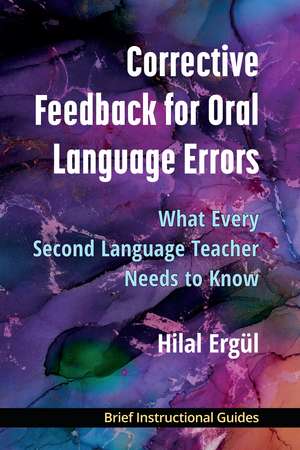
Corrective Feedback for Oral Language Errors: What Every Second Language Teacher Needs to Know: BIGs (Brief Instructional Guides)
Autor Hilal Ergülen Limba Engleză Paperback – 7 ian 2027
Extending beyond a grammar-dominant focus, Ergül addresses pragmatics and discourse intonation as consequential but often neglected correction targets, and frames pronunciation feedback around intelligibility and functional load rather than native-likeness. The book also examines technology-mediated corrective feedback (including synchronous computer-mediated communication, speech visualization, and AI-based tools) as options that can expand feedback opportunities when aligned with instructional goals. With concrete classroom guidance, reproducible student handouts, and reflection tools, Corrective Feedback on Oral Language Errors supports teachers who want learners to speak more, speak more accurately, and build long-term confidence.
Din seria BIGs (Brief Instructional Guides)
-
 Preț: 121.41 lei
 -
 Preț: 127.05 lei
 -
 Preț: 117.50 lei
 -
 Preț: 133.28 lei
 -
 Preț: 121.30 lei
 -
 Preț: 117.44 lei
 -
 Preț: 117.48 lei
 -
 Preț: 117.19 lei
 -
 Preț: 117.28 lei
 -
 Preț: 117.48 lei
 -
 Preț: 117.48 lei
 -
 Preț: 117.28 lei
 -
 Preț: 117.02 lei
 -
 Preț: 122.18 lei
 -
 Preț: 119.26 lei
 -
 Preț: 119.97 lei
 -
 Preț: 146.23 lei
 -
 Preț: 119.97 lei
 - nou
 Preț: 114.60 lei
 -
-
Preț: 114.60 lei
Precomandă
Puncte Express: 172
Carte nepublicată încă
Livrare prin curier în România Precomanda se expediază când titlul devine disponibil.
Transport gratuit de la 400.00 lei Plată online sau ramburs, în funcție de opțiunile comenzii.
Retur gratuit în 14 zile Comandă securizată și suport în română.
Doresc să fiu notificat când acest titlu va fi disponibil:
Se trimite...
Specificații
ISBN-13: 9780472040407
ISBN-10: 0472040405
Pagini: 126
Ilustrații: 4 tables
Dimensiuni: 152 x 229 mm
Greutate: 0.45 kg
Editura: UNIVERSITY OF MICHIGAN PRESS
Colecția University of Michigan Press ELT
Seria BIGs (Brief Instructional Guides)
ISBN-10: 0472040405
Pagini: 126
Ilustrații: 4 tables
Dimensiuni: 152 x 229 mm
Greutate: 0.45 kg
Editura: UNIVERSITY OF MICHIGAN PRESS
Colecția University of Michigan Press ELT
Seria BIGs (Brief Instructional Guides)
Notă biografică
Hilal Ergül is Associate Professor of Applied Linguistics/TESOL at the University of Northern Iowa.
Cuprins
Abbreviations
Acknowledgments
Introduction
Chapter 1: What is Oral Corrective Feedback?
A Brief Historical Overview
Why OCF Matters
Summary
Annotated Further Reading
Chapter 1 Reflection Worksheet
Chapter 2: Oral Corrective Feedback Strategies and Their Effectiveness
Types of Feedback
Summary
Annotated Further Reading
Chapter 2 Reflection Worksheet
Chapter 3: Pragmatic Aspects of Oral Corrective Feedback
Face and Mitigation
Smiling and Other Nonverbal Behavior
Summary
Annotated Further Reading
Chapter 3 Reflection Worksheet
Chapter 4: Peer Oral Corrective Feedback
Benefits of Peer Oral Corrective Feedback
Summary
Annotated Further Reading
Chapter 4 Reflection Worksheet
Chapter 5: Responding to Learner Errors: To Correct or Not to Correct
Reasons to Correct Learner Errors
Some Reasons Not to Address Errors
Teacher and Learner Perceptions
Summary
Annotated Further Reading
Chapter 5 Reflection Worksheet
Chapter 6: Oral Corrective Feedback Timing
The Efficacy of Immediate versus Delayed Feedback
Classroom Implementation
Summary
Annotated Further Reading
Chapter 6 Reflection Worksheet
Chapter 7: Choosing the Correction Targets
Deciding What to Correct as an Instructional Act
OCF beyond Grammar
Summary
Annotated Further Reading
Chapter 7 Reflection Worksheet
Chapter 8: Technology and Oral Corrective Feedback
OCF and Synchronous Computer-Mediated Communication
Technology-assisted OCF provision
Making Principled Choices about Technology Use in OCF
Summary
Annotated Further Reading
Chapter 8 Reflection Worksheet
Chapter 9: An Empirical and Pedagogical Approach to Improving Feedback Practices
Why Action Research?
Disseminating Action Research
Summary
Annotated Further Reading
Chapter 9 Reflection Worksheet
Chapter 10: Conclusion: How Oral Corrective Feedback Fits Within Curriculum and Syllabus Design
Summary
Annotated Further Reading
Chapter 10 Reflection Worksheet
References
Acknowledgments
Introduction
Chapter 1: What is Oral Corrective Feedback?
A Brief Historical Overview
Why OCF Matters
Summary
Annotated Further Reading
Chapter 1 Reflection Worksheet
Chapter 2: Oral Corrective Feedback Strategies and Their Effectiveness
Types of Feedback
Summary
Annotated Further Reading
Chapter 2 Reflection Worksheet
Chapter 3: Pragmatic Aspects of Oral Corrective Feedback
Face and Mitigation
Smiling and Other Nonverbal Behavior
Summary
Annotated Further Reading
Chapter 3 Reflection Worksheet
Chapter 4: Peer Oral Corrective Feedback
Benefits of Peer Oral Corrective Feedback
Summary
Annotated Further Reading
Chapter 4 Reflection Worksheet
Chapter 5: Responding to Learner Errors: To Correct or Not to Correct
Reasons to Correct Learner Errors
Some Reasons Not to Address Errors
Teacher and Learner Perceptions
Summary
Annotated Further Reading
Chapter 5 Reflection Worksheet
Chapter 6: Oral Corrective Feedback Timing
The Efficacy of Immediate versus Delayed Feedback
Classroom Implementation
Summary
Annotated Further Reading
Chapter 6 Reflection Worksheet
Chapter 7: Choosing the Correction Targets
Deciding What to Correct as an Instructional Act
OCF beyond Grammar
Summary
Annotated Further Reading
Chapter 7 Reflection Worksheet
Chapter 8: Technology and Oral Corrective Feedback
OCF and Synchronous Computer-Mediated Communication
Technology-assisted OCF provision
Making Principled Choices about Technology Use in OCF
Summary
Annotated Further Reading
Chapter 8 Reflection Worksheet
Chapter 9: An Empirical and Pedagogical Approach to Improving Feedback Practices
Why Action Research?
Disseminating Action Research
Summary
Annotated Further Reading
Chapter 9 Reflection Worksheet
Chapter 10: Conclusion: How Oral Corrective Feedback Fits Within Curriculum and Syllabus Design
Summary
Annotated Further Reading
Chapter 10 Reflection Worksheet
References
Descriere
Translating research on corrective feedback for spoken language into clear, classroom-ready guidance