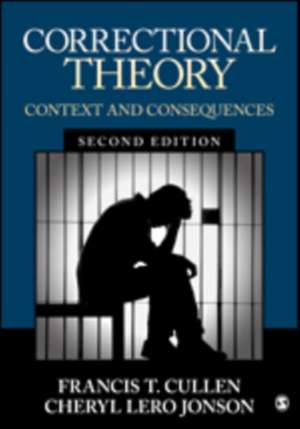
Correctional Theory
Autor Francis T. Cullen, Cheryl Lero Jonsonen Limba Engleză Paperback – 27 ian 2016
Găsim în această a doua ediție a lucrării Correctional Theory o abordare riguroasă a interdependenței dintre criminologie, sociologie și politici publice, oferind o perspectivă interdisciplinară esențială pentru înțelegerea sistemului penal contemporan. Autorii Francis T. Cullen și Cheryl Lero Jonson demonstrează cum evoluția teoriilor academice nu este doar un exercițiu intelectual, ci un instrument care legitimează noi modalități de tratament sau pedepsire a infractorilor în funcție de climatul politic al momentului. Suntem de părere că forța acestui volum rezidă în capacitatea de a demonta „bunul simț” neștiințific în favoarea unor decizii bazate strict pe dovezi empirice. Această ediție actualizată se poziționează ca o alternativă la Criminal Justice Theory, Volume 26 pentru cursurile de politici corecționale, având avantajul unei structuri pedagogice care ghidează cititorul de la criza istorică a reabilitării până la mecanismele complexe ale descurajării. În contextul operei sale, Francis T. Cullen continuă temele explorate în Criminological Theory, dar își rafinează analiza asupra instituției închisorii, așa cum a făcut-o și în The American Prison, concentrându-se aici pe fundamentul teoretic al execuției pedepselor. Structurată în părți distincte care abordează criza sistemului american și răspunsul punitiv, cartea progresează logic de la teorie la politici concrete. Primele capitole analizează declinul idealului reabilitării și doctrina „nothing works”, în timp ce secțiunile ulterioare disecă nuanțele dintre retribuție și descurajare. Este un text care nu doar informează, ci și educă viitorii specialiști să devină consumatori sofisticați de informație criminologică.
Preț: 641.09 lei
Preț vechi: 754.22 lei
-15%
Carte tipărită la comandă
Livrare economică 27 noiembrie-11 decembrie
Specificații
ISBN-10: 1506306527
Pagini: 354
Dimensiuni: 178 x 254 x 19 mm
Greutate: 0.61 kg
Ediția:2. Auflage
Editura: Sage Publications, Inc
Locul publicării:Thousand Oaks, United States
V-ar putea interesa
-
 NewjackTed ConoverPreț: 112.29 lei
 -
 Preț: 135.88 lei
 -
 The Death Penalty in Contemporary ChinaS. Trevaskes-15%Preț: 637.97 lei750.56 lei
 -
 Orange Is the New Black: My Time in a Women's PrisonPiper Kerman-25%Preț: 59.56 lei79.82 lei
 -
 Penal SystemsMick Cavadino-18%Preț: 782.22 lei953.92 lei
 -
 Punishment and PrisonsJoe SimPreț: 466.70 lei
 -
 And Crocodiles are Hungry at NightJack Mapanje-27%Preț: 79.79 lei109.87 lei
 -
 Preț: 524.54 lei
 -
 -27%Preț: 1577.34 lei2150.98 lei
 -
 Pain and RetributionDavid Wilson-14%Preț: 213.81 lei249.92 lei
 -
 Hell's PrisonerChristopher Parnell-21%Preț: 61.27 lei77.43 lei
 -
 Fifty-One MovesBen AshcroftPreț: 96.03 lei
 -
 Dear FionaFiona FullertonPreț: 339.77 lei
De ce să citești această carte
Recomandăm această carte studenților și practicienilor din domeniul asistenței sociale și criminologiei care doresc să înțeleagă mecanismele din spatele politicilor de detenție. Cititorul câștigă o viziune critică asupra modului în care ideologia influențează justiția, primind argumente solide pentru implementarea unor practici bazate pe dovezi, esențiale într-un sistem penal aflat în continuă transformare.
Despre autor
Francis T. Cullen este profesor de justiție penală și sociologie la Universitatea din Cincinnati, fiind una dintre cele mai respectate voci în teoria criminologică contemporană. Expertiza sa se concentrează pe reabilitarea infractorilor și pe analiza sistemului penitenciar american. Prin lucrări precum Reaffirming Rehabilitation și Criminological Theory, Cullen a influențat dezbaterile academice despre eficiența pedepselor, pledând constant pentru politici publice fundamentate pe cercetare științifică, nu pe reacții politice de moment.
Descriere scurtă
Recenzii
“Abstract theoretical concepts are thoroughly explained and illustrated. It’s all done in a brief, relatively readable format.”
“Not too heavy on academic jargon, making it easier for students to follow and grasp”
“Readable, Affordable, Theoretically Grounded”
“Focuses on the main and essential ideas while providing a clear and to the point conclusion”
“The text is an incredible composite of the literature that has shaped correctional practice. The authors have a great capacity for making research interesting and accessible. Cullen and Jonson have accomplished their goal of motivating readers to become sophisticated consumers of correctional knowledge.”
“Book promotes thoughts and avoids the traditional corrections textbook structure and content.”
“It is my experience that students tend to think of theory as boring and unnecessary. This text does a good job of making theory interesting and explaining why it is important. The authors do a good job of connecting theory, methods, and results. The writing style and ways that the authors explain concepts convey a lot of information, which is often quite complex, in an accessible way.”
“This is an excellent text that contributes to the knowledge base by presenting correctional theories in such a way that makes it approachable for students. The discussion of the socio-historical context, how this influenced why the public and criminal justice professionals favored a particular theory, and the resulting policies are important concepts for criminal justice students to understand today… I see its value, and would not hesitate to adopt it for a course.”
“[Strengths include] Writing style, ease of understanding the material, organization and length”
Cuprins
PART I. Crisis in American Corrections
CHAPTER 1. From Theory to Policy: Evidence-Based Corrections
Theories of Corrections
Six Theories in Brief
Utility, Opinion, and Evidence
Evidence-Based Corrections
Conclusion: What’s Ahead?
CHAPTER 2. Correctional Theory in Crisis: America’s Changing Context
What Is Rehabilitation?
The Rise of the Rehabilitative Ideal
Attacking Rehabilitation
The “Nothing Works” Doctrine: Martinson and Beyond
Conclusion: Crisis in Correctional Theory
PART II. The Punishment Response
CHAPTER 3. Just Deserts: Doing Justice or Getting Tough?
The Concepts of Retribution and Just Deserts: Punishing the Crime
Retribution: Just and Painful
Four Problems for Retribution
The Justice Model: Restraining State Discretion
What Went Wrong? Winning the Battle but Losing the War
Conclusion: The Need for Crime Control
CHAPTER 4. Deterrence: Scaring Offenders Straight
The Concept of Deterrence
Is Deterrence a “Conservative” Theory?
The Theoretical Assumptions of Deterrence
Studying Whether Deterrence Works: Assessing Types of Evidence
Policy Changes That Increase Punishment
Macro-Level Studies of Punishment and Crime Rates
Perceptual Deterrence Studies
Deterrence in the Community
The Effects of Imprisonment
Conclusion: The Limits of Deterrence
CHAPTER 5. Incapacitation: Locking Up the Wicked
Too Many Prisoners
More Than Enough Criminals
The Concept of Incapacitation
Estimating the Incapacitation Effect: Studying Individual Offenders
Estimating the Incapacitation Effect: Macro-Level Studies
Conclusion: Compared to What?
PART III. The Social Welfare Response
CHAPTER 6. Restorative Justice: Reintegrative Shaming
The Concept of Restorative Justice
The Appeal of Restorative Justice
Three Problems
Does Restorative Justice Work?
Conclusion: The Limits of Harm
CHAPTER 7. Rehabilitation: What Works to Change Offenders
The Concept of Rehabilitation
Knowing What Works
Challenging Nothing Works: Narrative Reviews
Challenging Nothing Works: Meta-Analytic Reviews
What Does Not Work
What Does Work: Principles of Effective Intervention
What Else Might Work?
Conclusion: Reaffirming Rehabilitation
PART IV. Extending the Vision of Corrections
CHAPTER 8. Reentry: Saving Offenders from a Life in Crime
From Parole to Reentry
The Reentry Problem
Reentry Programs
The Effectiveness Problem
Two Things to Keep in Mind
Conclusion: Saving Offenders From a Life in Crime
CHAPTER 9. Early Intervention: Saving Children From a Life in Crime
Lessons From Childhood Criminology
The Need for Early Intervention
Five Programs That Work—At Least When Done Right
Two More Reasons to Support Early Intervention
Conclusion: Beyond Adult-Limited Corrections
CHAPTER 10. Six Correctional Lessons: Choosing Our Future
Three Themes
Four Lessons
Conclusion: Choosing Our Future
References
Index
About the Authors