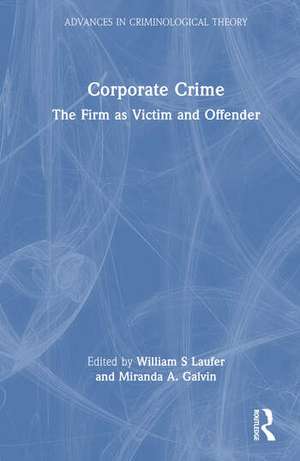
Corporate Crime: The Firm as Victim and Offender: Advances in Criminological Theory
Editat de Miranda A. Galvin, William S. Lauferen Limba Engleză Hardback – 21 aug 2025
- When are firms morally and legally responsible agents?
- What are the harms of corporate wrongdoing and who are the victims?
- What theories offer insight to explain corporate wrongdoing?
The chapters in this volume underscore the failures of the current system and are intended to inspire readers to push for change. This important work will be of interest to a wide range of criminologists and has potential to shape the future of corporate crime theory and research. It is ideal for use in graduate seminars and upper-level undergraduate courses.
Din seria Advances in Criminological Theory
- 9%
 Preț: 812.18 lei
 -
 Preț: 436.05 lei
 -
 Preț: 474.79 lei
 -
 Preț: 428.18 lei
 -
 Preț: 473.71 lei
 -
 Preț: 450.28 lei
 -
 Preț: 418.76 lei
 -
 Preț: 481.54 lei
 - 15%
 Preț: 462.55 lei
 -
 Preț: 410.87 lei
 -
 Preț: 486.28 lei
 -
 Preț: 491.12 lei
 -
 Preț: 444.29 lei
 -
 Preț: 452.90 lei
 -
 Preț: 424.50 lei
 -
 Preț: 424.61 lei
 -
 Preț: 422.01 lei
 -
 Preț: 415.12 lei
 - 18%
 Preț: 1111.68 lei
 -
 Preț: 440.15 lei
 -
 Preț: 464.26 lei
 -
 Preț: 465.76 lei
 - 21%
 Preț: 347.26 lei
 - 10%
 Preț: 368.89 lei
 - 11%
 Preț: 368.79 lei
 - 21%
 Preț: 346.26 lei
Preț: 1160.15 lei
Preț vechi: 1414.82 lei
-18%
Puncte Express: 1740
Carte tipărită la comandă
Livrare economică 02-16 decembrie
Livrare prin curier în România Termenul estimat este afișat lângă disponibilitate.
Transport gratuit pentru acest produs Plată online sau ramburs, în funcție de opțiunile comenzii.
Retur gratuit în 14 zile Comandă securizată și suport în română.
Specificații
ISBN-13: 9780367536664
ISBN-10: 0367536668
Pagini: 302
Ilustrații: 16
Dimensiuni: 152 x 229 x 21 mm
Greutate: 0.72 kg
Ediția:1
Editura: Taylor & Francis
Colecția Routledge
Seria Advances in Criminological Theory
Locul publicării:Oxford, United Kingdom
ISBN-10: 0367536668
Pagini: 302
Ilustrații: 16
Dimensiuni: 152 x 229 x 21 mm
Greutate: 0.72 kg
Ediția:1
Editura: Taylor & Francis
Colecția Routledge
Seria Advances in Criminological Theory
Locul publicării:Oxford, United Kingdom
Public țintă
PostgraduateCuprins
Contributors
Preface
Part I. Setting the Stage: Crime and Theories of the Firm
1. Moral Responsibility and Theories of the Firms
Eric W. Orts
2. Corporate Criminal Liability and the Purposes of Punishment
Robert C. Hughes
3. Some Reflections on the “Corporate Offender” in Criminal Law
William S. Laufer and Susana Aires de Sousa
Part II. Corporate Victimization
4. What Do We Owe the Victims of Corporate Crime?
Mihailis E. Diamantis
5. Corporate Crime, Capture, and the Opioid Crisis
Miranda A. Galvin
6. Corporate Crime Victimization in the Gambling Industry
Melissa Rorie and Matthew P. West
7. Weaving Webs of Compliance: Integrating Vertical and Horizontal Prevention of Corporate Involvement in Human Rights Violations
Wim Huisman and Susanne Karstedt
Part III. Corporate Offending
8. Applying the Opportunity Theory to Corporate Offending and Victimization
Michael L. Benson and Diana Sun
9. Corporate Wrongdoing and Shareholders
Vikramaditya S. Khanna
10. Patterns of Corporate Life-Course Offending
Sally S. Simpson, M. Cristina Layana, and Miranda A. Galvin
11. Structure, Agency, and the Role of the State in Corporate Crime: Negotiating Current and Contemporary Challenges to Human Safety
Kenneth Sebastian Leon
Afterword: Corporate Criminal Justice
Miranda A. Galvin and William S. Laufer
Preface
Part I. Setting the Stage: Crime and Theories of the Firm
1. Moral Responsibility and Theories of the Firms
Eric W. Orts
2. Corporate Criminal Liability and the Purposes of Punishment
Robert C. Hughes
3. Some Reflections on the “Corporate Offender” in Criminal Law
William S. Laufer and Susana Aires de Sousa
Part II. Corporate Victimization
4. What Do We Owe the Victims of Corporate Crime?
Mihailis E. Diamantis
5. Corporate Crime, Capture, and the Opioid Crisis
Miranda A. Galvin
6. Corporate Crime Victimization in the Gambling Industry
Melissa Rorie and Matthew P. West
7. Weaving Webs of Compliance: Integrating Vertical and Horizontal Prevention of Corporate Involvement in Human Rights Violations
Wim Huisman and Susanne Karstedt
Part III. Corporate Offending
8. Applying the Opportunity Theory to Corporate Offending and Victimization
Michael L. Benson and Diana Sun
9. Corporate Wrongdoing and Shareholders
Vikramaditya S. Khanna
10. Patterns of Corporate Life-Course Offending
Sally S. Simpson, M. Cristina Layana, and Miranda A. Galvin
11. Structure, Agency, and the Role of the State in Corporate Crime: Negotiating Current and Contemporary Challenges to Human Safety
Kenneth Sebastian Leon
Afterword: Corporate Criminal Justice
Miranda A. Galvin and William S. Laufer
Notă biografică
William S. Laufer is the Aresty Professor of Legal Studies and Business Ethics, Sociology, and Criminology at the University of Pennsylvania. He is the Co-Director of the Zicklin Center for Governance and Business Ethics at the Wharton School, the co-sponsor of a wide range of business ethics research projects from the CPA-Zicklin Index for Corporate Accountability to the work of the Amazon Research Center. Prof. Laufer studies corporate criminal liability, prosecution, and punishment.
Miranda A. Galvin is an Assistant Professor in the Department of Sociology and Criminology at the Pennsylvania State University. Her research interests include white-collar crime, criminal sentencing, prosecution, and policy impacts. She earned her Ph.D. in Criminology and Criminal Justice at the University of Maryland, receiving the Charles A. Caramello Award for Distinguished Dissertation for her work on the federal case processing of white-collar crime. She later received the 2020 Early Career Scholar Award from the American Society of Criminology’s Division of White Collar and Corporate Crime.
Miranda A. Galvin is an Assistant Professor in the Department of Sociology and Criminology at the Pennsylvania State University. Her research interests include white-collar crime, criminal sentencing, prosecution, and policy impacts. She earned her Ph.D. in Criminology and Criminal Justice at the University of Maryland, receiving the Charles A. Caramello Award for Distinguished Dissertation for her work on the federal case processing of white-collar crime. She later received the 2020 Early Career Scholar Award from the American Society of Criminology’s Division of White Collar and Corporate Crime.
Descriere
This volume speaks to the fundamental issues inherent in trying to understand the who-what-where-and-whys of corporate crime. Only in addressing these larger issues does it become possible to begin to integrate the study of corporate crime into the larger criminological theory literature.