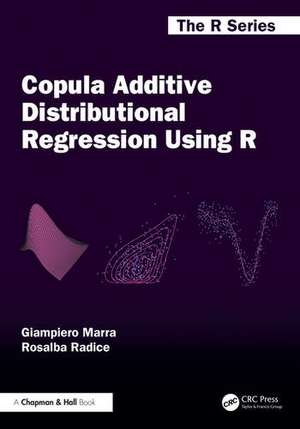
Copula Additive Distributional Regression Using R: Chapman & Hall/CRC The R Series
Autor Giampiero Marra, Rosalba Radiceen Limba Engleză Hardback – 23 iun 2025
Key Features:
- Provides a comprehensive overview of joint regression modeling for multiple outcomes, with a focus on bivariate responses
- Offers a practical approach with real-world examples from various fields
- Demonstrates the implementation of all the discussed models using the GJRM package in R
- Includes supplementary resources such as data accessible through the GJRM.data package in R and additional code available on the authors' webpages
Din seria Chapman & Hall/CRC The R Series
- 8%
 Preț: 552.89 lei
 - 20%
 Preț: 406.28 lei
 - 8%
 Preț: 443.45 lei
 - 8%
 Preț: 493.59 lei
 -
 Preț: 442.08 lei
 - 8%
 Preț: 610.91 lei
 - 15%
 Preț: 530.47 lei
 - 15%
 Preț: 453.73 lei
 - 15%
 Preț: 587.96 lei
 - 15%
 Preț: 626.36 lei
 - 20%
 Preț: 702.96 lei
 - 20%
 Preț: 1165.32 lei
 - 15%
 Preț: 543.36 lei
 - 15%
 Preț: 448.12 lei
 - 20%
 Preț: 1490.60 lei
 - 20%
 Preț: 728.89 lei
 - 18%
 Preț: 721.72 lei
 - 20%
 Preț: 513.86 lei
 - 15%
 Preț: 459.11 lei
 - 15%
 Preț: 605.86 lei
 -
 Preț: 237.42 lei
 - 18%
 Preț: 1003.26 lei
 - 20%
 Preț: 1184.33 lei
 - 18%
 Preț: 1250.55 lei
 -
 Preț: 485.61 lei
 - 20%
 Preț: 400.89 lei
 - 20%
 Preț: 416.24 lei
 - 18%
 Preț: 959.71 lei
 -
 Preț: 212.03 lei
 - 20%
 Preț: 269.87 lei
 - 18%
 Preț: 1276.79 lei
 - 20%
 Preț: 1314.25 lei
 - 15%
 Preț: 566.12 lei
 - 18%
 Preț: 692.78 lei
 - 18%
 Preț: 928.58 lei
 -
 Preț: 347.22 lei
 -
 Preț: 484.25 lei
 -
 Preț: 484.25 lei
 -
 Preț: 484.25 lei
Preț: 614.92 lei
Preț vechi: 723.43 lei
-15%
Puncte Express: 922
Carte tipărită la comandă
Livrare economică 09-23 noiembrie
Livrare prin curier în România Termenul estimat este afișat lângă disponibilitate.
Transport gratuit pentru acest produs Plată online sau ramburs, în funcție de opțiunile comenzii.
Retur gratuit în 14 zile Comandă securizată și suport în română.
Specificații
ISBN-13: 9781032973111
ISBN-10: 1032973110
Pagini: 152
Ilustrații: 60
Dimensiuni: 178 x 254 x 16 mm
Greutate: 0.44 kg
Ediția:1
Editura: CRC Press
Colecția Chapman and Hall/CRC
Seria Chapman & Hall/CRC The R Series
ISBN-10: 1032973110
Pagini: 152
Ilustrații: 60
Dimensiuni: 178 x 254 x 16 mm
Greutate: 0.44 kg
Ediția:1
Editura: CRC Press
Colecția Chapman and Hall/CRC
Seria Chapman & Hall/CRC The R Series
Public țintă
Academic, Postgraduate, and Professional ReferenceCuprins
1. Core concepts in copula regression. 2. Continuous outcomes. 3. Count outcomes . 4. Survival outcomes. 5. Binary outcomes . 6. Ordinal outcomes. 7. Binary outcome with partial observability. 8. Ordinal and continuous outcomes. 9. Binary and continuous outcomes. 10. Binary and count outcomes. 11. Count and continuous outcomes. 12. Binary outcome with binary treatment effect. 13. Time-to-event outcome with binary treatment effect. 14. Binary outcome with missingness not at random.
Notă biografică
Giampiero Marra is a Professor of Statistics in the Department of Statistical Science at University College London (UCL). He holds a degree in Statistics and Economics from the University of Bologna (2004) and began his career in consultancy roles in the private sector. In 2007, he completed an MSc in Statistics at UCL and successfully defended his PhD thesis at the University of Bath in November 2010. Giampiero joined UCL as a faculty member in September 2010.
Rosalba Radice is a Professor of Statistics at Bayes Business School, City St George’s, University of London. After earning her PhD in Statistics from the University of Bath, she held positions as a research assistant and research fellow at the London School of Hygiene and Tropical Medicine. From 2012 to 2018, Rosalba served as Lecturer, Senior Lecturer and then Reader in Statistics at Birkbeck, University of London.
For over 15 years, Giampiero and Rosalba have collaborated extensively to advance methodological, computational and applied statistics. Their research spans diverse areas, including penalized likelihood-based inference, copula regression and survival analysis, with impactful applications in fields such as healthcare, economics, epidemiology and the social sciences. As part of their work, they developed the GJRM package for R, which enables researchers and practitioners to implement these methods effectively while promoting transparency and reproducibility.
Rosalba Radice is a Professor of Statistics at Bayes Business School, City St George’s, University of London. After earning her PhD in Statistics from the University of Bath, she held positions as a research assistant and research fellow at the London School of Hygiene and Tropical Medicine. From 2012 to 2018, Rosalba served as Lecturer, Senior Lecturer and then Reader in Statistics at Birkbeck, University of London.
For over 15 years, Giampiero and Rosalba have collaborated extensively to advance methodological, computational and applied statistics. Their research spans diverse areas, including penalized likelihood-based inference, copula regression and survival analysis, with impactful applications in fields such as healthcare, economics, epidemiology and the social sciences. As part of their work, they developed the GJRM package for R, which enables researchers and practitioners to implement these methods effectively while promoting transparency and reproducibility.
Descriere
Copula additive distributional regression enables the joint modeling of multiple outcomes, an essential aspect of many real-world research problems. This book provides an accessible overview of this modeling approach, with a particular focus on its implementation in the GJRM R package