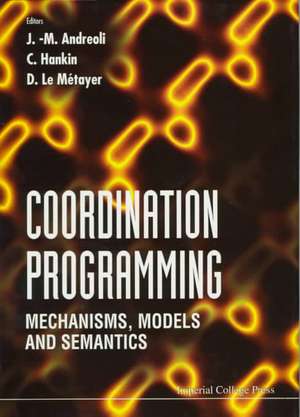
Coordination Programming: Mechanisms, Models and Semantics
en Limba Engleză Hardback – aug 1996
Preț: 945.20 lei
Preț vechi: 1181.50 lei
-20%
Puncte Express: 1418
Carte tipărită la comandă
Livrare economică 26 noiembrie-10 decembrie
Livrare prin curier în România Termenul estimat este afișat lângă disponibilitate.
Transport gratuit pentru acest produs Plată online sau ramburs, în funcție de opțiunile comenzii.
Retur gratuit în 14 zile Comandă securizată și suport în română.
Specificații
ISBN-13: 9781860940231
ISBN-10: 1860940234
Pagini: 400
Dimensiuni: 152 x 216 x 28 mm
Greutate: 0.68 kg
Editura: Imperial College Press
ISBN-10: 1860940234
Pagini: 400
Dimensiuni: 152 x 216 x 28 mm
Greutate: 0.68 kg
Editura: Imperial College Press
V-ar putea interesa
-
 The Art of Multiprocessor ProgrammingMaurice Herlihy-40%Preț: 375.12 lei620.73 lei
 -
 An Introduction to Parallel ProgrammingPeter Pacheco-41%Preț: 382.32 lei644.49 lei
 -
 -20%Preț: 225.84 lei282.30 lei
 -
 Types and Programming LanguagesBenjamin C. Pierce-21%Preț: 616.11 lei776.93 lei
 -
 Structure and Interpretation of Computer Programs, second editionGerald Jay Sussman-20%Preț: 552.11 lei690.14 lei
 -
 Distributed SystemsGeorge Coulouris-20%Preț: 624.57 lei780.72 lei
 -
 -20%Preț: 574.25 lei717.80 lei
 -
 Programming Language PragmaticsMichael Scott-40%Preț: 488.02 lei808.04 lei
 -
 Computer Architecture: A Quantitative ApproachJohn L. Hennessy-39%Preț: 536.81 lei884.58 lei
 -
 -20%Preț: 740.41 lei925.52 lei
 -
 CompilersAlfred V. Aho-20%Preț: 629.07 lei786.34 lei
 -
 Coding For Dummies, All New EditionPaul McFedries-20%Preț: 116.94 lei146.18 lei
 -
 Agentic AI For DummiesPam Baker-20%Preț: 145.95 lei182.44 lei
 -
 Click, Connect, Compute: Computer Science EssentialsDr Dharini Balasubramaniam-37%Preț: 52.05 lei82.18 lei
 -
 Concurrent and Real-time ProgrammingManuel I. Capel-20%Preț: 353.05 lei441.31 lei
 -
 -20%Preț: 316.28 lei395.35 lei
 -
 -20%Preț: 328.16 lei410.20 lei
 -
 -20%Preț: 317.85 lei397.31 lei
 -
 Nonsequential and Distributed Programming with GoChristian Maurer-20%Preț: 378.97 lei473.70 lei
 -
 -14%Preț: 683.83 lei795.15 lei
Cuprins
Part 1 Coordination models: gamma and the chemical reaction model - ten years after, J.-P. Banatre and D. Le Metayer; coordination in LO, J.-M. Andreoli; truth and action osmosis (the TAO computation model), A. Porto and V.T. Vasconcelos; type inference and subtyping for higher-order generative communication, L. Dami. Part 2 Semantics: temporal semantics for gamma, M. Reynolds; a programme logic for gamma, S.J. Gay and C.L. Hankin; schedules for multiset transformer programmes, M. Chaudron and E. de Jong; composed reduction systems, D. Sands; an alternative semantics for the parallel operator of the calculas of gamma programmes, P. Ciancarini et al; a linear logic view of gamma style computations as proof searches, P. Bruscoli and A. Guglielmi. Part 3 Implementations, application: specifying a reflective and distributed implemenation of LO in higher order gamma, M. Bourgois; practical implications of reflection for coordination languages, M. Mourgois; Gammalog - a coordination language based on gamma and Godel, P. Ciancarini et al; coordination of distributed and parallel programmes in ConCoord, A.A. Holzbacher; gamma, chromatic typing and vegetation, H. McEvoy.