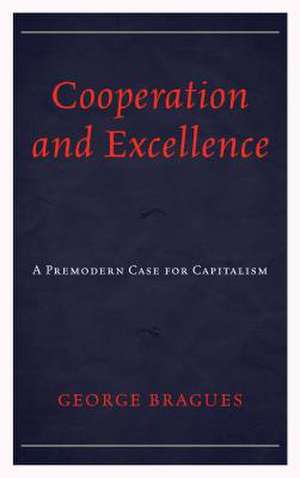
Cooperation and Excellence: A Premodern Case for Capitalism
Autor George Braguesen Limba Engleză Hardback – 28 iul 2017
Preț: 586.26 lei
Preț vechi: 883.80 lei
-34%
Puncte Express: 879
Preț estimativ în valută:
103.64€ • 123.57$ • 89.89£
103.64€ • 123.57$ • 89.89£
Carte tipărită la comandă
Livrare economică 17-31 martie
Specificații
ISBN-13: 9781498529730
ISBN-10: 1498529739
Pagini: 264
Ilustrații: 2 b/w illustrations
Dimensiuni: 157 x 239 x 24 mm
Greutate: 0.57 kg
Editura: Bloomsbury Publishing
Colecția Lexington Books
Locul publicării:New York, United States
ISBN-10: 1498529739
Pagini: 264
Ilustrații: 2 b/w illustrations
Dimensiuni: 157 x 239 x 24 mm
Greutate: 0.57 kg
Editura: Bloomsbury Publishing
Colecția Lexington Books
Locul publicării:New York, United States
Cuprins
Acknowledgments
Introduction: Why Pro-Capitalists Need to Think Pre-Modern
Chapter 1: Why Modern Ideas Leave Capitalism Exposed
Chapter 2: The Social Cooperation Directive
Chapter 3: The Ciceronian Theory of Justice
Chapter 4: Capitalism Cannot Be Secular
Chapter 5: A Constitution that Opens the Way to Capitalism
Chapter 6: How a Redistributive State Jeopardizes Social Cooperation
Chapter 7: Pursuing Human Excellence under Capitalism
Conclusion: From Utter Skepticism to Probabilistic Contrarianism
Bibliography
About the Author
Introduction: Why Pro-Capitalists Need to Think Pre-Modern
Chapter 1: Why Modern Ideas Leave Capitalism Exposed
Chapter 2: The Social Cooperation Directive
Chapter 3: The Ciceronian Theory of Justice
Chapter 4: Capitalism Cannot Be Secular
Chapter 5: A Constitution that Opens the Way to Capitalism
Chapter 6: How a Redistributive State Jeopardizes Social Cooperation
Chapter 7: Pursuing Human Excellence under Capitalism
Conclusion: From Utter Skepticism to Probabilistic Contrarianism
Bibliography
About the Author
Recenzii
Ultimately, this book is a valuable and novel contribution. Bragues's theory is different from both most modern and Aristotelian-inspired defenses of capitalism. In writing this book, he has done us a service by detailing the Ciceronian theory of justice and in showing how it can cohere, perhaps unexpectedly, with capitalism. He also shows that we still have much to learn from the ancients, especially from Cicero.
George Bragues's well-written and thoroughly researched book is a much needed reminder to economists and others that there are thinkers before Adam Smith whose work is relevant to the case for capitalism. By also focusing on the pre-modern concern for community and other values often neglected in more modern arguments, Bragues helpfully expands the case for capitalism by emphasizing the importance of elements of human behavior other than self-interest.
This book attempts the unusual exercise of making an apology for the capitalist society not on the traditional grounds associated with Adam Smith's "Invisible Hand" but on the basis of pre-modern classical thought. The author uses the great Roman statesman and philosopher Marcus Tullius Cicero as a fulcrum upon which to lift his case that the classical thinkers can be made available to those wishing to defend the free market economy and its concomitant benefits. To defend capitalism on this basis, Bragues argues, means defending politics as a sovereign sphere in its own right and religion's presence in society as preservative of the limitations on the state which pure secularism tends to undermine. Professor Bragues further argues that more than any other known system capitalism can bring an indefinably wide range of citizens within reach of the one, true, best way of life. By placing the simply best life for man at the center of capitalism's justification Professor Bragues makes revolution upon the more standard apologetics for the commercial society. In doing so he has produced some indispensable reading for those seeking to gauge the parameters of justice under the liberal democratic regime.
In this important and challenging book, George Bragues contends that the best defense of capitalism derives not from the modern philosophers but from a thinker of ancient Rome: Cicero. This is a careful, striking, and thoughtful account of how Cicero's consideration of social cooperation suggests the sort of principles, beliefs, institutions, and virtues that provide a plausible defense of capitalism. Anyone interested in understanding the nature and conditions of a free market and a good society should read this book.
George Bragues's well-written and thoroughly researched book is a much needed reminder to economists and others that there are thinkers before Adam Smith whose work is relevant to the case for capitalism. By also focusing on the pre-modern concern for community and other values often neglected in more modern arguments, Bragues helpfully expands the case for capitalism by emphasizing the importance of elements of human behavior other than self-interest.
This book attempts the unusual exercise of making an apology for the capitalist society not on the traditional grounds associated with Adam Smith's "Invisible Hand" but on the basis of pre-modern classical thought. The author uses the great Roman statesman and philosopher Marcus Tullius Cicero as a fulcrum upon which to lift his case that the classical thinkers can be made available to those wishing to defend the free market economy and its concomitant benefits. To defend capitalism on this basis, Bragues argues, means defending politics as a sovereign sphere in its own right and religion's presence in society as preservative of the limitations on the state which pure secularism tends to undermine. Professor Bragues further argues that more than any other known system capitalism can bring an indefinably wide range of citizens within reach of the one, true, best way of life. By placing the simply best life for man at the center of capitalism's justification Professor Bragues makes revolution upon the more standard apologetics for the commercial society. In doing so he has produced some indispensable reading for those seeking to gauge the parameters of justice under the liberal democratic regime.
In this important and challenging book, George Bragues contends that the best defense of capitalism derives not from the modern philosophers but from a thinker of ancient Rome: Cicero. This is a careful, striking, and thoughtful account of how Cicero's consideration of social cooperation suggests the sort of principles, beliefs, institutions, and virtues that provide a plausible defense of capitalism. Anyone interested in understanding the nature and conditions of a free market and a good society should read this book.