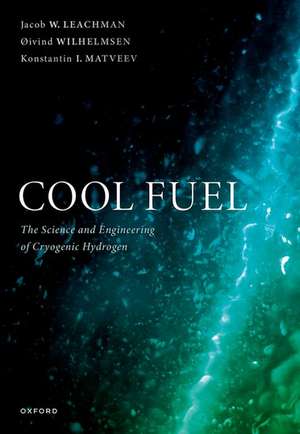
Cool Fuel: The Science and Engineering of Cryogenic Hydrogen
Autor Jacob W. Leachman, Øivind Wilhelmsen, Konstantin I. Matveeven Limba Engleză Hardback – 18 feb 2025
Preț: 373.44 lei
Preț vechi: 415.61 lei
-10%
Puncte Express: 560
Carte disponibilă
Livrare economică 12-18 noiembrie
Livrare express 24-30 octombrie pentru 84.83 lei
Livrare prin curier în România Termenul estimat este afișat lângă disponibilitate.
Transport gratuit de la 400.00 lei Plată online sau ramburs, în funcție de opțiunile comenzii.
Retur gratuit în 14 zile Comandă securizată și suport în română.
Specificații
ISBN-13: 9780198936664
ISBN-10: 0198936664
Pagini: 240
Ilustrații: 112 figures
Dimensiuni: 177 x 253 x 18 mm
Greutate: 0.62 kg
Editura: OUP OXFORD
Colecția OUP Oxford
Locul publicării:Oxford, United Kingdom
ISBN-10: 0198936664
Pagini: 240
Ilustrații: 112 figures
Dimensiuni: 177 x 253 x 18 mm
Greutate: 0.62 kg
Editura: OUP OXFORD
Colecția OUP Oxford
Locul publicării:Oxford, United Kingdom
V-ar putea interesa
-
 Quantum Hydrodynamics and TurbulenceMakoto Tsubota-20%Preț: 447.95 lei563.41 lei
 -
 -27%Preț: 962.31 lei1321.69 lei
 -
 Chemical and Engineering Thermodynamics, 5eStanley I. Sandler-19%Preț: 581.45 lei717.84 lei
 -
 Understanding ThermodynamicsH. C. Van NessPreț: 65.45 lei
 -
 Applied Thermodynamics for Engineering TechnologistsT. D. Eastop-15%Preț: 664.50 lei781.76 lei
 -
 Fluid Mechanics: Volume 4David TongPreț: 250.72 lei
 -
 Preț: 305.74 lei
 -
 Rocket Propulsion Elements 9eGP Sutton-23%Preț: 904.86 lei1175.15 lei
 -
 Fundamentals of Thermodynamics, Eleventh EditionClaus Borgnakke-23%Preț: 785.54 lei1020.18 lei
 -
 Thermodynamics For DummiesMichael PaukenPreț: 166.32 lei
 -
 -26%Preț: 385.77 lei518.94 lei
 -
 -23%Preț: 686.35 lei891.35 lei
 -
 Preț: 242.97 lei
 -
 Thermal Sciences for MachinesGiorgio Cornetti-15%Preț: 611.10 lei718.94 lei
 -
 -14%Preț: 852.55 lei991.33 lei
 -
 Thermodynamics for Chemical EngineersKenneth R. Hall-11%Preț: 548.74 lei616.56 lei
 -
 Next-Generation Hydrogen EconomyPeeyush Phogat-23%Preț: 899.64 lei1168.37 lei
 -
 Hydrogen in Automotive EngineeringManfred Klell-15%Preț: 610.61 lei718.37 lei
 -
 MechanicsStefan Roth-11%Preț: 401.93 lei451.60 lei
Recenzii
This book offers a comprehensive exploration of the science and engineering behind cryogenic hydrogen. Its multidisciplinary approach and comprehensive coverage make it a valuable resource for diverse stakeholders.
Notă biografică
Jacob Leachman is a Professor in the School of Mechanical and Materials Engineering at Washington State University (WSU) and founding Director of the Hydrogen Properties for Energy Research (HYPER) laboratory. He earned a B.S. degree in Mechanical Engineering in 2005 and a M.S. degree in 2007 from the University of Idaho. His master's thesis has been adopted as the foundation for hydrogen fuelling standards and custody exchange, in addition to winning the Western Association of Graduate Schools Distinguished Thesis Award for 2008. He completed his Ph.D. in the Cryogenic Engineering Laboratory at the University of Wisconsin-Madison in 2010. In 2018 he received the Roger W. Boom Award from the Cryogenic Society of America.Øivind Wilhelmsen is a Professor at the Norwegian University of Science and Technology, where he is responsible for the Thermodynamics group in the Department of Chemistry. He holds an Msc. and a PhD in physical chemistry and has worked for many years in the applied research institute SINTEF Energy Research with technologies for the liquefaction of hydrogen. His research spans from a fundamental, molecular description of hydrogen and quantum mixed refrigerants to the development of more energy efficient hydrogen liquefaction processes and process equipment. He has been endorsed by several national and international awards such as the Hydrogen Prize, the Prigogine Prize, the EFCE Excellence Award in Thermodynamics and Transport Properties and the National Award for Young Outstanding Researcher Talents within Natural Sciences in 2018.Konstantin Matveev earned a PhD in Mechanical Engineering from Caltech in 2003 and, prior to that, BS and MS degrees in Applied Physics from the Moscow Institute of Physics and Technology. He carried out post-doctoral research at Los Alamos National Laboratory and worked as a Senior Hydrodynamicist for Art Anderson Associates. He is currently a professor in the School of Mechanical and Materials Engineering at Washington State University and a Fellow of the American Society of Mechanical Engineers. His research work spans liquid hydrogen systems, multiphase flow, thermoacoustics, advanced marine and aerial vehicles, and computational fluid dynamics.
Cuprins
- Historical and future trends
- Thermophysical properties
- Para-orthohydrogen conversion
- Liquefaction
- Elements of transfer
- Storage
- Safety