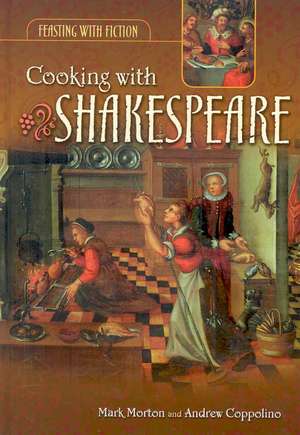
Cooking with Shakespeare: Feasting with Fiction
Autor Mark Morton, Andrew Coppolinoen Limba Engleză Hardback – 29 mar 2008 – vârsta până la 17 ani
Analiza obiceiurilor culinare elisabetane reprezintă poarta de acces pe care Cooking with Shakespeare o propune pentru înțelegerea profunzimii operei marelui dramaturg. Considerăm că acest volum, publicat de Bloomsbury Publishing în seria Feasting with Fiction, depășește granițele unei simple cărți de bucate istorice, devenind un instrument pedagogic riguros. Structura este concepută pentru a servi atât curriculumului școlar, cât și entuziaștilor gastronomiei, oferind peste 180 de rețete extrase direct din sursele primare ale secolului al XVI-lea.
Fiecare capitol este dedicat unui grup specific de ingrediente — de la pește și fructe de mare la carne de vită sau băuturi — și este ancorat în textul literar prin citate care demonstrează cum hrana reflectă statutul social și conflictele dramatice. Cititorii familiarizați cu Shakespeare in the Kitchen de Marissa Nicosia vor aprecia aici abordarea practică: autorii nu se opresc la analiza teoretică, ci oferă versiuni modernizate ale rețetelor, făcând aromele epocii accesibile în bucătăriile de astăzi. Spre deosebire de studiul Food in Shakespeare al lui Joan Fitzpatrick, care se concentrează pe implicațiile morale și sociale ale dietei, volumul de față prioritizează experiența senzorială și contextualizarea economică, incluzând date fascinante despre prețurile alimentelor și salariile din acea perioadă.
Apreciem în mod deosebit rigoarea cu care Mark Morton și Andrew Coppolino au compilat resursele finale, oferind un glosar esențial și o listă de ingrediente dificil de găsit. Această ediție hardback transformă lectura pieselor lui Shakespeare dintr-un exercițiu pur intelectual într-unul viu, tactil și gustativ.
Preț: 275.58 lei
Preț vechi: 492.15 lei
-44%
Carte tipărită la comandă
Livrare economică 26 noiembrie-10 decembrie
Specificații
ISBN-10: 0313337071
Pagini: 336
Dimensiuni: 178 x 254 x 24 mm
Greutate: 0.86 kg
Editura: Bloomsbury Publishing
Colecția Greenwood
Seria Feasting with Fiction
Locul publicării:New York, United States
V-ar putea interesa
-
 Television: The Critical ViewHorace Newcomb-27%Preț: 924.06 lei1265.84 lei
 -
 -18%Preț: 1120.63 lei1366.63 lei
 -
 Experimentation in Improvised Jazz: Chasing IdeasAndrys OnsmanPreț: 450.95 lei
 -
 Music Festivals in the UK: Beyond the CarnivalesqueChris AndertonPreț: 424.79 lei
 -
 Preț: 432.39 lei
 -
 Tropical Gothic in Literature and Culture: The AmericasJustin D. EdwardsPreț: 442.66 lei
 -
 War Gothic in Literature and CultureSteffen HantkePreț: 437.63 lei
 -
 Preț: 437.63 lei
 -
 Women and the Nineteenth-Century LiedAisling KennyPreț: 415.92 lei
 -
 Musical Listening in the Age of Technological ReproductionGianmario BorioPreț: 457.60 lei
 -
 Youth, Drugs, and NightlifeGeoffrey Hunt-5%Preț: 455.52 lei479.50 lei
 -
 HEROES OF THE BORDERLANDSChristopher ConwayPreț: 513.13 lei
 -
 Remixing European Jazz CultureKristin McGee-18%Preț: 1114.04 lei1358.58 lei
 -
 The Southern Rock Revival: The Old South in a New WorldJason T. Eastman-27%Preț: 270.53 lei369.31 lei
 -
 Love, Language, Place, and Identity in Popular CultureMaría Ramos-García-19%Preț: 618.65 lei763.77 lei
 -
 Intimate StrangersRichard Schickel-15%Preț: 97.37 lei114.60 lei
 -
 -32%Preț: 583.67 lei864.29 lei
 -
 -32%Preț: 599.73 lei880.85 lei
 -
 Feminism in Popular CultureDr Joanne Hollows-22%Preț: 206.77 lei266.07 lei
 -
 Receptions of the Ancient Near East in Popular Culture and BeyondLorenzo VerderamePreț: 244.10 lei
De ce să citești această carte
Recomandăm această carte educatorilor și pasionaților de istorie care doresc să exploreze universul lui Shakespeare prin prisma vieții cotidiene. Cititorul câștigă o perspectivă unică asupra culturii materiale elisabetane, având la dispoziție rețete adaptate care permit recrearea autentică a banchetelor din piese. Este un hibrid rar între critică literară și ghid gastronomic practic.
Despre autor
Mark Morton este profesor asistent de limbă engleză la Universitatea din Winnipeg și o prezență constantă în spațiul cultural canadian în calitate de columnist pentru CBC Radio. Expertiza sa lingvistică se împletește cu pasiunea pentru istoria culturală, Morton fiind recunoscut pentru capacitatea de a face accesibile teme academice complexe. Deși bibliografia sa include lucrări diverse, precum memoriile Desolation, contribuția sa în cadrul seriei Feasting with Fiction evidențiază rigoarea sa în cercetarea arhivelor culinare și a textelor clasice, aducând la viață contextul istoric al literaturii engleze.
Notă biografică
Descriere scurtă
Cuprins
Recenzii
A rich, fun survey of early cooking methods and recipes for modern readers and librarians interested in culinary history.
Cooking with Shakespeare is packed with information that will interest culinary historians, lovers of Shakespeare, and foodies alike.
The introduction outlines the material and ideological conditions surrounding the production and consumption of food in Shakespeare's time. Each of the 189 entries couples a recipe taken from an early modern source with a related reference in Shakespeare, a short discussion of important terms in the recipe or quotation, and a translation of the recipe into modern terms..Bon appetit.
.Cooking with Shakespeare should set a new standard for cookbooks about food and cookery of 16th-century England..Cooking with Shakespeare should satisfy almost everyone with an appetite for the subject.