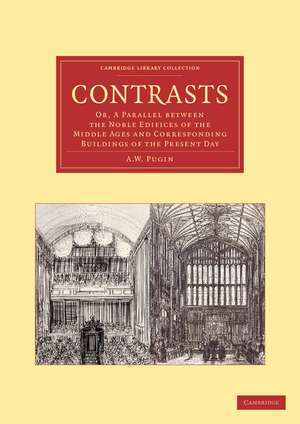
Contrasts
Autor A. W. Puginen Limba Engleză Paperback – 8 mai 2013
Preț: 191.64 lei
Puncte Express: 287
Carte tipărită la comandă
Livrare economică 24 noiembrie-08 decembrie
Livrare prin curier în România Termenul estimat este afișat lângă disponibilitate.
Transport gratuit de la 400.00 lei Plată online sau ramburs, în funcție de opțiunile comenzii.
Retur gratuit în 14 zile Comandă securizată și suport în română.
Specificații
ISBN-13: 9781108061346
ISBN-10: 1108061346
Pagini: 136
Ilustrații: 17 b/w illus.
Dimensiuni: 210 x 297 x 8 mm
Greutate: 0.37 kg
Editura: Cambridge University Press
Locul publicării:Cambridge, United Kingdom
ISBN-10: 1108061346
Pagini: 136
Ilustrații: 17 b/w illus.
Dimensiuni: 210 x 297 x 8 mm
Greutate: 0.37 kg
Editura: Cambridge University Press
Locul publicării:Cambridge, United Kingdom
V-ar putea interesa
-
 Aureli, P: POSSIBILITY OF AN ABSOLUTE ARCPier Vittorio AureliPreț: 197.87 lei
 -
 Preț: 482.14 lei
 -
 The Secret Lives Of BuildingsEdward HollisPreț: 93.71 lei
 -
 Yes Is More: An Archicomic on Architectural EvolutionBjarke IngelsPreț: 171.94 lei
 -
 Koolhaas/ObristHans Ulrich ObristPreț: 342.45 lei
Cuprins
Preface to the second edition; Plates; 1. On the feelings which produced the great edifices of the middle ages; 2. On the revived pagan principle; 3. Under Henry VIII; 4. Under Edward VI; 5. On the present degraded state of ecclesiastical buildings; Conclusion; Appendix.
Descriere
This 1841 revised second edition of Contrasts champions medieval architecture by satirically comparing it with 'debased' Regency equivalents.