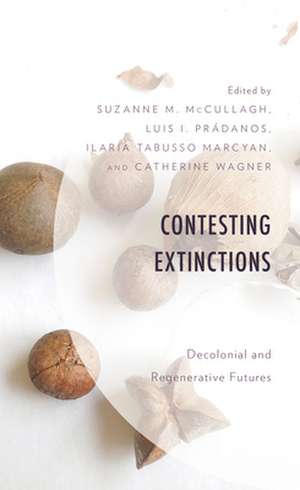
Contesting Extinctions: Decolonial and Regenerative Futures: Environment and Society
Editat de Suzanne M. McCullagh, Luis I. Prádanos, Ilaria Tabusso Marcyan, Catherine Wagner Contribuţii de Alex Benson, Leonardo E. Figueroa Helland, Ryan Heryford, Wesley Y. Leonard, Felix Mantz, Marjolein Oele, Lisa Ottum, Abigail Perez Aguileraen Limba Engleză Hardback – 8 noi 2021
Din seria Environment and Society
- 11%
 Preț: 536.19 lei
 - 32%
 Preț: 552.72 lei
 - 36%
 Preț: 490.21 lei
 - 36%
 Preț: 525.68 lei
 - 32%
 Preț: 597.00 lei
 - 26%
 Preț: 267.00 lei
 - 35%
 Preț: 539.68 lei
 - 15%
 Preț: 618.35 lei
 - 35%
 Preț: 623.42 lei
 - 34%
 Preț: 602.05 lei
 - 32%
 Preț: 537.30 lei
 - 26%
 Preț: 282.92 lei
 - 27%
 Preț: 256.21 lei
 - 28%
 Preț: 220.85 lei
 - 32%
 Preț: 593.85 lei
 - 28%
 Preț: 222.24 lei
 - 33%
 Preț: 641.48 lei
 - 32%
 Preț: 583.75 lei
 - 28%
 Preț: 220.25 lei
 - 32%
 Preț: 490.04 lei
 - 33%
 Preț: 515.07 lei
 -
 Preț: 200.59 lei
 - 28%
 Preț: 219.94 lei
 - 32%
 Preț: 664.15 lei
 - 35%
 Preț: 624.82 lei
 - 35%
 Preț: 537.83 lei
 - 28%
 Preț: 221.74 lei
 - 32%
 Preț: 597.09 lei
 - 27%
 Preț: 257.10 lei
 - 32%
 Preț: 615.79 lei
 - 33%
 Preț: 514.88 lei
 - 32%
 Preț: 550.96 lei
 - 33%
 Preț: 578.43 lei
 - 15%
 Preț: 591.03 lei
 - 24%
 Preț: 220.06 lei
 - 33%
 Preț: 518.83 lei
 - 37%
 Preț: 660.35 lei
 - 32%
 Preț: 593.05 lei
 - 32%
 Preț: 488.94 lei
 - 34%
 Preț: 570.96 lei
Preț: 524.64 lei
Preț vechi: 815.59 lei
-36%
Puncte Express: 787
Carte tipărită la comandă
Livrare economică 27 noiembrie-11 decembrie
Livrare prin curier în România Termenul estimat este afișat lângă disponibilitate.
Transport gratuit pentru acest produs Plată online sau ramburs, în funcție de opțiunile comenzii.
Retur gratuit în 14 zile Comandă securizată și suport în română.
Specificații
ISBN-13: 9781793652812
ISBN-10: 1793652813
Pagini: 190
Ilustrații: 6 b/w illustrations
Dimensiuni: 163 x 227 x 18 mm
Greutate: 0.43 kg
Editura: Bloomsbury Publishing
Colecția Lexington Books
Seria Environment and Society
Locul publicării:New York, United States
ISBN-10: 1793652813
Pagini: 190
Ilustrații: 6 b/w illustrations
Dimensiuni: 163 x 227 x 18 mm
Greutate: 0.43 kg
Editura: Bloomsbury Publishing
Colecția Lexington Books
Seria Environment and Society
Locul publicării:New York, United States
Cuprins
Chapter One: Decolonize, ReIndigenize: Planetary Crisis, Biocultural Diversity, Indigenous Resurgence and Land Rematriation
Chapter Two: "The Word for Bringing Bodies Back from Water:" Black Oceanic Ecopoetics and the Re-Imagining of Extinction
Chapter Three: Philosophizing Extinction: On the Loss of World, and the Possibility of Rebirth through Languages of the Sea
Chapter Four: What We Talk About When We Talk About Extinction
Chapter Five: Rat-Fall: Time and Taxa in the Colorado River Delta, c. 1900
Chapter Six: Contesting Extinction through a Praxis of Language Reclamation
Chapter Two: "The Word for Bringing Bodies Back from Water:" Black Oceanic Ecopoetics and the Re-Imagining of Extinction
Chapter Three: Philosophizing Extinction: On the Loss of World, and the Possibility of Rebirth through Languages of the Sea
Chapter Four: What We Talk About When We Talk About Extinction
Chapter Five: Rat-Fall: Time and Taxa in the Colorado River Delta, c. 1900
Chapter Six: Contesting Extinction through a Praxis of Language Reclamation
Recenzii
This dynamic book is an exciting and timely contribution to urgent conversations in the environmental humanities and postcolonial and ethnic studies about extinction. Rather than consider extinction as a singular or future event, this interdisciplinary collection explores temporally expansive settler-colonial extinctions in the plural. Foregrounding Indigenous, Black, and decolonial responses, the contributors trace a praxis of contestation to capital's eradicating drive that is rooted in critical relationality.
This volume is a crucial addition to the growing field of extinction studies. The editors and contributors elucidate how contesting extinction means careful attention to both loss and revitalization: It means finding new ways to write about animals, plants, waters, and places; it means dismantling settler colonialism and contributing to Indigenous resurgences; it means practicing new ways of grieving and loving together in a non-extractivist manner. These are powerful essays against erasure and towards regenerative biocultural futures.
When the biomass associated with humans threatens to surpass that of all other living biomass on the planet, observant people know that humankind has fulfilled the biblical command to multiply and subdue Earth. With the exception of a few pests that consume food supplies (e.g., locusts), the human race has poisoned many insects nearly out of existence, some, such as honeybees, essential to human survival. In this anthology, six essays from the related conference dissect various existing and anticipated outcomes of human influence while also contesting the allegedly capitalistic premise underlying the term Anthropocene.. The book is mainly about historical or anticipated extinction of indigenous peoples and languages-events not to be ignored, of course. The text does a good job of documenting these. [A]ppropriate for use as a supplementary text. Recommended... Upper-division undergraduates. Graduate students.
This volume is a crucial addition to the growing field of extinction studies. The editors and contributors elucidate how contesting extinction means careful attention to both loss and revitalization: It means finding new ways to write about animals, plants, waters, and places; it means dismantling settler colonialism and contributing to Indigenous resurgences; it means practicing new ways of grieving and loving together in a non-extractivist manner. These are powerful essays against erasure and towards regenerative biocultural futures.
When the biomass associated with humans threatens to surpass that of all other living biomass on the planet, observant people know that humankind has fulfilled the biblical command to multiply and subdue Earth. With the exception of a few pests that consume food supplies (e.g., locusts), the human race has poisoned many insects nearly out of existence, some, such as honeybees, essential to human survival. In this anthology, six essays from the related conference dissect various existing and anticipated outcomes of human influence while also contesting the allegedly capitalistic premise underlying the term Anthropocene.. The book is mainly about historical or anticipated extinction of indigenous peoples and languages-events not to be ignored, of course. The text does a good job of documenting these. [A]ppropriate for use as a supplementary text. Recommended... Upper-division undergraduates. Graduate students.