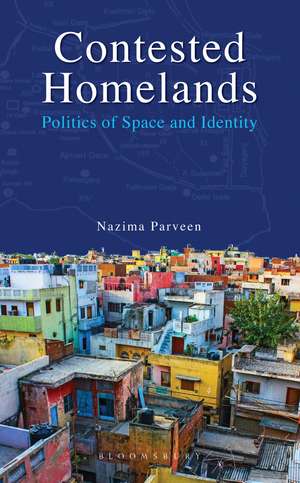
Contested Homelands: Politics of Space and Identity: Bloomsbury Academic India
Autor Nazima Parveenen Limba Engleză Hardback – 30 dec 2020
Observăm în lucrarea Contested Homelands o schimbare de paradigmă necesară în analiza geografiei urbane a Indiei, mutând accentul de la simpla demografie la procesele discursive care au „construit” politic zonele locuite de musulmani în Delhi. Nazima Parveen aduce un plus de rigoare prin investigarea modului în care identitatea religioasă a fost mapată pe spațiul fizic, transformând cartierele în zone de contestare ideologică unde s-a materializat proiectul național. Această analiză completează perspectiva oferită de Communal Geographies de Stephen Legg, adăugând o dimensiune istorică profundă ce pornește de la întâlnirile coloniale de la începutul secolului al XIX-lea și ajunge până la politicile agresive de reamenajare urbană din anii '70.
Structura volumului este cronologică și tematică, ghidând cititorul printr-o progresie logică: de la conflictele de identitate pre-1939, la impactul fracturantei idei de Pakistan din anii '40 și, în final, la realitatea administrativă a taberelor de refugiați de după 1947. Ne-a atras atenția capitolul dedicat perioadei 1955-1970, unde Nazima Parveen explorează subtilitățile legate de castă și clasă în interiorul comunității, demontând mitul unui bloc musulman monolitic. Tonul este unul academic precis, evitând generalizările și ancorând fiecare argument în procese istorice concrete, precum segregarea prin reglementări de urbanism și impactul politicilor de „curățare” a spațiului public. Este o resursă esențială pentru înțelegerea modului în care urbanismul și politica se împletesc pentru a marginaliza sau defini cetățenia în Asia de Sud postcolonială.
Din seria Bloomsbury Academic India
- 32%
 Preț: 564.07 lei
 - 33%
 Preț: 551.02 lei
 - 33%
 Preț: 548.03 lei
 - 33%
 Preț: 548.91 lei
 - 33%
 Preț: 550.47 lei
 - 32%
 Preț: 552.23 lei
 - 33%
 Preț: 551.26 lei
 - 30%
 Preț: 97.52 lei
 - 32%
 Preț: 564.14 lei
 - 32%
 Preț: 551.25 lei
 - 33%
 Preț: 549.26 lei
 - 33%
 Preț: 548.52 lei
 - 32%
 Preț: 555.13 lei
 - 33%
 Preț: 559.35 lei
 - 33%
 Preț: 551.53 lei
 - 32%
 Preț: 563.88 lei
 - 32%
 Preț: 552.38 lei
 - 33%
 Preț: 548.91 lei
 - 33%
 Preț: 550.16 lei
 - 33%
 Preț: 550.68 lei
 - 33%
 Preț: 549.68 lei
 - 32%
 Preț: 555.52 lei
 - 33%
 Preț: 550.86 lei
 - 33%
 Preț: 548.52 lei
 - 33%
 Preț: 559.40 lei
 - 33%
 Preț: 549.74 lei
 - 32%
 Preț: 561.17 lei
 - 32%
 Preț: 551.25 lei
 - 33%
 Preț: 550.47 lei
 - 32%
 Preț: 551.86 lei
 - 33%
 Preț: 558.21 lei
 - 33%
 Preț: 548.91 lei
 - 33%
 Preț: 558.37 lei
 - 33%
 Preț: 548.32 lei
 - 33%
 Preț: 556.93 lei
 - 33%
 Preț: 551.34 lei
 - 32%
 Preț: 552.80 lei
 - 33%
 Preț: 551.65 lei
 - 33%
 Preț: 550.68 lei
 - 33%
 Preț: 549.31 lei
 - 33%
 Preț: 558.37 lei
 - 32%
 Preț: 552.03 lei
 - 33%
 Preț: 551.25 lei
 - 32%
 Preț: 565.77 lei
 - 33%
 Preț: 548.91 lei
 - nou
 Preț: 547.03 lei
 - nou
 Preț: 443.40 lei
 - nou
 Preț: 135.86 lei
 - nou
 Preț: 548.80 lei
Preț: 552.19 lei
Preț vechi: 819.74 lei
-33%
Carte disponibilă
Livrare economică 02-16 noiembrie
Specificații
ISBN-10: 9389000904
Pagini: 336
Dimensiuni: 142 x 220 x 24 mm
Greutate: 0.53 kg
Editura: Bloomsbury Publishing
Colecția Bloomsbury Academic India
Seria Bloomsbury Academic India
Locul publicării:New Delhi, India
De ce să citești această carte
Recomandăm această carte cercetătorilor și studenților interesați de istoria socială și geografia politică a Indiei. Contested Homelands oferă o înțelegere nuanțată a modului în care spațiul urban din Delhi a devenit un câmp de luptă pentru identitate. Cititorul câștigă o perspectivă critică asupra modului în care politicile de stat și discursurile naționaliste modelează viața cotidiană și segregarea în metropolele contemporane.
Descriere
How did community and space relation come to be defined on religious lines?
In what ways were 'Muslim-dominated' areas perceived as contested zones?
Invoking the ideas of homeland as a useful vantage point to enter into the wider discourse around the conceptualization of space, the book suggests that the relation between Muslim communities and their living spaces has evolved out of a long process of politicization and communalization of space in Delhi.
Cuprins
1: Colonial Encounters, Identities, Conflicts and Space: A Background, 1809-1939
2: Contested Homelands: Territorial Nations and the Idea of Pakistan, 1940-1947
3: Demarcated Space: 'Muslim Refugee Camps' and 'Muslim Zones' in Delhi, 1947-1954
4: Caste, Class and Religion of Meat: Contest and Conflicts in Muslim Localities, 1955-1970
5: Reorganization of Muslim Space: Clearance, Resettlement and Redevelopment, 1970-1977
Conclusion
Notă biografică
Nazima Parveen is an independent research scholar. The focus of her work is the rights of ethnic and religious minorities, communalization of space and the politics of urban transformation in colonial and postcolonial South Asia. Parveen completed her PhD from Victoria University of Wellington, New Zealand. She has worked as an assistant professor at Jamia Millia Islamia, New Delhi. Parveen has also worked in the UK, India and Nepal between 200. She has worked on different UK government and EU-funded research programmes during 2002-2007.
She was the recipient of ICSSR Post-Doctoral Fellowship 2018, Royal Society of New Zealand Doctoral Scholarship 2013-2016, ICSSR-CSDS Doctoral Fellowship programme 2010-2012 and ASIA Fellows Awards 2008-2009. She also writes opinion pieces on current affairs for digital news portals.