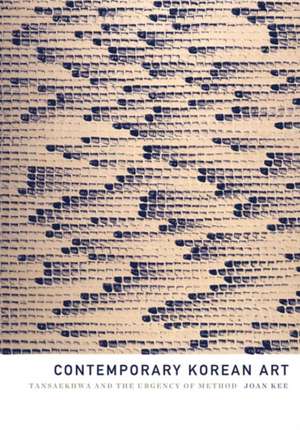
Contemporary Korean Art: Tansaekhwa and the Urgency of Method
Autor Joan Keeen Limba Engleză Paperback – 18 iul 2013
Descoperim în Contemporary Korean Art o perspectivă academică riguroasă asupra mișcării Tansaekhwa, elementul central care a definit identitatea vizuală a Coreei de Sud pe scena internațională începând cu anii '60. Ceea ce diferențiază acest manual de alte prezentări generale este focalizarea sa asupra 'metodei'. În loc să analizeze tablourile doar ca obiecte estetice, Joan Kee investighează acțiunile fizice — împingerea vopselei, ruperea hârtiei sau înmuierea pânzei — ca forme de rezistență și implicare activă într-o lume marcată de tensiuni politice. Notăm cu interes cum autoarea reușește să transforme analiza formală a monocromiei într-o discuție despre agenția artei sub regimuri autoritare.
Această lucrare reprezintă o alternativă focalizată la Modern and Contemporary Korean Art in Context (1950 - Now) de Jung-Sil Lee. În timp ce volumul lui Lee oferă o panoramă vastă a mai multor mișcări, de la Minjung Misul la arta digitală, Joan Kee alege profunzimea în detrimentul lărgimii, oferind prima interpretare critică extinsă în limba engleză dedicată exclusiv urgenței metodei în Tansaekhwa. Structura cărții este construită logic, debutând cu redefinirea picturii de către Kwon Young-woo și Yun Hyoungkeun, trecând prin faimoasele serii 'Conjunction' și 'Écriture', și culminând cu o analiză a modului în care această estetică a fost idealizată în context global.
În contextul operei sale, această carte continuă interesul autoarei pentru intersecția dintre artă și sistemele de putere, temă explorată și în Models of Integrity – Art and Law in Post–Sixties America. Dacă în lucrările anterioare analiza relația dintre estetică și cadrul legal, aici Joan Kee demonstrează cum abstractizarea nu a fost o evadare din realitate, ci un instrument prin care artiștii au navigat traumele decolonizării și ale Războiului Rece.
Preț: 263.71 lei
Carte disponibilă
Livrare economică 14-28 noiembrie
Specificații
ISBN-10: 0816679886
Pagini: 384
Ilustrații: 135
Dimensiuni: 178 x 254 x 20 mm
Greutate: 1.08 kg
Ediția:1
Editura: University of Minnesota Press
Colecția Univ Of Minnesota Press
V-ar putea interesa
-
 Preț: 259.97 lei
 -
 Dances with Darwin, 1875–1910: Vernacular Modernity in FranceRae Beth Gordon-18%Preț: 1248.98 lei1523.15 lei
 -
 Preț: 162.45 lei
 -
 Preț: 99.21 lei
 -
 Der Wald als romantischer ToposUte Jung-Kaiser-9%Preț: 787.15 lei864.99 lei
 -
 -5%Preț: 158.19 lei166.51 lei
 -
 SHITAOHelmut BrinkerPreț: 162.44 lei
De ce să citești această carte
Recomandăm această carte istoricilor de artă și studenților care doresc să înțeleagă rădăcinile modernismului est-asiatic. Cititorul câștigă o înțelegere profundă a modului în care minimalismul coreean diferă de cel occidental, fiind ancorat în practici materiale care sfidează contextul politic opresiv. Este un instrument esențial pentru a descifra de ce Tansaekhwa rămâne cea mai influentă mișcare artistică din Coreea de Sud.
Despre autor
Joan Kee este o figură proeminentă în istoria artei contemporane, cunoscută pentru capacitatea sa de a conecta analiza vizuală cu cadrele juridice și politice. Profesor de istoria artei, ea s-a remarcat prin lucrări precum The Geometries of Afro Asia și Models of Integrity – Art and Law in Post–Sixties America, explorând modul în care arta interacționează cu normele sociale și politice globale. Expertiza sa în arta asiatică și americană post-1945 îi permite să ofere în Contemporary Korean Art o viziune nuanțată, bazată pe cercetări extinse de teren și o cunoaștere profundă a contextului istoric coreean.
Descriere scurtă
Starting in the mid-1960s, a group of Korean artists began to push paint, soak canvas, drag pencils, rip paper, and otherwise manipulate the materials of painting in ways that prompted critics to describe their actions as “methods” rather than artworks. A crucial artistic movement of twentieth-century Korea, Tansaekhwa (monochromatic painting) also became one of its most famous and successful. Promoted in Seoul, Tokyo, and Paris, Tansaekhwa grew to be the international face of contemporary Korean art and a cornerstone of contemporary Asian art.
In this full-color, richly illustrated account—the first of its kind in English—Joan Kee provides a fresh interpretation of the movement’s emergence and meaning that sheds new light on the history of abstraction, twentieth-century Asian art, and contemporary art in general. Combining close readings, archival research, and interviews with leading Tansaekhwa artists, Kee focuses on an essential but often overlooked dimension of the movement: how artists made a case for abstraction as a way for viewers to engage productively with the world and its systems. As Kee shows, artists such as Lee Ufan, Park Seobo, Kwon Young-woo, Yun Hyongkeun, and Ha Chonghyun urgently stressed certain fundamentals, recognizing that overwhelming forces such as decolonization, authoritarianism, and the rise of a new postwar internationalism could be approached through highly individual experiences that challenged viewers to consider how they understood their world rather than why.
Against the backdrop of the Cold War, decolonization, and the declaration of martial law in South Korea, these artists asked questions that continue to resonate today: In what ways can art matter to the world? How does art exert agency when its viewers live in times of explicit or implicit duress? How can specific social and political conditions inspire or influence methods and styles?
Notă biografică
Joan Kee is assistant professor of art history at the University of Michigan, Ann Arbor.
Cuprins
Contents
Note to Readers
Introduction: The Urgency of Method
1. Kwon Young-woo and Yun Hyoungkeun Rethink Painting
2. Rates of Exchange in Ha Chongyun’s Conjunction
3. Encountering Lee Ufan in Korea and Japan
4. Reading Park Seobo’s Écriture in Authoritarian Korea
5. Tansaekhwa and the Idealization of Asian Art
Epilogue: The Contextualist Predicament
Acknowledgments
Appendix: Korean Names and Terms
Notes
Index
Recenzii
"Rich in analysis and description, Kee’s book traces the development of Korean painting and issues of national artistic identity as a reflection of the country’s economic growth and political turmoil over the past five decades. This pioneering, generously illustrated tome deserves a place in every serious collection of books about modern art in Asia."—ArtAsiaPacific
"Kee does an excellent job of placing Tansaekhwa artists in context, giving the reader a greater understanding of how the artists fit into contemporary Korean art and the international art world. Readers who are not familiar with Korean history will be well-served by the historical context that the author provides."—Art Libraries Society
"A gorgeous and thoughtful introduction to the history of contemporary art in Korea. It’s a beautiful and fascinating book."—New Books Network
"Kee displays throughout the book a rare sensitivity to formal qualities of the visual materials before her and exhaustive knowledge of theoretical discussions that surrounded and gave rise to the movement, all while writing a refined but accessible prose without a shred of excess."—Journal of Asian Studies
"Kee successfully carves out a definable and cultivated place for the Tansaekhwa artist in the global history of modernist abstraction and contemporary art."—Orientations
"This book is required reading for anyone with even a passing interest in Korean art of the 20th century."—Korean Quarterly
"The horizontally evanescing yet rhythmically resurging dots of the frontispiece by Lee Ufan invites us into the exciting journey offered by this by this elaborately strucutured narrative of tansaekhwa."—Korean Studies
"This book delivers a solid argument, displays meticulous research, and offers an in-depth reading of artworks. The questions Kee’s intervention raises will make this book an important point of reference and engagement for any future studies of contemporary Korean and non-Western art."—Art Journal
"Kee’s attention to forms and method is brilliant, and her theoretical knowledge of contemporary Korean art provides pleasurable reading for even non-art historians."—Pacific Affairs