Contemporary Extreme Value Methods: Contributions to Economics
Autor Omid M. Ardakanien Limba Engleză Hardback – 28 oct 2026
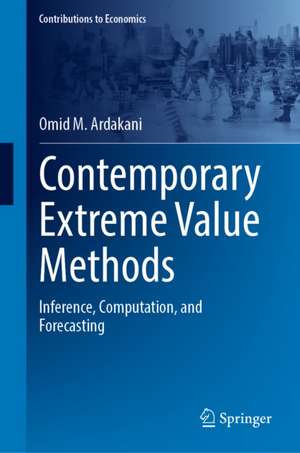
The first part develops GEV and GPD foundations with complete measure-theoretic proofs. It extends max-stability to high dimensions using angular measure decompositions that scale to hundreds of risk factors. The second part covers nonparametric tail estimation with boundary bias correction, Bayesian Extreme Learning with entropy-regularized posteriors, Dirichlet process mixtures for heavy-tailed data, and the Extreme Value Information Criterion for tail-focused model selection. The third part introduces dynamic GEV state-space models with particle filtering for nonstationary extremes, threshold-weighted scoring rules for forecast evaluation and combination, Pareto-EVaR as a coherent risk measure that unifies GPD calibration with exponential moment constraints, and portfolio optimization under extremal transfer entropy constraints. The fourth part formalizes causal inference under regularly varying noise, develops tail-adaptive machine learning for extreme quantile estimation, and applies quantum density matrices and quantum copulas to systemic risk detection.
All theoretical results include complete proofs. Methods are implemented in R and Python with reproducible code tested on financial returns, temperature records, flood data, and cryptocurrency markets. The book serves researchers, graduate students, and advanced undergraduates in econometrics, finance, environmental science, and risk management.
Din seria Contributions to Economics
- 18%
 Preț: 1096.48 lei
 - 18%
 Preț: 979.65 lei
 - 18%
 Preț: 1072.68 lei
 - 18%
 Preț: 1217.13 lei
 - 15%
 Preț: 512.41 lei
 - 18%
 Preț: 1068.04 lei
 - 15%
 Preț: 624.86 lei
 - 15%
 Preț: 645.13 lei
 - 15%
 Preț: 616.67 lei
 - 15%
 Preț: 628.52 lei
 - 15%
 Preț: 622.37 lei
 - 15%
 Preț: 644.90 lei
 - 15%
 Preț: 619.51 lei
 - 15%
 Preț: 620.55 lei
 - 15%
 Preț: 620.35 lei
 - 15%
 Preț: 640.73 lei
 -
 Preț: 368.79 lei
 - 18%
 Preț: 923.26 lei
 - 15%
 Preț: 624.49 lei
 - 15%
 Preț: 636.90 lei
 -
 Preț: 363.99 lei
 -
 Preț: 367.68 lei
 -
 Preț: 391.49 lei
 - 15%
 Preț: 624.36 lei
 - 15%
 Preț: 625.75 lei
 -
 Preț: 388.51 lei
 -
 Preț: 397.45 lei
 -
 Preț: 373.40 lei
 - 15%
 Preț: 641.11 lei
 - 20%
 Preț: 624.51 lei
 - 18%
 Preț: 726.06 lei
 -
 Preț: 374.14 lei
 - 15%
 Preț: 609.53 lei
 -
 Preț: 373.16 lei
 -
 Preț: 381.75 lei
 -
 Preț: 371.03 lei
 - 15%
 Preț: 639.42 lei
 -
 Preț: 383.27 lei
 - 15%
 Preț: 638.58 lei
 -
 Preț: 372.67 lei
 - 15%
 Preț: 626.40 lei
 -
 Preț: 371.73 lei
 - 15%
 Preț: 619.20 lei
 -
 Preț: 372.70 lei
 -
 Preț: 368.62 lei
 - 15%
 Preț: 623.96 lei
 -
 Preț: 384.50 lei
 -
 Preț: 370.30 lei
 -
 Preț: 383.79 lei
 -
 Preț: 368.05 lei
Preț: 775.76 lei
Preț vechi: 969.70 lei
-20% Precomandă
Puncte Express: 1164
Carte nepublicată încă
Livrare prin curier în România Precomanda se expediază când titlul devine disponibil.
Transport gratuit pentru acest produs Plată online sau ramburs, în funcție de opțiunile comenzii.
Retur gratuit în 14 zile Comandă securizată și suport în română.
Doresc să fiu notificat când acest titlu va fi disponibil:
Se trimite...
Specificații
ISBN-13: 9783032249142
ISBN-10: 3032249147
Pagini: 408
Dimensiuni: 155 x 235 mm
Editura: Springer Nature Switzerland AG
Colecția Contributions to Economics
Seria Contributions to Economics
ISBN-10: 3032249147
Pagini: 408
Dimensiuni: 155 x 235 mm
Editura: Springer Nature Switzerland AG
Colecția Contributions to Economics
Seria Contributions to Economics
Notă biografică
Omid M. Ardakani is a Professor of Economics at Georgia Southern University and the Solomons Economic Research Fellow at the Parker College of Business. His research has appeared in journals such as the Journal of the Royal Statistical Society: Series A, European Journal of Operational Research, International Statistical Review, International Review of Financial Analysis, Finance Research Letters, Studies in Nonlinear Dynamics and Econometrics, Economics Letters, Econometrics and Statistics, Economic Modelling, Expert Systems with Applications, Journal of Economic Dynamics and Control, and Journal of Futures Markets. His work focuses on extreme value theory, information-theoretic methods, and Bayesian approaches to economic modeling. He has received the Gary M. Davis Excellence in Business Research Award, the Solomons Economic Research Fellowship, and the Donald D. Howard Faculty Award. He is co-editor of the Economics Journal, section editor of the Financial Statistical Journal, and serves on the editorial boards of the Journal of Information Economics and International Finance and Banking. Dr. Ardakani teaches graduate courses in economic forecasting and financial analysis and has industry experience as a quantitative research analyst and economic consultant.
Cuprins
.Part I: FoundationsofExtremes.- Chapter 1: Overview of Extreme Value Theory.- Chapter 2: Multivariate andHigh-DimensionalExtremes.- Part II: II Inference Methods.- Chapter 3: Nonparametric andSemiparametricMethods forExtremes.- Chapter 4: Bayesian Inference for Extreme Values.- Chapter 5: Bayesian Nonparametrics for Heavy-Tailed Data.- Chapter 6: odelSelectioninHeavy-TailedRegimes.- Part III: Dynamics, Risk, and Forecasting.- Chapter 7: DynamicExtremeValueModels.- Chapter 8: Evaluation and Combination of Predictive Models.- Chapter 9: ExtremeRiskMeasures.- Chapter 10: Portfolio Optimization under Extremes.- Part IV: Emerging Frameworks.- Chapter 11: Causal Inference in Tail Regimes.- Chapter 12: Machine Learning for Tail Risk Forecasting.- Chapter 13: Quantum Information Perspectives.