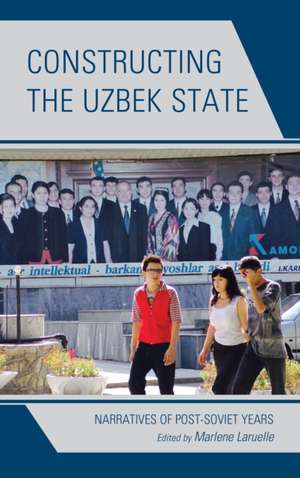
Constructing the Uzbek State: Narratives of Post-Soviet Years: Contemporary Central Asia: Societies, Politics, and Cultures
Editat de Marlene Laruelle Contribuţii de Sergey Abashin, Peter Finke, Matteo Fumagalli, Alisher Ilkhamov, Morgan Y. Liu, Maria Louw, Nick Megoran, Svetlana Peshkova, Sebastien Peyrouse, Johan Rasanayagam, Noah Tucker, Rano Turaeva-Hoehne, Rustamjon Urinboyev, Russell Zancaen Limba Engleză Hardback – 20 dec 2017
The death of President Islam Karimov, in power for a quarter of century, in late 2016, reopened the future of the country, offering it more room for evolution. To better grasp the challenges facing post-Karimov Uzbekistan, this volume reviews nearly three decades of independence. In the first part, it discusses the political construct of Uzbekistan under Karimov, based on the delineation between the state, the elite, and the people, and the tight links between politics and economy. The second section of the volume delves into the social and cultural changes related to labor migration and one specific trigger - the difficulties to reform agriculture. The third part explores the place of religion in Uzbekistan, both at the state level and in society, while the last part looks at the renegotiation of collective identities.
Din seria Contemporary Central Asia: Societies, Politics, and Cultures
- 22%
 Preț: 313.19 lei
 - 34%
 Preț: 584.53 lei
 - 26%
 Preț: 272.60 lei
 - 34%
 Preț: 555.13 lei
 - 18%
 Preț: 699.90 lei
 - 34%
 Preț: 609.59 lei
 - 34%
 Preț: 609.19 lei
 - 34%
 Preț: 553.21 lei
 - 21%
 Preț: 350.62 lei
 - 26%
 Preț: 522.27 lei
 - 31%
 Preț: 346.52 lei
 -
 Preț: 308.74 lei
 - 26%
 Preț: 244.92 lei
 - 26%
 Preț: 258.72 lei
 - 26%
 Preț: 267.17 lei
 - 24%
 Preț: 211.62 lei
 - 31%
 Preț: 491.97 lei
 - 34%
 Preț: 542.10 lei
 - 34%
 Preț: 523.01 lei
 - 34%
 Preț: 554.62 lei
 - 34%
 Preț: 646.26 lei
 - 26%
 Preț: 271.35 lei
 - 26%
 Preț: 266.21 lei
 - 34%
 Preț: 672.83 lei
 - 34%
 Preț: 592.96 lei
 - 25%
 Preț: 270.42 lei
Preț: 730.79 lei
Preț vechi: 1104.39 lei
-34%
Puncte Express: 1096
Preț estimativ în valută:
129.38€ • 150.65$ • 112.39£
129.38€ • 150.65$ • 112.39£
Carte tipărită la comandă
Livrare economică 23 februarie-09 martie
Preluare comenzi: 021 569.72.76
Specificații
ISBN-13: 9781498538367
ISBN-10: 1498538363
Pagini: 398
Ilustrații: 1 Graph, 7 Tables
Dimensiuni: 159 x 237 x 29 mm
Greutate: 0.67 kg
Editura: Bloomsbury Publishing
Colecția Lexington Books
Seria Contemporary Central Asia: Societies, Politics, and Cultures
Locul publicării:New York, United States
ISBN-10: 1498538363
Pagini: 398
Ilustrații: 1 Graph, 7 Tables
Dimensiuni: 159 x 237 x 29 mm
Greutate: 0.67 kg
Editura: Bloomsbury Publishing
Colecția Lexington Books
Seria Contemporary Central Asia: Societies, Politics, and Cultures
Locul publicării:New York, United States
Cuprins
Introduction, Marlene Laruelle
Part I: Uzbekistan's Political Construct
Chapter 1: When Security Trumps Identity: Uzbekistan's Foreign Policy under Islam Karimov, Matteo Fumagalli
Chapter 2: The Magic of Territory: Remaking of Border Landscapes as a Spatial Manifestation of Nationalist Ideology, Nick Megoran
Chapter 3: Grand Corruption in Uzbekistan's Telecommunications Sector: Root Causes and Social Costs, Alisher Ilkhamov
Chapter 4: Uzbek Political Thinking in the Third Decade of Independence, Morgan Y. Liu
Part II: Agriculture and Labor Migration. Changing the Social Fabric
Chapter 5: Government, Cotton Farms, and Labor Migration from Uzbekistan, Russell Zanca
Chapter 6: Uzbeks in Russia: A New Diaspora or a Transnational Society?, Sergei Abashin
Chapter 7: Establishing an "Uzbek Mahalla" via Smartphones and Social Media: Everyday Transnational Lives of Uzbek Labor Migrants in Russia, Rustamjon Urinboyev
Part III: Uzbek Islam: State Control, Resilience, and Resistance
Chapter 8: Counter-Extremism, Secularism, and the Category of Religion in the United Kingdom and Uzbekistan: Should We Be Studying Islam at All?, Johan Rasanayagam
Chapter 9: At the Crossroads of Religion and Regime Security: Teaching Islam in Uzbekistan,
Sebastien Peyrouse
Chapter 10: Moral Exemplars and Ordinary Ethics: Sufism in Bukhara, Maria Louw
Chapter 11: The Evolving "Uzbek Jihad": Islamist Militant Recruiting and State Responses, Noah Tucker
Part IV: Renegotiating Identities and Cultural Legacies
Chapter 12: Be(com)ing Uzbek: Patterns of Identification and Processes of Assimilation,
Peter Finke
Chapter 13: The Nation Narrated: Uzbekistan's Political and Cultural Nationalism, Marlene Laruelle
Chapter 14: Public Life in Private Spaces in Uzbekistan: Women, Religion, and Politics, Svetlana Peshkova
Chapter 15: Gender and Changing Women's Roles in Uzbekistan: From Soviet Workers to Post-Soviet Entrepreneurs, Rano Turaeva-Hoehne
Part I: Uzbekistan's Political Construct
Chapter 1: When Security Trumps Identity: Uzbekistan's Foreign Policy under Islam Karimov, Matteo Fumagalli
Chapter 2: The Magic of Territory: Remaking of Border Landscapes as a Spatial Manifestation of Nationalist Ideology, Nick Megoran
Chapter 3: Grand Corruption in Uzbekistan's Telecommunications Sector: Root Causes and Social Costs, Alisher Ilkhamov
Chapter 4: Uzbek Political Thinking in the Third Decade of Independence, Morgan Y. Liu
Part II: Agriculture and Labor Migration. Changing the Social Fabric
Chapter 5: Government, Cotton Farms, and Labor Migration from Uzbekistan, Russell Zanca
Chapter 6: Uzbeks in Russia: A New Diaspora or a Transnational Society?, Sergei Abashin
Chapter 7: Establishing an "Uzbek Mahalla" via Smartphones and Social Media: Everyday Transnational Lives of Uzbek Labor Migrants in Russia, Rustamjon Urinboyev
Part III: Uzbek Islam: State Control, Resilience, and Resistance
Chapter 8: Counter-Extremism, Secularism, and the Category of Religion in the United Kingdom and Uzbekistan: Should We Be Studying Islam at All?, Johan Rasanayagam
Chapter 9: At the Crossroads of Religion and Regime Security: Teaching Islam in Uzbekistan,
Sebastien Peyrouse
Chapter 10: Moral Exemplars and Ordinary Ethics: Sufism in Bukhara, Maria Louw
Chapter 11: The Evolving "Uzbek Jihad": Islamist Militant Recruiting and State Responses, Noah Tucker
Part IV: Renegotiating Identities and Cultural Legacies
Chapter 12: Be(com)ing Uzbek: Patterns of Identification and Processes of Assimilation,
Peter Finke
Chapter 13: The Nation Narrated: Uzbekistan's Political and Cultural Nationalism, Marlene Laruelle
Chapter 14: Public Life in Private Spaces in Uzbekistan: Women, Religion, and Politics, Svetlana Peshkova
Chapter 15: Gender and Changing Women's Roles in Uzbekistan: From Soviet Workers to Post-Soviet Entrepreneurs, Rano Turaeva-Hoehne
Recenzii
This is an excellent book, one that examines the most pressing issues in contemporary Uzbekistan Combining insights from a rare mix of top specialists, this very readable volume takes a penetrating look into Uzbekistan's society, culture, and politics. A country with enormous possibility, yet burdened by deep-seated challenges, Uzbekistan highlights the truly multifaceted nature of building a state in this part of the world. Covering migration, economic reform, security threats, and how gender, religion, and culture define Uzbekistan's rich social fabric, Constructing the Uzbek State is essential reading for anyone interested in this important country.
This tour de force of contemporary scholarship on Uzbekistan is as insightful as it is timely. In 2016 the first president of Uzbekistan died after twenty-five years of stern rule and was replaced by a successor who immediately proposed small but significant changes. The analysis in this book will be invaluable to those who want to engage with the opportunities that may arise from new openings in one of the most closed countries in the world. This is the only book on Uzbekistan that has brought together top academic experts who speak the local languages and have lived in and studied the region for many years. The result is a rich and nuanced picture of Uzbekistan's political, economic, and social life in the early twenty-first century that is accessible to students and policymakers alike.
This tour de force of contemporary scholarship on Uzbekistan is as insightful as it is timely. In 2016 the first president of Uzbekistan died after twenty-five years of stern rule and was replaced by a successor who immediately proposed small but significant changes. The analysis in this book will be invaluable to those who want to engage with the opportunities that may arise from new openings in one of the most closed countries in the world. This is the only book on Uzbekistan that has brought together top academic experts who speak the local languages and have lived in and studied the region for many years. The result is a rich and nuanced picture of Uzbekistan's political, economic, and social life in the early twenty-first century that is accessible to students and policymakers alike.