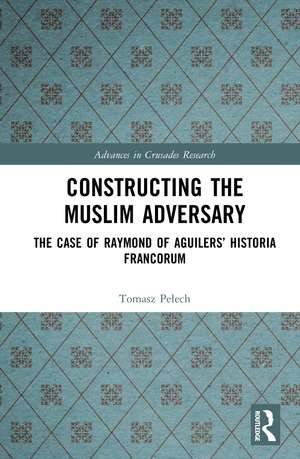
Constructing the Muslim Adversary: The Case of Raymond of Aguilers’ Historia Francorum: Advances in Crusades Research
Autor Tomasz Pełechen Limba Engleză Hardback – 30 oct 2026
Combining textual criticism, intellectual history, literary analysis, and quantitative evidence, the book reconstructs Raymond’s biography, authorship, manuscript tradition, chronology, language, and relationship to other First Crusade narratives. It introduces ‘xenophany’ as a framework for analysing how the Muslim adversary is made manifest through names, ethnic catalogues, accusations of paganism and blasphemy, depictions of warfare, and portraits of Muslim rulers. Rather than treating these images as failed ethnography, the study shows that they render the crusade intelligible as providential history: the enemy confirms Christian identity, divine judgement, and the justice of Frankish victory.
The book will appeal to scholars and advanced students of the crusades, medieval historiography, Latin literature, Christian–Muslim relations, religious violence, and the cultural history of the Mediterranean. Its close reading of a neglected eyewitness, combined with new arguments about authorship, reception, narrative technique, and theological meaning, offers a major reassessment of both Raymond of Aguilers and the textual construction of the First Crusade.


Preț: 1352.12 lei
Preț vechi: 1648.93 lei
-18% Precomandă
Puncte Express: 2028
Carte nepublicată încă
Livrare prin curier în România Precomanda se expediază când titlul devine disponibil.
Transport gratuit pentru acest produs Plată online sau ramburs, în funcție de opțiunile comenzii.
Retur gratuit în 14 zile Comandă securizată și suport în română.
Doresc să fiu notificat când acest titlu va fi disponibil:
Se trimite...
Specificații
ISBN-13: 9781041212645
ISBN-10: 104121264X
Pagini: 302
Ilustrații: 4
Dimensiuni: 156 x 234 mm
Greutate: 0.72 kg
Ediția:1
Editura: Taylor & Francis
Colecția Routledge
Seria Advances in Crusades Research
Locul publicării:Oxford, United Kingdom
ISBN-10: 104121264X
Pagini: 302
Ilustrații: 4
Dimensiuni: 156 x 234 mm
Greutate: 0.72 kg
Ediția:1
Editura: Taylor & Francis
Colecția Routledge
Seria Advances in Crusades Research
Locul publicării:Oxford, United Kingdom
Public țintă
AcademicCuprins
Acknowledgements
List of Tables and Figures
List of Abbreviations
Introduction
Chapter I. The Image of Muslims as the ‘Other’ in Crusade Sources as a Subject of Scholarly Reflection: State of Research and Methodological Foundations
Chapter II. Historia Francorum qui ceperunt Iherusalem – The Author and His Work
Chapter III. The Image of the Enemy in Historia Francorum qui ceperunt Iherusalem
Chapter IV. Narratives of Battles, Sieges, and Commanders
Conclusion
Bibliography
Index
List of Tables and Figures
List of Abbreviations
Introduction
Chapter I. The Image of Muslims as the ‘Other’ in Crusade Sources as a Subject of Scholarly Reflection: State of Research and Methodological Foundations
Chapter II. Historia Francorum qui ceperunt Iherusalem – The Author and His Work
Chapter III. The Image of the Enemy in Historia Francorum qui ceperunt Iherusalem
Chapter IV. Narratives of Battles, Sieges, and Commanders
Conclusion
Bibliography
Index
Notă biografică
Tomasz Pełech, PhD, is a researcher at the Institute of Archaeology and Ethnology of the Polish Academy of Sciences, Poland. His research focuses on the First Crusade, the Latin Kingdom of Jerusalem, medieval kingship, and the political and religious culture of the Latin East, as well as Byzantium in the Komnenian period and Byzantine–Latin relations. He has published studies on crusade narratives, royal ideology, seals, diplomatic practice, and ecclesiastical institutions in the Kingdom of Jerusalem. He is the author of monographs on Anna Komnene’s Alexias (2016) and Raymond of Aguilers (2025) and is currently researching kingship and political culture in crusader Jerusalem.
Descriere
This book reassesses Raymond of Aguilers as a learned author who transformed crusading experience into a coherent work of sacred history. It asks how his representation of Muslims functioned within a narrative shaped by theology, biblical exegesis, liturgy, and the political culture of the Provençal contingent.