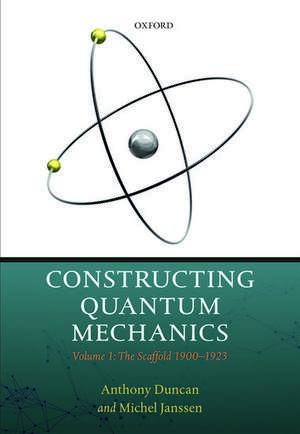
Constructing Quantum Mechanics: Volume 1: The Scaffold: 1900-1923
Autor Anthony Duncan, Michel Janssenen Limba Engleză Hardback – 29 aug 2019
Lucrarea de față, semnată de Anthony Duncan și Michel Janssen, aduce o perspectivă proaspătă asupra genezei fizicii moderne, concentrându-se pe perioada crucială 1900-1923. Ne-a atras atenția modul în care autorii reușesc să depășească narațiunea simplistă a descoperirilor liniare, oferind în schimb o analiză riguroasă a ceea ce ei numesc „schela” (the scaffold) pe care s-a construit ulterior arhitectura mecanicii cuantice moderne. Volumul se distinge prin tratamentul aprofundat al lucrărilor lui Sommerfeld și ale cercului său, adesea eclipsate în manualele standard de figurile lui Planck, Einstein sau Bohr.
Apreciem rigoarea cu care sunt examinate sursele primare și secundare, cele 512 pagini fiind susținute de 69 de ilustrații care clarifică datele spectroscopice complexe ale epocii. Această lucrare acoperă aceeași arie istorică precum The Historical Development of Quantum Theory de Jagdish Mehra, dar cu o abordare mult mai tehnică și focalizată pe mecanismele interne ale tranziției de la fizica clasică la cea cuantică. Dacă Quantum Concepts in Physics de Malcolm Longair este o introducere excelentă pentru studenți, volumul de față este o monografie densă, destinată celor care caută să înțeleagă efortul eroic de interpretare a datelor experimentale care au forțat limitele paradigmei vechi.
În contextul operei lui Anthony Duncan, această carte continuă interesul său pentru fundamentele teoretice, vizibil și în The Conceptual Framework of Quantum Field Theory. Totuși, aici accentul se mută de pe cadrul conceptual pur spre o reconstrucție istorică și matematică a modului în care s-au născut aceste idei. Este o resursă esențială pentru istoricii științei și fizicienii interesați de evoluția disciplinară, oferind o claritate rar întâlnită în analiza lucrărilor clasice.
Preț: 600.40 lei
Preț vechi: 752.88 lei
-20%
Carte disponibilă
Livrare economică 26 iunie-07 iulie
Specificații
ISBN-10: 0198845472
Pagini: 512
Ilustrații: 69 illustrations
Dimensiuni: 176 x 254 x 31 mm
Greutate: 1.14 kg
Editura: OUP OXFORD
Colecția OUP Oxford
Locul publicării:Oxford, United Kingdom
De ce să citești această carte
Recomandăm acest volum fizicienilor și istoricilor care doresc să înțeleagă mecanica cuantică nu doar ca pe un set de ecuații, ci ca pe un proces istoric de rezolvare a unor crize empirice. Cititorul câștigă o perspectivă detaliată asupra „vechii teorii cuantice” și a modului în care eșecurile acesteia au pavat drumul către succesul teoriei moderne. Este o lectură fundamentală pentru înțelegerea rădăcinilor fizicii contemporane.
Despre autor
Anthony Duncan este un autor cu o traiectorie intelectuală remarcabilă, îmbinând expertiza în fizică teoretică cu o carieră de lungă durată în cadrul Bisericii Angliei. Această dualitate i-a permis să abordeze subiecte complexe din perspective inedite, de la fundamentele teoriei câmpurilor cuantice în The Conceptual Framework of Quantum Field Theory, până la explorări în filozofie și spiritualitate în lucrări precum To Think Without Fear. În prezentul volum, Duncan își folosește rigoarea analitică pentru a descurca ițele istorice ale mecanicii cuantice, demonstrând o stăpânire profundă a arhivelor științifice.
Descriere
Recenzii
Engineers and scientists from across the board will get a kick out of being able to read about the origins of their everyday toolkits - this is lucid historical reasoning about one of the great accomplishments of modern science. After seeing the author's track the launch of the old quantum theory, I'm looking forward to their account of full-blown quantum mechanics to come in volume 2!
Clearly written, by highly competent authors, giving full reasoning and calculations for all important developments.
This will be a widely read book and used in many physics and history of physics courses at the undergraduate college-university level. It will be greeted most enthusiastically by scholars and teachers alike.
Indeed a very important and valuable contribution to the history of quantum mechanics.
What seemed a good piece of work at the start is magisterial. This is the book I have been waiting to see for a long time.
This book will very likely become a new point of reference for everyone working on the history of quantum physics.
[F]or a deep dive into the details of the core developments, these two volumes really do set the bar at a level that I feel can only be described as magisterial.