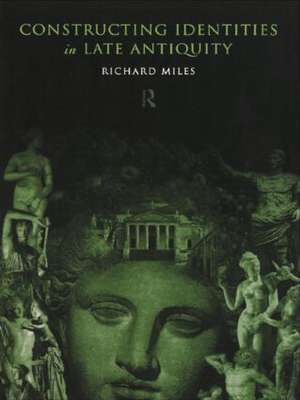
Constructing Identities in Late Antiquity
Editat de Richard Milesen Limba Engleză Paperback – 15 aug 2014
Preț: 452.16 lei
Preț vechi: 531.96 lei
-15%
Puncte Express: 678
Carte tipărită la comandă
Livrare economică 04-18 decembrie
Livrare prin curier în România Termenul estimat este afișat lângă disponibilitate.
Transport gratuit pentru acest produs Plată online sau ramburs, în funcție de opțiunile comenzii.
Retur gratuit în 14 zile Comandă securizată și suport în română.
Specificații
ISBN-13: 9780415518864
ISBN-10: 0415518865
Pagini: 272
Dimensiuni: 138 x 216 x 15 mm
Greutate: 0.32 kg
Ediția:1
Editura: Taylor & Francis
Colecția Routledge
Locul publicării:Oxford, United Kingdom
ISBN-10: 0415518865
Pagini: 272
Dimensiuni: 138 x 216 x 15 mm
Greutate: 0.32 kg
Ediția:1
Editura: Taylor & Francis
Colecția Routledge
Locul publicării:Oxford, United Kingdom
V-ar putea interesa
-
 Carthage Must Be DestroyedRichard Miles-18%Preț: 100.89 lei123.12 lei
 -
 Law and Family in Late Antiquity: The Emperor Constantine's Marriage LegislationJudith Evans Grubbs-34%Preț: 653.32 lei983.97 lei
 -
 Rethinking the MediterraneanW. V. Harris-28%Preț: 474.50 lei660.84 lei
 -
 -29%Preț: 511.04 lei714.82 lei
 -
 -31%Preț: 548.52 lei791.43 lei
 -
 Pyrrho, his Antecedents, and his LegacyRichard Bett-29%Preț: 496.57 lei695.48 lei
 -
 -32%Preț: 635.94 lei941.10 lei
 -
 Ancient WorldsRichard MilesPreț: 124.53 lei
 -
 HeraklesEmma StaffordPreț: 372.83 lei
 -
 The Palaeolithic Origins of Human BurialPaul PettittPreț: 382.93 lei
 -
 The Women of Pliny's LettersJoann Shelton-18%Preț: 1131.56 lei1379.95 lei
 -
 Greece in the Making 1200-479 BCRobin OsbornePreț: 452.05 lei
 -
 Readings in Late Antiquity: A SourcebookMichael Maas-15%Preț: 448.38 lei527.52 lei
 -
 Preț: 407.17 lei
 -
 Preț: 196.45 lei
 -
 Encyclopedia of Ancient GreeceNigel Wilson-15%Preț: 604.37 lei711.03 lei
 -
 Attila The HunChristopher KellyPreț: 113.94 lei
Notă biografică
Richard Miles is a Research Fellow in Classical Studies at the Open University, and a Teaching By-Fellow and Director of Studies in Classics at Churchill College, Cambridge. He is currently working on a book on text and authority in the late antique North African church.
Cuprins
1 Introduction: constructing identities in late antiquity 2 The writes of passage: cultural initiation in Heliodorus’ Aethiopica 3 Gender and identity in Musaeus’ Hero and Leander 4 Prudentius’ Psychomachia: the Christian arena and the politics of display 5 Dramatic identities: tragedy in late antiquity 6 Translate into Greek: Porphyry of Tyre on the new barbarians 7 Autobiographical identity and philosophical past in Augustine’s dialogue De Libero Arbitrio 8 The destruction of statues in late antiquity 9 Women and learning: gender and identity in scenes of intellectual life on late Roman sarcophagi 10 Constructing the judge: judicial accountability and the culture of criticism in late antiquity 11 The barbarian in late antiquity: image, reality, and transformation
Descriere
Examines the theme of identity: geographic, ethnic , religious, status and sex-based. Discussions of Roman texts and images show how constructions of identity and culture contributed to the creation of "late antiquity" as a historical concept.