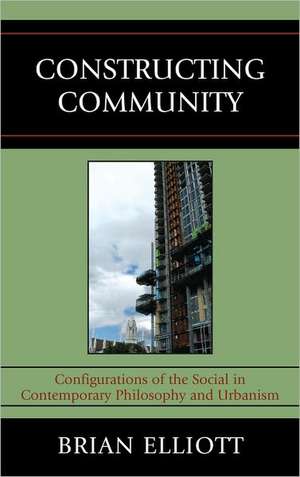
Constructing Community: Configurations of the Social in Contemporary Philosophy and Urbanism
Autor Brian Elliotten Limba Engleză Hardback – 20 aug 2010
Preț: 566.36 lei
Preț vechi: 854.77 lei
-34%
Puncte Express: 850
Preț estimativ în valută:
100.23€ • 117.14$ • 87.02£
100.23€ • 117.14$ • 87.02£
Carte tipărită la comandă
Livrare economică 19 februarie-05 martie
Preluare comenzi: 021 569.72.76
Specificații
ISBN-13: 9780739139660
ISBN-10: 0739139665
Pagini: 165
Ilustrații: black & white illustrations, figures
Dimensiuni: 168 x 246 x 16 mm
Greutate: 0.43 kg
Editura: Bloomsbury Publishing
Colecția Lexington Books
Locul publicării:New York, United States
ISBN-10: 0739139665
Pagini: 165
Ilustrații: black & white illustrations, figures
Dimensiuni: 168 x 246 x 16 mm
Greutate: 0.43 kg
Editura: Bloomsbury Publishing
Colecția Lexington Books
Locul publicării:New York, United States
V-ar putea interesa
-
 Marxism and the CityIra Katznelson-34%Preț: 644.94 lei979.40 lei
 -
 LeadvilleEdward Platt-24%Preț: 67.95 lei89.69 lei
 -
 Triumph of the CityEdward Glaeser-44%Preț: 49.57 lei89.03 lei
 -
 Urban World/Global CityDavid Clark-21%Preț: 254.25 lei320.77 lei
 -
 Benjamin for ArchitectsBrian Elliott-27%Preț: 191.31 lei263.49 lei
 -
 -23%Preț: 475.06 lei616.96 lei
 -
 Campbell BunkJerry WhitePreț: 137.57 lei
 -
 Urban OutcastsLoic (University of California at Berkeley) WacquantPreț: 154.02 lei
 -
 The SAGE Companion to the CityTimothy Hall-15%Preț: 464.05 lei545.93 lei
 -
 Spaces for ConsumptionSteven MilesPreț: 446.90 lei
 -
 Readings in Urban Theory 3eS Fainstein-23%Preț: 425.50 lei552.59 lei
 -
 Cultures and Globalization: Cities, Cultural Policy and GovernanceHelmut K. Anheier-15%Preț: 561.42 lei660.49 lei
 -
 The Cultures of CitiesS ZukinPreț: 457.99 lei
 -
 ThirdspaceEdward W. SojaPreț: 310.15 lei
Cuprins
Part 1 Introduction
Part 2 I. Part One. Theories of Community
Chapter 3 1. Habermas and Dialogical Community
Chapter 4 2. Singular Community
Chapter 5 3. Dissenting Community
Part 6 II. Urbanism and Community
Chapter 7 4. New Urbanism
Chapter 8 5. Postmodern Urbanism
Chapter 9 6. Dialectical Utopianism
Part 10 Bibliography
Part 2 I. Part One. Theories of Community
Chapter 3 1. Habermas and Dialogical Community
Chapter 4 2. Singular Community
Chapter 5 3. Dissenting Community
Part 6 II. Urbanism and Community
Chapter 7 4. New Urbanism
Chapter 8 5. Postmodern Urbanism
Chapter 9 6. Dialectical Utopianism
Part 10 Bibliography
Recenzii
Constructing Community presents a compelling argument about the nature and prospects of urban communities. First, Brian Elliott provides a general account of the self-organization of dissenting, or resisting, localized communities. His approach combines key aspects of "dialogical" (Habermas) and "singular" (Agamben/Nancy) conceptions of social formation. Applying this model to cities like Portland, Oregon, he explains why "New Urbanists" and "postmodern urbanists" run into problems analogous to those faced by theorists of community. He defends a version of dialectical utopianism that is sensitive to both the communicative power of discourse and the exigencies of bare life. Much as Benjamin taught us to think of Paris as the capital of the nineteenth century, Elliott invites us to imagine a dialectically utopian Portland as the capital of the twenty-first.
Following an exposure of weaknesses that he detects in a variety of post-Habermasian conceptions of the just community, Brian Elliott supports his alternative conception with detailed descriptions of grassroots urban movements demonstrating that traditional liberal rights productive of identity and consensus demand supplementation by a right to a space that is productive of dissent and direct action. His case is presented with cool passion, breadth of vision, and dazzling forensic skill.
Following an exposure of weaknesses that he detects in a variety of post-Habermasian conceptions of the just community, Brian Elliott supports his alternative conception with detailed descriptions of grassroots urban movements demonstrating that traditional liberal rights productive of identity and consensus demand supplementation by a right to a space that is productive of dissent and direct action. His case is presented with cool passion, breadth of vision, and dazzling forensic skill.