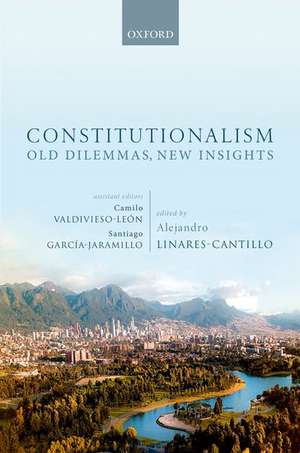
Constitutionalism: Old Dilemmas, New Insights
Editat de Alejandro Linares Cantillo Camilo Valdivieso-León, Santiago García-Jaramilloen Limba Engleză Hardback – 11 mar 2021
Majoritatea juriștilor consideră că o constituție este un set rigid de reguli menit să protejeze democrația prin stabilitate imuabilă. Volumul Constitutionalism, editat de Alejandro Linares Cantillo, Camilo Valdivieso-León și Santiago García-Jaramillo, provoacă această premisă, demonstrând că vitalitatea ordinii constituționale rezidă tocmai în tensiunea dintre 'vechile dileme' și dinamismul interpretării judiciare. Apreciem modul în care lucrarea refuză să trateze dreptul constituțional ca pe o disciplină izolată, transformând-o într-un dialog viu între filosofi și cercetători empirici.
Abordarea diferă de Democratizing Constitutional Law de Thomas Bustamante prin faptul că este mai puțin abstractă și mult mai aplicabilă, ancorând dezbaterea teoretică în realitățile sud-americane și globale, nu doar în scepticismul filosofic față de controlul judiciar. Remarcăm structura riguroasă a celor 20 de eseuri: după o introducere conceptuală, volumul analizează rolul curților în democrațiile moderne — unde autori precum Andrei Marmor explorează relația dintre liberalism și democrație — pentru ca apoi să treacă spre secțiunea 'New Insights'. Aici, cititorul va învăța despre mecanismele complexe ale amendamentelor neconstituționale și despre modul în care tribunalele acționează ca garanți împotriva regresului democratic.
Merită menționat că această lucrare, publicată de OUP Oxford, reușește să integreze experiența columbiană într-un cadru universal. Spre deosebire de Constitutionalism in Context, care utilizează studii de caz modulare, acest volum construiește o progresie logică de la fundamentele 'Hercules la răscruce' până la probleme contemporane precum limitele mandatelor prezidențiale și dreptul internațional. Este o resursă esențială pentru a înțelege cum dreptul comparat poate oferi soluții la crizele instituționale actuale.
Preț: 874.03 lei
Preț vechi: 1294.12 lei
-32%
Carte disponibilă
Livrare economică 13-24 noiembrie
Specificații
ISBN-10: 019289675X
Pagini: 496
Dimensiuni: 162 x 241 x 33 mm
Greutate: 0.86 kg
Editura: OUP OXFORD
Colecția OUP Oxford
Locul publicării:Oxford, United Kingdom
V-ar putea interesa
-
 -30%Preț: 649.92 lei928.12 lei
 -
 The Oxford Handbook of Comparative LawMathias Reimann-32%Preț: 1468.16 lei2150.13 lei
 -
 The Indian Yearbook of Comparative Law 2016Mahendra Pal Singh-29%Preț: 366.28 lei518.11 lei
 -
 Law and the Limits of ReasonAdrian Vermeule-27%Preț: 403.46 lei555.97 lei
 -
 Judiciaries in Comparative PerspectiveH. P. Lee-14%Preț: 1130.95 lei1315.05 lei
 -
 Russian Culture, Property Rights, and the Market EconomyUriel ProcacciaPreț: 308.91 lei
 -
 Religion-State Relations in the United States and GermanyClaudia E. Haupt-14%Preț: 790.10 lei918.72 lei
 -
 Constituting EqualitySusan H. WilliamsPreț: 394.82 lei
 -
 Legal Reform and Administrative Detention Powers in ChinaSarah BiddulphPreț: 433.58 lei
 -
 Preț: 339.24 lei
 -
 Audio-Visual Coverage of CourtsDaniel StepniakPreț: 357.34 lei
 -
 European Constitutional Courts and Transitions to DemocracyFrancesco Biagi-14%Preț: 795.14 lei924.57 lei
 -
 Comparative Religious LawNorman DoePreț: 348.74 lei
 -
 Der spanische MaklervertragMarcus Iske-23%Preț: 422.89 lei549.21 lei
 -
 Gerechte Steuerentlastungen der VerbrauchsteuerWen-Chin ChenPreț: 495.65 lei
 -
 Der Bahnhof als öffentliches ForumLivia FengerPreț: 445.92 lei
De ce să citești această carte
Această carte se adresează specialiștilor în drept constituțional și științe politice care caută o perspectivă globală, nu doar eurocentrică. Cititorul câștigă acces la analizele unor experți de renume despre modul în care curțile pot proteja democrația în fața populismului. Este un instrument teoretic robust pentru a înțelege limitele amendării constituțiilor și rolul activist al tribunalelor în apărarea drepturilor socio-economice.
Despre autor
Volumul este coordonat de o echipă editorială de elită, condusă de Alejandro Linares Cantillo, figură proeminentă în peisajul juridic columbian, alături de Camilo Valdivieso-León și Santiago García-Jaramillo. Aceștia au reunit voci fundamentale ale teoriei dreptului contemporan pentru a marca a XIII-a Conferință Academică a Curții Constituționale a Columbiei. Expertiza lor colectivă facilitează o sinteză rară între rigoarea academică a 'Nordului Global' și experiența practică, adesea inovatoare, a jurisdicțiilor din 'Sudul Global', oferind o perspectivă integrată asupra viitorului constituționalismului.
Descriere
Notă biografică
Cuprins
- I. INTRODUCTION
- II. THE ROLE OF CONSTITUTIONAL COURTS IN MODERN DEMOCRACIES
- Hercules at the Crossroads
- 1.: Andrei Marmor: Constitutionalism, Liberalism, and Democracy
- 2.: Wilfrid Waluchow: The Misconceived Quest for the Elusive Right Answer, or Dedication to a Process, Not a Result
- 3.: Roberto Gargarella: Dialogic constitutionalism in defective democracies
- 4.: Mario Cajas-Sarria: From the Public Action of Unconstitutionality of 1910 to the Constitutional Court of 1991: The political and legal struggles for Constitutional Justice in Colombia
- III. NEW INSIGHTS
- A) We the People or We the Judges: The Judicial Enforcement of Unconstitutional Constitutional Amendments
- 5.: Samuel Issacharoff: Courts as Guarantors of Democracy
- 6.: Tom Ginsburg: The Machinery of International Law and Democratic Backsliding: The Problem of Term Limit
- 7.: Yaniv Roznai: The Straw that Broke the Constitution's Back? Qualitative Quantity in Judicial Review of Constitutional Amendments
- 8.: Andrea Celemin: Between the Explicit and Implicit Limits? An Analysis of Judicial Review of the Constitutional Amendment Doctrine in Colombia
- B) A Struggle for Equality or Judges as policy makers: The Judicial Enforcement of Socio-Economic Rights
- 9.: Axel Tschentscher: Constitutional Rights Without the Notion of Optimization: Limiting Judicial Activism in the Realm of Social and Economic Rights
- 10.: Octavio Luis Motta-Ferraz: To Interfere or Not to Interfere? The Court's Dilemma in Social Rights' Enforcement
- 11.: David Bilchitz: How can Rights Be Individuated?
- 12.: David Landau: The Colombian Model of Structural Socioeconomic Rights Remedies: Lessons from and for Comparative Experience
- C) Courts as Mediators or Courts Setting the Ultimate Standard of Fairness: Transitional Justice
- 13.: David Dyzenhaus and Alma Diamond: The Resilient Constitution
- 14.: Colleen Murphy: Judging the Justice of the Colombian Final Agreement
- 15.: Juana I. Acosta-López and Cindy Vanessa Espitia-Murcia: The transitional justice model in Colombia vis-à-vis the Inter-American Human Rights System: Amidst the conventionality control and the national margin of appreciation
- 16.: Diana Acosta-Navas: Righting Wrong or Wronging Rights? An Ethical Perspective on the Colombian Integrated System for Transitional Justice
- IV. THE ROLE OF INTERNATIONAL, COMPARATIVE AND FOREIGN LAW IN DOMESTIC CONSTITUTIONAL LAW: DIALOGUE AMONG THE GLOBAL SOUTH
- The Use of Foreign Precedents, a 'Global South' monologue or a conversation among equals
- 17.: Muna Ndulo: International and Foreign Law in Domestic Constitutional Law: A Comparative Examination of the Practice in United States and Post Conflict Countries
- 18.: Mitchell Lasser: The Inter-Institutional Dimension of the Fundamental Rights Revolution: The Colombian-American Implications of the Franco-European Experience
- 19.: Marie-Christine Fuchs: The Changing role and reception of international law in domestic constitutional law: Some Thoughts about Latin America and Europe
- 20.: Carlos Arévalo and Julián Huertas: Not so Moderate: The Relationship Between the Colombian Legal System and International Law