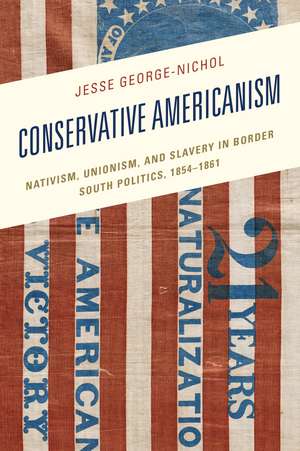
Conservative Americanism: Nativism, Unionism, and Slavery in Border South Politics, 1854–1861: New Studies in Southern History
Autor Jesse George-Nicholen Limba Engleză Hardback – 11 dec 2024






Preț: 648.31 lei
Preț vechi: 959.87 lei
-32%
Puncte Express: 972
Carte tipărită la comandă
Livrare economică 07-21 decembrie
Livrare prin curier în România Termenul estimat este afișat lângă disponibilitate.
Transport gratuit pentru acest produs Plată online sau ramburs, în funcție de opțiunile comenzii.
Retur gratuit în 14 zile Comandă securizată și suport în română.
Specificații
ISBN-13: 9781666923339
ISBN-10: 1666923338
Pagini: 314
Ilustrații: 7 BW Photos
Dimensiuni: 160 x 232 x 26 mm
Greutate: 0.59 kg
Editura: Bloomsbury Publishing
Colecția Lexington Books
Seria New Studies in Southern History
Locul publicării:New York, United States
ISBN-10: 1666923338
Pagini: 314
Ilustrații: 7 BW Photos
Dimensiuni: 160 x 232 x 26 mm
Greutate: 0.59 kg
Editura: Bloomsbury Publishing
Colecția Lexington Books
Seria New Studies in Southern History
Locul publicării:New York, United States
Cuprins
Acknowledgments
Introduction
Chapter 1: The Rise of Conservative Americanism, 1854?1855
Chapter 2: Slavery and the National American Party, Summer 1855
Chapter 3: A Conservative American Party, 1855?1856
Chapter 4: The Election of 1856
Chapter 5: Political Realignment, 1857?1859
Chapter 6: The Constitutional Union Party
Chapter 7: Compromise and the Secession Crisis
Conclusion
Bibliography
About the Author
Introduction
Chapter 1: The Rise of Conservative Americanism, 1854?1855
Chapter 2: Slavery and the National American Party, Summer 1855
Chapter 3: A Conservative American Party, 1855?1856
Chapter 4: The Election of 1856
Chapter 5: Political Realignment, 1857?1859
Chapter 6: The Constitutional Union Party
Chapter 7: Compromise and the Secession Crisis
Conclusion
Bibliography
About the Author
Recenzii
Conservative Americanism proves to be an excellent work, documenting the role of nativist arguments in the pursuit of compromise during the tumultuous period of the sectional crisis.
With its in-depth coverage of the border South's search for a middle ground in a time of mounting catastrophe, Conservative Americanism is first-class political history on a subject too little done, written with clarity, a fair amount of verve, and the most prodigious research.
George-Nichol's tight chronological and regional focus pays multiple dividends, helping make this a strong contribution to the growing literature on late antebellum conservatism. Her organizing concept of Conservative Americanism also lends a welcome precision to her discussion of a terribly important but often underrated group, Border South Unionists.
This welcome book by a promising young scholar breathes life into a heretofore overlooked political movement that surfaced during the mid-1850s. Alarmed by the increasingly fractious North-South impasse and by the surge of foreign immigration, promoters of 'Conservative Americanism' decided that radical refugees from the failed European revolutions of 1848 threatened to intensify the dangerous antislavery movement. The Conservative American political coalition showed promise in the Upper South, but never commanded enough support to become a national force. Kentucky Senator John J. Crittenden emerges as the most memorable character in Jesse George-Nichol's resurrection of an alternate universe, where reason and compromise prevailed over the passionate polarization that led to the Civil War.
In our current political crisis over minoritarian extremism, Jesse George-Nichol has offered a timely window into an earlier American reckoning, when moderate proslavery 'conservatives' from the Border South proved unable to convince other proslavery Americans, southern and northern, to compromise in defense of the Union against what they believed was the nation's greatest threat: egalitarian radicalism. As both irony and cautionary tale, Conservative Americanism is the best kind of political history.
In this engrossing and much-needed study of Southern Unionism in the Civil War era, Jesse George-Nichol shows the close connections between nineteenth-century conservatism and fears of foreign influence. Key to this history is the Know Nothing Party, typically seen as a northern phenomenon, that attracted Southern moderates who defined American democracy in opposition to the tumultuous politics of Europe. Told through compelling portraits of six prominent slave-state Unionists, Conservative Americanism provides fresh insights into the South's troubled path to secession and the civil war.
With its in-depth coverage of the border South's search for a middle ground in a time of mounting catastrophe, Conservative Americanism is first-class political history on a subject too little done, written with clarity, a fair amount of verve, and the most prodigious research.
George-Nichol's tight chronological and regional focus pays multiple dividends, helping make this a strong contribution to the growing literature on late antebellum conservatism. Her organizing concept of Conservative Americanism also lends a welcome precision to her discussion of a terribly important but often underrated group, Border South Unionists.
This welcome book by a promising young scholar breathes life into a heretofore overlooked political movement that surfaced during the mid-1850s. Alarmed by the increasingly fractious North-South impasse and by the surge of foreign immigration, promoters of 'Conservative Americanism' decided that radical refugees from the failed European revolutions of 1848 threatened to intensify the dangerous antislavery movement. The Conservative American political coalition showed promise in the Upper South, but never commanded enough support to become a national force. Kentucky Senator John J. Crittenden emerges as the most memorable character in Jesse George-Nichol's resurrection of an alternate universe, where reason and compromise prevailed over the passionate polarization that led to the Civil War.
In our current political crisis over minoritarian extremism, Jesse George-Nichol has offered a timely window into an earlier American reckoning, when moderate proslavery 'conservatives' from the Border South proved unable to convince other proslavery Americans, southern and northern, to compromise in defense of the Union against what they believed was the nation's greatest threat: egalitarian radicalism. As both irony and cautionary tale, Conservative Americanism is the best kind of political history.
In this engrossing and much-needed study of Southern Unionism in the Civil War era, Jesse George-Nichol shows the close connections between nineteenth-century conservatism and fears of foreign influence. Key to this history is the Know Nothing Party, typically seen as a northern phenomenon, that attracted Southern moderates who defined American democracy in opposition to the tumultuous politics of Europe. Told through compelling portraits of six prominent slave-state Unionists, Conservative Americanism provides fresh insights into the South's troubled path to secession and the civil war.