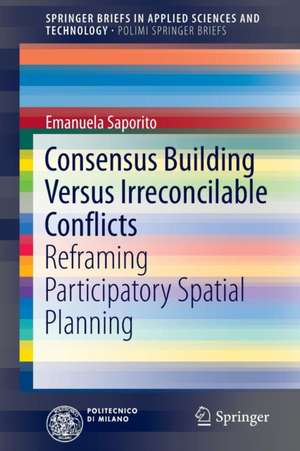
Consensus Building Versus Irreconcilable Conflicts: SpringerBriefs in Applied Sciences and Technology
Autor Emanuela Saporitoen Limba Engleză Paperback – iul 2016
Din seria SpringerBriefs in Applied Sciences and Technology
-
 Preț: 312.71 lei
 -
 Preț: 379.02 lei
 - 20%
 Preț: 326.97 lei
 -
 Preț: 378.77 lei
 -
 Preț: 470.50 lei
 -
 Preț: 382.08 lei
 -
 Preț: 429.04 lei
 -
 Preț: 382.68 lei
 -
 Preț: 380.26 lei
 - 20%
 Preț: 324.90 lei
 -
 Preț: 336.26 lei
 -
 Preț: 393.96 lei
 -
 Preț: 334.91 lei
 -
 Preț: 262.20 lei
 -
 Preț: 334.09 lei
 -
 Preț: 265.02 lei
 -
 Preț: 383.67 lei
 -
 Preț: 382.68 lei
 -
 Preț: 379.58 lei
 -
 Preț: 461.36 lei
 - 20%
 Preț: 226.91 lei
 -
 Preț: 363.26 lei
 -
 Preț: 385.41 lei
 -
 Preț: 391.30 lei
 -
 Preț: 396.35 lei
 -
 Preț: 332.21 lei
 -
 Preț: 379.88 lei
 -
 Preț: 251.49 lei
 -
 Preț: 330.32 lei
 - 5%
 Preț: 354.23 lei
 -
 Preț: 398.15 lei
 -
 Preț: 334.09 lei
 -
 Preț: 366.64 lei
 - 20%
 Preț: 286.05 lei
 -
 Preț: 333.81 lei
 -
 Preț: 378.48 lei
 -
 Preț: 382.08 lei
 -
 Preț: 369.31 lei
 -
 Preț: 333.28 lei
 -
 Preț: 381.54 lei
 -
 Preț: 400.85 lei
 -
 Preț: 379.88 lei
 -
 Preț: 378.48 lei
 -
 Preț: 379.31 lei
 - 20%
 Preț: 314.65 lei
 - 20%
 Preț: 326.02 lei
 -
 Preț: 413.73 lei
 -
 Preț: 368.70 lei
 - 15%
 Preț: 476.02 lei
 -
 Preț: 376.86 lei
Preț: 365.99 lei
Puncte Express: 549
Carte tipărită la comandă
Livrare economică 03-17 decembrie
Livrare prin curier în România Termenul estimat este afișat lângă disponibilitate.
Transport gratuit de la 400.00 lei Plată online sau ramburs, în funcție de opțiunile comenzii.
Retur gratuit în 14 zile Comandă securizată și suport în română.
Specificații
ISBN-13: 9783319308272
ISBN-10: 3319308270
Pagini: 124
Ilustrații: XV, 105 p. 6 illus.
Dimensiuni: 155 x 235 x 8 mm
Greutate: 0.2 kg
Ediția:1st edition 2016
Editura: Springer
Colecția SpringerBriefs in Applied Sciences and Technology
Seria SpringerBriefs in Applied Sciences and Technology
Locul publicării:Cham, Switzerland
ISBN-10: 3319308270
Pagini: 124
Ilustrații: XV, 105 p. 6 illus.
Dimensiuni: 155 x 235 x 8 mm
Greutate: 0.2 kg
Ediția:1st edition 2016
Editura: Springer
Colecția SpringerBriefs in Applied Sciences and Technology
Seria SpringerBriefs in Applied Sciences and Technology
Locul publicării:Cham, Switzerland
V-ar putea interesa
-
 -34%Preț: 714.29 lei1078.01 lei
 -
 Wild SardiniaTracey HeatheringtonPreț: 254.09 lei
 -
 The Hidden DimensionEdward T. HallPreț: 92.92 lei
 -
 -15%Preț: 486.91 lei572.84 lei
 -
 Space, Knowledge and Power: Foucault and GeographyStuart EldenPreț: 430.58 lei
 -
 Preț: 424.97 lei
 -
 Key Concepts in PlanningGavin ParkerPreț: 382.55 lei
 -
 Creative Industry DistrictsJinliao He-15%Preț: 665.01 lei782.36 lei
 -
 -18%Preț: 5736.76 lei6996.04 lei
Cuprins
New challenges for participatory approaches in spatial planning.- Looking for a way out: three groups of theories.- the controversial story of PII Isola in Milan.- What happened in practice? Looking inside "black boxes".- How to reframe participative spatial planning: some critical reflections.- Index.
Caracteristici
Compares three principal theoretical models of participation in urban planning processes Presents a case study, the Integrated Intervention Program PII Isola Lunetta in Milan, to investigate model performance in the field Includes numerous excerpts from interviews with expert witnesses (Susan Fainstein, Larry Suskind, etc.) Includes supplementary material: sn.pub/extras