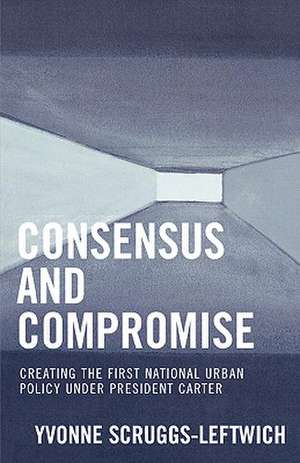
Consensus and Compromise: Creating the First National Urban Policy under President Carter
Autor Yvonne Scruggs-Leftwichen Limba Engleză Paperback – 23 feb 2006
Preț: 335.11 lei
Preț vechi: 486.86 lei
-31%
Puncte Express: 503
Preț estimativ în valută:
59.35€ • 69.31$ • 51.55£
59.35€ • 69.31$ • 51.55£
Carte tipărită la comandă
Livrare economică 21 februarie-07 martie
Preluare comenzi: 021 569.72.76
Specificații
ISBN-13: 9780761833550
ISBN-10: 0761833552
Pagini: 269
Dimensiuni: 182 x 215 x 23 mm
Greutate: 0.39 kg
Editura: Bloomsbury Publishing
Colecția University Press of America
Locul publicării:New York, United States
ISBN-10: 0761833552
Pagini: 269
Dimensiuni: 182 x 215 x 23 mm
Greutate: 0.39 kg
Editura: Bloomsbury Publishing
Colecția University Press of America
Locul publicării:New York, United States
Recenzii
This book should be read by all with an interest in and passion for Urban America. It is historic, instructive, and inspiring...
Urban policy makers, scholars, and advocates for the truly disadvantaged had better absorb the wise, candid, and pragmatic insights of Yvonne Scruggs-Leftwich on the evolution of President Carter's national urban policy. The mind boggling insider turf battles among Democrats in the creation of that policy are not unrelated to America's failures at solving the continuing dilemmas of poverty, race, inequality, class warfare by the rich, and loss of "soft power" abroad. The federal government's immoral blunders in New Orleans before and after Hurrican Katrina illustrate the continuing failures of America's military-industrial complex ruling elite to repair and rebuild decaying urban education, security, and other public infrastructure. There has been no coherent urban policy since President Carter. Why?
In recent years, many of America' major cities have been struggling with the endemic problems of a loss of jobs, violent crime, a lack of social services, and the spread of blight. A strong, strategic national urban policy would be critical in helping communities to address these challenges, but unfortunately, under the current Administration such a policy does not seem to exist.
In 1967, when 85 American cities were in flames and the stability that business as usual requires was fundamentally threatened, leaders of the governmental, business, labor, civil rights and faith sectors met to found the National Urban Coalition, and to study cities for the first time. They prayed together and vowed to persist until the root causes of urban unrest were cured. Yet it was not until President Jimmy Carter's Secretary of Housing and Urban Development Patrica Roberts Harris, appointed Dr.Yvonne (Perry) Scruggs-Leftwich Executive Director of the President's Urban and Regional Policy Group (URPG), and they together produced the first formal national urban policy in 1978, that a coherent approach to the problems of America' cities was articulated.Consensus and Compromise chronicles this centrally important process. It is must reading for all who respect the true domestic history of the United States in the 20th Century..
Urban policy makers, scholars, and advocates for the truly disadvantaged had better absorb the wise, candid, and pragmatic insights of Yvonne Scruggs-Leftwich on the evolution of President Carter's national urban policy. The mind boggling insider turf battles among Democrats in the creation of that policy are not unrelated to America's failures at solving the continuing dilemmas of poverty, race, inequality, class warfare by the rich, and loss of "soft power" abroad. The federal government's immoral blunders in New Orleans before and after Hurrican Katrina illustrate the continuing failures of America's military-industrial complex ruling elite to repair and rebuild decaying urban education, security, and other public infrastructure. There has been no coherent urban policy since President Carter. Why?
In recent years, many of America' major cities have been struggling with the endemic problems of a loss of jobs, violent crime, a lack of social services, and the spread of blight. A strong, strategic national urban policy would be critical in helping communities to address these challenges, but unfortunately, under the current Administration such a policy does not seem to exist.
In 1967, when 85 American cities were in flames and the stability that business as usual requires was fundamentally threatened, leaders of the governmental, business, labor, civil rights and faith sectors met to found the National Urban Coalition, and to study cities for the first time. They prayed together and vowed to persist until the root causes of urban unrest were cured. Yet it was not until President Jimmy Carter's Secretary of Housing and Urban Development Patrica Roberts Harris, appointed Dr.Yvonne (Perry) Scruggs-Leftwich Executive Director of the President's Urban and Regional Policy Group (URPG), and they together produced the first formal national urban policy in 1978, that a coherent approach to the problems of America' cities was articulated.Consensus and Compromise chronicles this centrally important process. It is must reading for all who respect the true domestic history of the United States in the 20th Century..