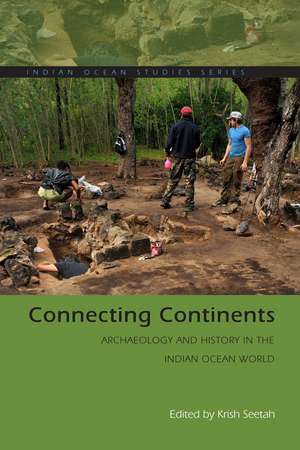
Connecting Continents: Archaeology and History in the Indian Ocean World: Indian Ocean Studies Series
Editat de Krish Seetahen Limba Engleză Hardback – 7 iun 2018
Winner, Society for American Archaeology Book Award
In recent decades, the vast and culturally diverse Indian Ocean region has increasingly attracted the attention of anthropologists, historians, political scientists, sociologists, and other researchers. Largely missing from this growing body of scholarship, however, are significant contributions by archaeologists and consciously interdisciplinary approaches to studying the region’s past and present.
Connecting Continents addresses two important issues: how best to promote collaborative research on the Indian Ocean world, and how to shape the research agenda for a region that has only recently begun to attract serious interest from historical archaeologists. The archaeologists, historians, and other scholars who have contributed to this volume tackle important topics such as the nature and dynamics of migration, colonization, and cultural syncretism that are central to understanding the human experience in the Indian Ocean basin.
This groundbreaking work also deepens our understanding of topics of increasing scholarly and popular interest, such as the ways in which people construct and understand their heritage and can make use of exciting new technologies like DNA and environmental analysis. Because it adopts such an explicitly comparative approach to the Indian Ocean, Connecting Continents provides a compelling model for multidisciplinary approaches to studying other parts of the globe.
Contributors: Richard B. Allen, Edward A. Alpers, Atholl Anderson, Nicole Boivin, Diego Calaon, Aaron Camens, Saša Čaval, Geoffrey Clark, Alison Crowther, Corinne Forest, Simon Haberle, Diana Heise, Mark Horton, Paul Lane, Martin Mhando, and Alistair Patterson.
In recent decades, the vast and culturally diverse Indian Ocean region has increasingly attracted the attention of anthropologists, historians, political scientists, sociologists, and other researchers. Largely missing from this growing body of scholarship, however, are significant contributions by archaeologists and consciously interdisciplinary approaches to studying the region’s past and present.
Connecting Continents addresses two important issues: how best to promote collaborative research on the Indian Ocean world, and how to shape the research agenda for a region that has only recently begun to attract serious interest from historical archaeologists. The archaeologists, historians, and other scholars who have contributed to this volume tackle important topics such as the nature and dynamics of migration, colonization, and cultural syncretism that are central to understanding the human experience in the Indian Ocean basin.
This groundbreaking work also deepens our understanding of topics of increasing scholarly and popular interest, such as the ways in which people construct and understand their heritage and can make use of exciting new technologies like DNA and environmental analysis. Because it adopts such an explicitly comparative approach to the Indian Ocean, Connecting Continents provides a compelling model for multidisciplinary approaches to studying other parts of the globe.
Contributors: Richard B. Allen, Edward A. Alpers, Atholl Anderson, Nicole Boivin, Diego Calaon, Aaron Camens, Saša Čaval, Geoffrey Clark, Alison Crowther, Corinne Forest, Simon Haberle, Diana Heise, Mark Horton, Paul Lane, Martin Mhando, and Alistair Patterson.



Preț: 606.04 lei
Preț vechi: 684.89 lei
-12%
Puncte Express: 909
Carte indisponibilă temporar
Doresc să fiu notificat când acest titlu va fi disponibil:
Se trimite...
Specificații
ISBN-13: 9780821423264
ISBN-10: 0821423266
Pagini: 428
Ilustrații: 23
Dimensiuni: 152 x 229 x 33 mm
Greutate: 0.79 kg
Editura: Ohio University Press
Colecția Ohio University Press
Seria Indian Ocean Studies Series
ISBN-10: 0821423266
Pagini: 428
Ilustrații: 23
Dimensiuni: 152 x 229 x 33 mm
Greutate: 0.79 kg
Editura: Ohio University Press
Colecția Ohio University Press
Seria Indian Ocean Studies Series
Recenzii
“The contributors do a superb job of situating the Indian Ocean within the most current discourses of historical archaeology, including, importantly, ways of broadening the field. The subject of the book is truly original and it makes a significant contribution to knowledge by its very presence.”—Charles E. Orser, author of Historical Archaeology
“Connecting Continents reviews and engages a tremendous range and depth of research, tacking largely between the history and archaeology (including bioarchaeology) of the Indian Ocean over the last two thousand years. The contributors display true intellectual generosity, and there is absolutely nothing else like it currently available.”—Adria LaViolette, co-editor of The Swahili World
Notă biografică
Krish Seetah, a native of Mauritius, is an environmental archaeologist and assistant professor of anthropology at Stanford University. Since 2008 he has directed the Mauritian Archaeology and Cultural Heritage (MACH) project.
Cuprins
Acknowledgments vii
Chapter 1 Interdisciplinary Ripples across the Indian Ocean
KRISH SEETAH AND RICHARD B. ALLEN
Chapter 2 Investigating Premodern Colonization of the Indian Ocean
The Remote Islands Enigma
ATHOLL ANDERSON, AARON CAMENS, GEOFFREY CLARK, AND SIMON HABERLE
Chapter 3 Facing Mecca from Africa
Islam and Globalization on the Swahili Coast during the First Millennium CE and Beyond
MARK HORTON, ALISON CROWTHER, AND NICOLE BOIVIN
Chapter 4 Researching the History of the Indian Ocean World
An Interdisciplinary Approach
EDWARD A. ALPERS
Chapter 5 History, Historical Archaeology, and the “History of Silence”
Forced and Free Labor Migration in the Indian Ocean, 1700–1900
RICHARD B. ALLEN
Chapter 6 The Archaeology of Colonial Encounters in Coastal East Africa
Recent Developments and Continuing Conceptual Challenges
PAUL J. LANE
Chapter 7 Historical Archaeology of Pearling in the Indian Ocean
Through the Lens of North West Australia
ALISTAIR PATERSON
Chapter 8 Interdisciplinarity as Image
At the Intersections of Historical, Heritage, and Media Approaches in the Indian Ocean World
DIANA HEISE AND MARTIN MHANDO
Chapter 9 Archaeology and Religious Syncretism in Mauritius
SAŠAČ AVAL
Chapter 10 Archaeology and the Process of Heritage
Construction in Mauritius
DIEGO CALAON AND CORINNE FOREST
Chapter 11 Climate and Disease in the Indian Ocean
An Interdisciplinary Study from Mauritius
KRISH SEETAH
Bibliography 317
Contributors 389
Index 397
Chapter 1 Interdisciplinary Ripples across the Indian Ocean
KRISH SEETAH AND RICHARD B. ALLEN
Chapter 2 Investigating Premodern Colonization of the Indian Ocean
The Remote Islands Enigma
ATHOLL ANDERSON, AARON CAMENS, GEOFFREY CLARK, AND SIMON HABERLE
Chapter 3 Facing Mecca from Africa
Islam and Globalization on the Swahili Coast during the First Millennium CE and Beyond
MARK HORTON, ALISON CROWTHER, AND NICOLE BOIVIN
Chapter 4 Researching the History of the Indian Ocean World
An Interdisciplinary Approach
EDWARD A. ALPERS
Chapter 5 History, Historical Archaeology, and the “History of Silence”
Forced and Free Labor Migration in the Indian Ocean, 1700–1900
RICHARD B. ALLEN
Chapter 6 The Archaeology of Colonial Encounters in Coastal East Africa
Recent Developments and Continuing Conceptual Challenges
PAUL J. LANE
Chapter 7 Historical Archaeology of Pearling in the Indian Ocean
Through the Lens of North West Australia
ALISTAIR PATERSON
Chapter 8 Interdisciplinarity as Image
At the Intersections of Historical, Heritage, and Media Approaches in the Indian Ocean World
DIANA HEISE AND MARTIN MHANDO
Chapter 9 Archaeology and Religious Syncretism in Mauritius
SAŠAČ AVAL
Chapter 10 Archaeology and the Process of Heritage
Construction in Mauritius
DIEGO CALAON AND CORINNE FOREST
Chapter 11 Climate and Disease in the Indian Ocean
An Interdisciplinary Study from Mauritius
KRISH SEETAH
Bibliography 317
Contributors 389
Index 397
Descriere
Connecting Continents addresses two issues: how to promote collaborative research, and how to shape the research agenda for a region only recently attracting serious interest from historical archaeologists exploring the dynamics of migration, colonization, and cultural syncretism central to understanding human experience in the Indian Ocean basin.