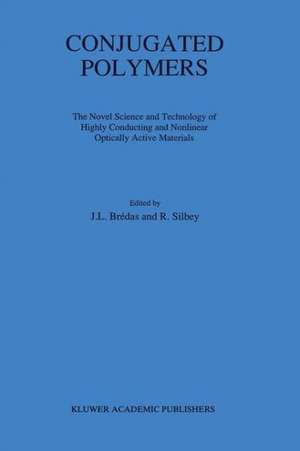
Conjugated Polymers
Editat de R. Silbey, J. L. Brédasen Limba Engleză Hardback – 30 sep 1991
Preț: 1222.23 lei
Preț vechi: 1608.20 lei
-24%
Puncte Express: 1833
Carte tipărită la comandă
Livrare economică 27 noiembrie-03 decembrie
Livrare prin curier în România Termenul estimat este afișat lângă disponibilitate.
Transport gratuit pentru acest produs Plată online sau ramburs, în funcție de opțiunile comenzii.
Retur gratuit în 14 zile Comandă securizată și suport în română.
Specificații
ISBN-13: 9780792314035
ISBN-10: 0792314034
Pagini: 648
Ilustrații: XVIII, 624 p.
Dimensiuni: 160 x 241 x 40 mm
Greutate: 1.08 kg
Ediția:1991
Editura: SPRINGER NETHERLANDS
Locul publicării:Dordrecht, Netherlands
ISBN-10: 0792314034
Pagini: 648
Ilustrații: XVIII, 624 p.
Dimensiuni: 160 x 241 x 40 mm
Greutate: 1.08 kg
Ediția:1991
Editura: SPRINGER NETHERLANDS
Locul publicării:Dordrecht, Netherlands
V-ar putea interesa
-
 Engineering PolymersR W Dyson-18%Preț: 1264.90 lei1542.57 lei
 -
 Silane Coupling AgentsEdwin P. Plueddemann-18%Preț: 1140.54 lei1390.90 lei
 -
 Thin Films: Preparation, Characterization, ApplicationsManuel P. Soriaga-18%Preț: 984.47 lei1200.58 lei
 -
 Plastics Processing Data HandbookD. V. Rosato-18%Preț: 1246.41 lei1520.01 lei
 -
 Polymer NetworksRobert F T Stepto-18%Preț: 1394.06 lei1700.08 lei
 -
 -18%Preț: 1278.03 lei1558.57 lei
 -
 Plastics SustainabilityAndrady-8%Preț: 668.25 lei726.36 lei
 -
 Polymers for PEM Fuel CellsHongting Pu-9%Preț: 1006.49 lei1106.04 lei
 -
 -9%Preț: 969.54 lei1065.43 lei
 -
 Macromolecular Self-assemblyBillon-9%Preț: 964.98 lei1060.42 lei
 -
 Metallocenes in Regio- and Stereoselective SynthesisTamotsu Takahashi-18%Preț: 1746.91 lei2130.37 lei
Public țintă
ResearchCuprins
Conjugated Polymers: The Interplay Between Synthesis, Structure, and Properties.- 1. Introduction.- 2. Structural Features of Conjugated Polymers.- 3. Polymer Synthesis: Basic Methods.- 4. Direct Synthetic Methods.- 5. Polymers from precursors.- 6. Extentions of these Methods in the Synthesis of “Small-Bandgap” Polymers.- 7. Conjugated Polymer Matrices.- 8. Conclusions and Caveats.- Acknowledgements.- References.- Properties of Highly Conducting Polyacetylene.- 1. Introduction.- 2. Sample Synthesis, Morphology and Properties.- 3. Conductivity: Experimental.- 4. Conductivity Measurements: Experimental Results.- 5. Discussion of ?(T).- 6. Morphology and Charge Transport.- 7. Conductivity Barriers and Morphology: a Comparison.- 8. Summary and Outlook.- Acknowledgements.- Literature.- Electronic Properties of Heavily Doped Trans-Polyacetylene.- 1. Introduction.- 2. Models for the Metallic State of Heavily Doped Trans-(CH)x.- 3. Methodology.- 4. Results and Discussion.- 5. Summary and Conclusion.- Acknowledgements.- References.- Solution Processing of Conducting Polymers: Opportunities for Science and Technology.- I. Introduction.- II. Conducting Polymers in Solution.- III. Electrical and Mechanical Properties of Oriented Poly(3-alkylthiophenes) Processed from Solution.- IV. Gels and Blends of the P3AT’s Processed from Solution.- V. Electrical and Mechanical Properties of Polyaniline and Blends of Polyaniline with PPTA Processed from Solution in Sulfuric Acid.- VI. Electrical and Mechanical Properties of PTV and PDMPV.- VII. Mechanical and Electrical Properties of Polyacetylene Films Oriented by Tensile Drawing.- VIII. Correlation between Electrical Conductivity and Mechanical Properties.- IX. Conclusion.- Acknowledgement.- References.- The Polyanilines: Model Systemsfor Diverse Electronic Phenomena.- 1. Introduction.- 2. Leucoemeraldine Base (LEB).- 3. Ring Rotation Polarons and Solitons.- 4. Emeraldine Base.- 5. Pernigraniline Base.- 6. “Metallic” Polyaniline.- 7. Effects of Derivitization.- 8. Summary.- 9. Acknowledgement.- 10. References.- Structural Characterization of Conjugated Polymer Solutions in the Undoped and Doped State.- 1. Introduction.- 2. Polymer Solutions.- References.- 3. Structural Studies with Small Angle Scattering.- References.- 4. Soluble Conjugated Polymers.- References.- 5. Polydiacetylenes.- References.- 6. Study of Dopable Polymers: PANI and Poly-n-Alkylthiophenes.- References.- 7. Does Conjugated Polymer Behave Like Saturated One.- Acknowledgement.- References.- Processable Conducting Poly(3-Alkylthiopenes).- 1. Introduction.- 2. Synthesis.- 3. Characterization.- 4. Processability-polymer Blends.- 5. Electronic Structure and Conformational Excitations.- 6. Doping and Stability.- 7. Transport Properties.- 8. Stretch Orientation of Poly(3-Alkylthiophenes).- 9. Applications.- 10. Conclusions.- Acknowledgements.- References.- Controlled Molecular Assemblies of Electrically Conductive Polymers.- 1. Introduction.- 2. Fabrication of Monolayer and Multilayer Thin Films of Electrically Conductive Polymers.- 3. Molecular and Supermolecular Organizations of LB Films Containing Conducting Polymers.- 4. Electrical Properties of LB Films Containing Conducting Polymers.- 5. Conclusions.- 6. Acknowledgements.- 7. References.- Electronic Properties of Linear Polyenes.- 1. Introduction.- 2. Terms and Concepts.- 3. Overview of Polyene Singlet States.- 4. Interpretative Model.- 5. The Ground State S0 (l1Ag).- 6. The Lowest Energy Excited Singlet State S1 (21Ag).- 7. The Strongly Allowed Excited Singlet State S2(11Bu).- 8. Concluding Remarks.- 9. Acknowledgement.- 10. References.- Vibrational Spectroscopy of Polyconjugated Aromatic Materials with Electrical and Non Linear Optical Properties - A Guided Tour.- 1. Introduction.- 2. Spectroscopy vs. Material Science.- 3. Spectroscopic Observables.- 4. The Vibrational Force Field. Classical vs. Quantum Mechanical Calculations.- 5. Spectroscopic Characteristics Peculiar to Poly-conjugated Materials.- 6. Theoretical Aspects of the Vibrational Spectra of Poly-conjugated Molecules.- 7. Worked-Out Study Cases.- 8. Polypyrrole.- 9. Polythiophene.- 10. Polyalkylthiophenes.- 11. Polyparaphenylene Vinylene.- 12. Conclusions.- Acknowledgement.- References.- Third Order Nonlinear Optical Effects in Conjugated Polymers.- 1. Introduction.- 2. Thin Film Preparation Methods.- 3. Principal x(3) Characterization Techniques.- 4. Frequency Spectrum and Resonance Effects in x(3).- 5. Multiphoton Resonances.- 6. Nonlinear Optical Dichroism.- 7. Perspectives of Applications.- References.- The Semiconductor Device Physics of Polyacetylene.- 1. Introduction.- 2. Electronic Excitations in Conjugated Polymers.- 3. Polymer Processing and Device Fabrication.- 4. Electronic Properties of Durham-Route Polyacetylene.- 5. Schottky Barrier Diodes.- 6. MIS Structures.- 7. MISFET Devices.- 8. General Discussion.- Acknowledgements.- References.
Recenzii
` The book ought to be compulsory reading for anybody proposing to work in the area and should be followed by a short exam before a `practitioners licence' is issued. '
Chemistry & Industry
'This book is a recommended addition to scientific libraries and to scientists interested in remaining abreast of recent advances....' Polymers News 17 1992
Chemistry & Industry
'This book is a recommended addition to scientific libraries and to scientists interested in remaining abreast of recent advances....' Polymers News 17 1992