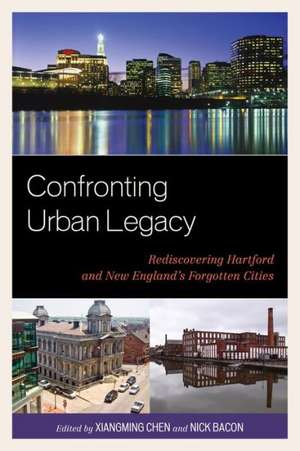
Confronting Urban Legacy: Rediscovering Hartford and New England's Forgotten Cities
Editat de Xiangming Chen, Nick Bacon Contribuţii de Llana Barber, Janet Bauer, Tom Condon, Jack Dougherty, James R. Gomes, Clyde McKee, Ezra Moser, Jason Rojas, Michael Sacks, John Shemo, Louise Simmons, Andrew Walsh, Lyle Wrayen Limba Engleză Paperback – 15 apr 2015
The myriad of dilemmas confronting Hartford calls for this book to take an interdisciplinary approach. The editors' introduction places Hartford in a global comparative perspective; Part I provides rich historical delineations of the many rises and (not quite) falls of Hartford; Part II offers a broad contemporary treatment of Hartford by dissecting recent immigration and examining the demographic and educational dimensions of the city-suburban divide; and Part III unpacks Hartford's current social, economic, and political situation and discusses what the city could become. Using the lessons from this book on Hartford and other underappreciated secondary cities in New England, urban scholars, leaders, and residents alike can gain a number of essential insights-both theoretical and practical.
Preț: 351.54 lei
Preț vechi: 469.74 lei
-25%
Puncte Express: 527
Carte tipărită la comandă
Livrare economică 06-20 noiembrie
Livrare prin curier în România Termenul estimat este afișat lângă disponibilitate.
Transport gratuit de la 400.00 lei Plată online sau ramburs, în funcție de opțiunile comenzii.
Retur gratuit în 14 zile Comandă securizată și suport în română.
Specificații
ISBN-13: 9780739149430
ISBN-10: 0739149431
Pagini: 324
Ilustrații: 12 b/w illustrations; 14 tables;
Dimensiuni: 152 x 229 x 25 mm
Greutate: 0.48 kg
Editura: Bloomsbury Publishing
Colecția Lexington Books
Locul publicării:New York, United States
ISBN-10: 0739149431
Pagini: 324
Ilustrații: 12 b/w illustrations; 14 tables;
Dimensiuni: 152 x 229 x 25 mm
Greutate: 0.48 kg
Editura: Bloomsbury Publishing
Colecția Lexington Books
Locul publicării:New York, United States
Cuprins
Prologue
Chapter 1: Introduction: Once Prosperous and Now Challenged: Hartford's Transformation in Comparative and Global Perspectives
Part 1: Urban Past and Present in New England
Chapter 2: Hartford: A Global History
Chapter 3: Podunk after Pratt: Place and Placelessness in East Hartford, Connecticut
Chapter 4: "If We Would.Leave the City, This Would Be a Ghost Town": Urban Crisis and Latino Migration in Lawrence, Massachusetts, 1945-2000
Part II: Social and Community Transformations
Chapter 5: Poverty, Inequality, Politics, and Social Activism in Hartford
Chapter 6: Investigating Spatial Inequality with the Cities, Suburbs, and Schools Project
Chapter 7: The Puerto Rican Effect on Hispanic Residential Segregation: Hartford and Springfield Metropolitan Areas in National Perspective
Chapter 8: A Metro Immigrant Gateway: Refugees in the Hartford Borderlands
Chapter 9: Re-Imagining Portland, Maine: Urban Renaissance and a Refugee Community
Part III: Renewing Hartford: Global and Regional Dynamics
Chapter 1: Introduction: Once Prosperous and Now Challenged: Hartford's Transformation in Comparative and Global Perspectives
Part 1: Urban Past and Present in New England
Chapter 2: Hartford: A Global History
Chapter 3: Podunk after Pratt: Place and Placelessness in East Hartford, Connecticut
Chapter 4: "If We Would.Leave the City, This Would Be a Ghost Town": Urban Crisis and Latino Migration in Lawrence, Massachusetts, 1945-2000
Part II: Social and Community Transformations
Chapter 5: Poverty, Inequality, Politics, and Social Activism in Hartford
Chapter 6: Investigating Spatial Inequality with the Cities, Suburbs, and Schools Project
Chapter 7: The Puerto Rican Effect on Hispanic Residential Segregation: Hartford and Springfield Metropolitan Areas in National Perspective
Chapter 8: A Metro Immigrant Gateway: Refugees in the Hartford Borderlands
Chapter 9: Re-Imagining Portland, Maine: Urban Renaissance and a Refugee Community
Part III: Renewing Hartford: Global and Regional Dynamics
Recenzii
Among urbanists, studies about megacities have been the prime agenda item in the research frontier. Not surprisingly, the literature on the world's largest cities is rich in number and coverage. However, there is a dearth of in-depth research about smaller cities considered to be second and third tier, and books on these smaller, lesser-known cities are few and far between. This book helps to fill that void by studying Hartford, Connecticut, and a couple of cities in other areas of New England. It is Hartford, however, that receives the most attention. Fifteen experts diffuse their experience on the region by mixing theory with applied practice, resulting in 14 very interesting chapters covering a wide range of topics, including the past, the present, and social, political, and economic issues. Not ignored is Hartford's position in the regional and global scene. Chapters examine the city's future potential with realistic conclusions, making it possible to gain an understanding of the city not previously available, particularly in a single volume. The rich bibliography found after each chapter can guide readers to greater insights. Maps, photographs, and tables complement the essays very well. Summing Up: Recommended. All academic levels/libraries.
Despite their global impact, so-called 'secondary cities' like Hartford have been largely overlooked in academic circles. Confronting Urban Legacy is a bold and welcome break from this tradition, focusing not only on these cities' own fortunes, but their context within the cultural and economic shifts of the past four centuries. Given the current challenges facing cities like Hartford, the content of this volume provides ample fuel for further research and public discussion on the twenty-first-century futures of cities like Hartford.
Chen and Bacon offer a provocative view of the sprawling New England conurbation, where 'not great' cities like Hartford, Springfield, and Portland form a regional Middletown for the twenty-first century. This region is thoroughly global and highly problematic, divided between poor cities and rich suburbs, ethnic groups representing the Caribbean, Africa, and the U.S. South, a shrinking industrial and white-collar economy and a growing non-profit sector. Here, in a microcosm, is urban society.
What is most striking about this latest book from Trinity's Center for Urban and Global Studies is the breadth of the offerings: the fascinating chapters that delve into the multi-faceted complexities of urban life as it has unfolded in Trinity's home city of Hartford over the last 400 years. The diverse range of authors includes not only well-established senior scholars but also a new generation of rising urbanists, including recent graduates of Trinity College who have added crucial insights on New England's vastly complicated and continuously changing urban environments.
Jane Jacobs famously wrote that the 'foundation of cities is trade.' I truly believe that in this century every city needs to understand its special position in the global economy and global networks, building from historic legacies and links. To this end, Chen and Bacon compile a rich and original set of research that positions Hartford and similar small New England cities firmly on the global stage. This is a great platform for rebirth and renewal.
Despite their global impact, so-called 'secondary cities' like Hartford have been largely overlooked in academic circles. Confronting Urban Legacy is a bold and welcome break from this tradition, focusing not only on these cities' own fortunes, but their context within the cultural and economic shifts of the past four centuries. Given the current challenges facing cities like Hartford, the content of this volume provides ample fuel for further research and public discussion on the twenty-first-century futures of cities like Hartford.
Chen and Bacon offer a provocative view of the sprawling New England conurbation, where 'not great' cities like Hartford, Springfield, and Portland form a regional Middletown for the twenty-first century. This region is thoroughly global and highly problematic, divided between poor cities and rich suburbs, ethnic groups representing the Caribbean, Africa, and the U.S. South, a shrinking industrial and white-collar economy and a growing non-profit sector. Here, in a microcosm, is urban society.
What is most striking about this latest book from Trinity's Center for Urban and Global Studies is the breadth of the offerings: the fascinating chapters that delve into the multi-faceted complexities of urban life as it has unfolded in Trinity's home city of Hartford over the last 400 years. The diverse range of authors includes not only well-established senior scholars but also a new generation of rising urbanists, including recent graduates of Trinity College who have added crucial insights on New England's vastly complicated and continuously changing urban environments.
Jane Jacobs famously wrote that the 'foundation of cities is trade.' I truly believe that in this century every city needs to understand its special position in the global economy and global networks, building from historic legacies and links. To this end, Chen and Bacon compile a rich and original set of research that positions Hartford and similar small New England cities firmly on the global stage. This is a great platform for rebirth and renewal.