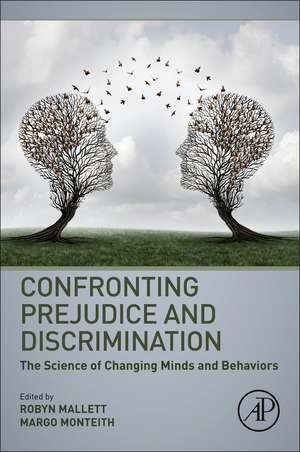
Confronting Prejudice and Discrimination: The Science of Changing Minds and Behaviors
Editat de Robyn K. Mallett, Margo J. Monteithen Limba Engleză Paperback – 15 mar 2019
- Addresses factors that determine individuals’ decisions to confront stereotyping, prejudice and discrimination
- Analyzes how personal and collective motives shape responses in confrontation-relevant situations
- Examines the consequences of confrontation from the perspectives of targets, perpetrators and bystanders
- Provides a roadmap for how to prepare for and engage in successful confrontations at the individual level
- Covers confronting bias in various settings including in schools, health care, the workplace and on the internet
- Discusses confrontation in the context of racism, sexism, sexual harassment and other forms of bias, including intersectional forms of bias
Preț: 520.30 lei
Preț vechi: 671.61 lei
-23%
Puncte Express: 780
Carte tipărită la comandă
Livrare economică 23 noiembrie-07 decembrie
Livrare prin curier în România Termenul estimat este afișat lângă disponibilitate.
Transport gratuit pentru acest produs Plată online sau ramburs, în funcție de opțiunile comenzii.
Retur gratuit în 14 zile Comandă securizată și suport în română.
Specificații
ISBN-13: 9780128147153
ISBN-10: 0128147156
Pagini: 372
Dimensiuni: 152 x 229 x 22 mm
Greutate: 0.49 kg
Editura: ELSEVIER SCIENCE
ISBN-10: 0128147156
Pagini: 372
Dimensiuni: 152 x 229 x 22 mm
Greutate: 0.49 kg
Editura: ELSEVIER SCIENCE
Public țintă
academic researchers in clinical, social, developmental, and cognitive psychology; advanced undergraduate and graduate students within social psychology; academic researchers in sociology, political science, communication studiesCuprins
I. Decisions to Confront Bias
1. Confronting intergroup bias: Predicted and actual responses to racism and sexism
2. The CPR Model: Decisions Involved in Confronting Prejudiced Responses
3. The decision to act: Factors that predict women’s and men’s decisions to confront sexism
4. When do groups with a victimized past feel solidarity with other victimized groups?
II. Motives and Consequences of Confrontation
5. Goals Drive Responses to Perceived Discrimination
6. How lay theories (or mindsets) shape the confrontation of prejudice
7. Personal, collective, and group-distancing motives underlying confrontation of prejudice
8. Adolescents’ Responses to Gendered Harassment and Discrimination: Effective Strategies within a School Context
9. Intersectional approaches to the study of confronting prejudice
10. The consequences of confronting prejudice: Confronter, confronted, and bystander perspectives
III. Approaches to Confrontation in Context
11. Navigating Successful Confrontations: What Should I Say and How Should I Say It?
12. Intervening to "break the gender bias habit."
13. Addressing Bias in Healthcare: Confrontation as a Tool for Bias Reduction and Patient and Provider Self-Advocacy
14. I disagree! Sexism is silly to me!" Teaching children to recognize and confront gender biases
15. From Pixels to Protest: Using the Internet to Confront Bias at the Societal Level
1. Confronting intergroup bias: Predicted and actual responses to racism and sexism
2. The CPR Model: Decisions Involved in Confronting Prejudiced Responses
3. The decision to act: Factors that predict women’s and men’s decisions to confront sexism
4. When do groups with a victimized past feel solidarity with other victimized groups?
II. Motives and Consequences of Confrontation
5. Goals Drive Responses to Perceived Discrimination
6. How lay theories (or mindsets) shape the confrontation of prejudice
7. Personal, collective, and group-distancing motives underlying confrontation of prejudice
8. Adolescents’ Responses to Gendered Harassment and Discrimination: Effective Strategies within a School Context
9. Intersectional approaches to the study of confronting prejudice
10. The consequences of confronting prejudice: Confronter, confronted, and bystander perspectives
III. Approaches to Confrontation in Context
11. Navigating Successful Confrontations: What Should I Say and How Should I Say It?
12. Intervening to "break the gender bias habit."
13. Addressing Bias in Healthcare: Confrontation as a Tool for Bias Reduction and Patient and Provider Self-Advocacy
14. I disagree! Sexism is silly to me!" Teaching children to recognize and confront gender biases
15. From Pixels to Protest: Using the Internet to Confront Bias at the Societal Level
Recenzii
"This exceptional edited book brings together insights from leading researchers to explore how, when, and why people may or may not confront expressions of prejudice and acts of discrimination. Written in a clear and accessible manner, the chapters in this volume distill hundreds of research studies to guide our understanding of the motivations and consequences of confrontation. The themes covered in this edited book are all the more important for us to reflect on, given the polarization of social and political attitudes and the proliferation of hate speech and hate crimes in our world today." --Linda R. Tropp, Ph.D., Professor, Department of Psychological and Brain Sciences Faculty Associate, University of Massachusetts Amherst