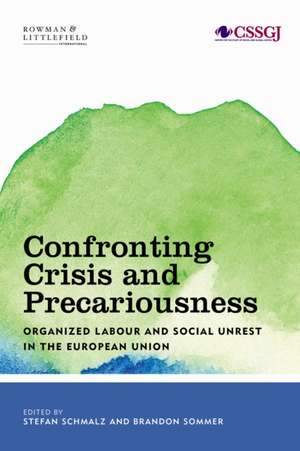
Confronting Crisis and Precariousness: Organised Labour and Social Unrest in the European Union: Studies in Social and Global Justice
Editat de Stefan Schmalz, Brandon Sommeren Limba Engleză Hardback – 24 iul 2019
Focusing on the triangular relationship of precariousness, trade unions and social movements, this book draws on a range of exciting cases, both comparative and country case studies, in order to understand how the shadow of the crisis still haunts organized labour in Europe. The chapters in this collection each offer a unique perspective on how the results of the crisis, in Western, Southern and Eastern Europe, are leading to a variety of new social movements as a consequence of increased precariousness and also how trade unions are attempting to respond.









Preț: 728.04 lei
Preț vechi: 1094.58 lei
-33%
Puncte Express: 1092
Carte tipărită la comandă
Livrare economică 25 noiembrie-09 decembrie
Livrare prin curier în România Termenul estimat este afișat lângă disponibilitate.
Transport gratuit pentru acest produs Plată online sau ramburs, în funcție de opțiunile comenzii.
Retur gratuit în 14 zile Comandă securizată și suport în română.
Specificații
ISBN-13: 9781786610478
ISBN-10: 1786610477
Pagini: 224
Ilustrații: 4 tables; 3 charts
Dimensiuni: 159 x 251 x 22 mm
Greutate: 0.5 kg
Editura: Bloomsbury Publishing
Colecția Rowman & Littlefield
Seria Studies in Social and Global Justice
Locul publicării:New York, United States
ISBN-10: 1786610477
Pagini: 224
Ilustrații: 4 tables; 3 charts
Dimensiuni: 159 x 251 x 22 mm
Greutate: 0.5 kg
Editura: Bloomsbury Publishing
Colecția Rowman & Littlefield
Seria Studies in Social and Global Justice
Locul publicării:New York, United States
Cuprins
1. Confronting Crisis and Precariousness in the European Union
Stefan Schmalz, Brandon Sommer and Antonio Loffredo
2. Precariousness in the Eurozone: Causes, Effects and Developments
Klaus Dörre
3. The Competitive Architecture of European Integration: European Labour Division, Locational Competition and the Precarization of Work and Life
Stefanie Hürtgen
4. Precarious Environment: European Trade Unions in a Time of Crises
Steffen Lehndorff, Heiner Dribbusch and Thorsten Schulten
5. Holding its Own: Labour Among Social Movements in France
Karel Yon
6. Are Trade Unions Trapped? Precarious Movements and Labour Struggles at the Left Turn in Portugal
Elísio Estanque, Hermes A. Costa, Dora Fonseca, and Andreia Santos
7. Enduring Austerity: Memoranda Politics and its Impact on Labour in Greece
Maria Markantonatou and Geoff Kennedy
8. Spatialities of Precarity: Young People in the Southern Mediterranean
Jörg Gertel
9. The End of the German Model? The Transformation of German Capitalism and Fragmented Labour Relations
Stefan Schmalz and Lea Schneidemesser
10. Precarity And Counter-Movements in the European Semi-Peripheries:
Adam Mrozowicki
11. Labour Protests in Eastern Europe
Joachim Becker
12. Conclusion: Two Worlds of Precariousness, Two Worlds of Unionism
Stefan Schmalz, Brandon Sommer, Raúl Lorente, and Johanna Sittel
Stefan Schmalz, Brandon Sommer and Antonio Loffredo
2. Precariousness in the Eurozone: Causes, Effects and Developments
Klaus Dörre
3. The Competitive Architecture of European Integration: European Labour Division, Locational Competition and the Precarization of Work and Life
Stefanie Hürtgen
4. Precarious Environment: European Trade Unions in a Time of Crises
Steffen Lehndorff, Heiner Dribbusch and Thorsten Schulten
5. Holding its Own: Labour Among Social Movements in France
Karel Yon
6. Are Trade Unions Trapped? Precarious Movements and Labour Struggles at the Left Turn in Portugal
Elísio Estanque, Hermes A. Costa, Dora Fonseca, and Andreia Santos
7. Enduring Austerity: Memoranda Politics and its Impact on Labour in Greece
Maria Markantonatou and Geoff Kennedy
8. Spatialities of Precarity: Young People in the Southern Mediterranean
Jörg Gertel
9. The End of the German Model? The Transformation of German Capitalism and Fragmented Labour Relations
Stefan Schmalz and Lea Schneidemesser
10. Precarity And Counter-Movements in the European Semi-Peripheries:
Adam Mrozowicki
11. Labour Protests in Eastern Europe
Joachim Becker
12. Conclusion: Two Worlds of Precariousness, Two Worlds of Unionism
Stefan Schmalz, Brandon Sommer, Raúl Lorente, and Johanna Sittel
Recenzii
This ambitious comparative project addresses the weakening position of labor unions in the EU since the economic crisis of 2008. Editors Schmalz (University of Jena, Germany) and Sommer (International Institute of Social Studies, the Hague) bring together various viewpoints revealing the levels of precariousness of organized labor from southern Europe to the more established northern EU member states. In the south particularly, the neoliberal economic restructuring (codified by the Single European Act in 1987) combined with economic recession 20 years later to foment union resistance to austerity policies and social unrest, yielding new social movements. Ultimately, trade unions have yet to formulate a coherent response to this new normal in Europe, and the outlook remains gloomy. Even in Germany, where the situation is less grim for unions, labor struggles have become more fragmented, leading to the emergence of nascent "social-movement-like strategies." However, in southern states mobilization-platform unionism has developed in conjunction with social protest. The diverse case studies present an antagonistic situation in the southern states that may spread to the North, as the EU has been unable to create common labor policies.
Summing Up: Recommended. Upper-division undergraduates through faculty; professionals.
The Great Regression has developed through very uneven territorial patterns. Common paths of neoliberal restructuring had different effects in different economic and political contexts. Bridging political economy with social movement studies, this remarkable collection presents a much needed account on how variegated neoliberalism was reflected in diverse forms of protest and union action.
Confronting Crisis and Precariousness provides a comprehensive framework in order to understand basic issues of European labor markets. First, the role of macro regulation, at European level, that promotes a pressure towards precariousness. Second, the national development of this process is uneven. Third, the challenge to unions and their different capacities to adapt and to develop new lines of action confronting austerity
This book is a unique and timely contribution to the debate on precariousness and collective action in the post-crisis context. The consequences of increased precariousness are discussed bringing together the debates on austerity politics, worker organisation and political transformations in Europe. This book is also admirable for its analysis of the role that not only traditional unions, but also new collective actors and grassroots movements, are playing in organised labour and in labour market policies in EU countries.
European labour relations have become fundamentally restructured. Through a focus on the triangular relationship of increasing precariousness, trade unions and social movements, this volume makes a crucial contribution to our understanding of two different worlds of precariousness and a variety of labour responses. This is a must-read for anyone seeking a way out of crisis for European labour.
Across Europe, work today is increasingly precarious. This wide-ranging survey by leading scholars in the main countries affected shows that intensified commodification of labour creates few winners and a multiplicity of losers. But the contributors also map innovative responses to the challenges, and explore how trade unions and social movements are building coalitions to respond to labour market insecurities.
A comprehensive country by country assessment of the underbelly of European integration, focused on the variable but always fraught relation between the included and the excluded; between those countries at the center of the EU and those at the periphery; between trade unions representing secure wage labor and movements of the precarious classes. Essential reading for understanding political responses - right and left - to the deepening inequality within and between nations.
Summing Up: Recommended. Upper-division undergraduates through faculty; professionals.
The Great Regression has developed through very uneven territorial patterns. Common paths of neoliberal restructuring had different effects in different economic and political contexts. Bridging political economy with social movement studies, this remarkable collection presents a much needed account on how variegated neoliberalism was reflected in diverse forms of protest and union action.
Confronting Crisis and Precariousness provides a comprehensive framework in order to understand basic issues of European labor markets. First, the role of macro regulation, at European level, that promotes a pressure towards precariousness. Second, the national development of this process is uneven. Third, the challenge to unions and their different capacities to adapt and to develop new lines of action confronting austerity
This book is a unique and timely contribution to the debate on precariousness and collective action in the post-crisis context. The consequences of increased precariousness are discussed bringing together the debates on austerity politics, worker organisation and political transformations in Europe. This book is also admirable for its analysis of the role that not only traditional unions, but also new collective actors and grassroots movements, are playing in organised labour and in labour market policies in EU countries.
European labour relations have become fundamentally restructured. Through a focus on the triangular relationship of increasing precariousness, trade unions and social movements, this volume makes a crucial contribution to our understanding of two different worlds of precariousness and a variety of labour responses. This is a must-read for anyone seeking a way out of crisis for European labour.
Across Europe, work today is increasingly precarious. This wide-ranging survey by leading scholars in the main countries affected shows that intensified commodification of labour creates few winners and a multiplicity of losers. But the contributors also map innovative responses to the challenges, and explore how trade unions and social movements are building coalitions to respond to labour market insecurities.
A comprehensive country by country assessment of the underbelly of European integration, focused on the variable but always fraught relation between the included and the excluded; between those countries at the center of the EU and those at the periphery; between trade unions representing secure wage labor and movements of the precarious classes. Essential reading for understanding political responses - right and left - to the deepening inequality within and between nations.