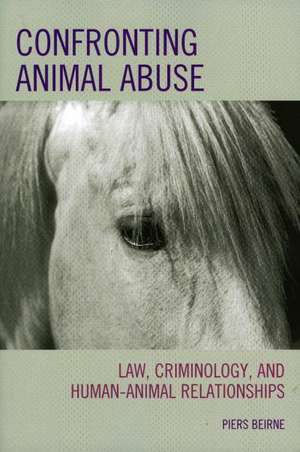
Confronting Animal Abuse: Law, Criminology, and Human-Animal Relationships
Autor Piers Beirneen Limba Engleză Paperback – 16 iul 2009
Beirne argues that if violations of animals' rights are to be taken seriously, then scholars and activists should examine why some harms to animals are defined as criminal, others as abusive but not criminal and still others as neither criminal nor abusive. Confronting Animal Abuse points to the need for a more inclusive concept of harms to animals, without which the meaning of animal abuse will be overwhelmingly confined to those harms that are regarded as socially unacceptable, one-on-one cases of animal cruelty. Certainly, those cases demand attention. But so, too, do those other and far more numerous institutionalized harms to animals, where abuse is routine, invisible, ubiquitous and often defined as socially acceptable.
In this pioneering, pro-animal book Beirne identifies flaws in our traditional understanding of human-animal relationships, and proposes a compelling new approach.
| Toate formatele și edițiile | Preț | Express |
|---|---|---|
| Paperback (1) | 321.43 lei 6-8 săpt. | |
| Bloomsbury Publishing – 16 iul 2009 | 321.43 lei 6-8 săpt. | |
| Hardback (1) | 718.01 lei 6-8 săpt. | |
| Bloomsbury Publishing – 16 iul 2009 | 718.01 lei 6-8 săpt. |
Preț: 321.43 lei
Preț vechi: 413.61 lei
-22%
Puncte Express: 482
Preț estimativ în valută:
56.89€ • 66.48$ • 49.39£
56.89€ • 66.48$ • 49.39£
Carte tipărită la comandă
Livrare economică 19 februarie-05 martie
Preluare comenzi: 021 569.72.76
Specificații
ISBN-13: 9780742547445
ISBN-10: 0742547442
Pagini: 237
Ilustrații: figures
Dimensiuni: 152 x 221 x 18 mm
Greutate: 0.37 kg
Editura: Bloomsbury Publishing
Colecția Rowman & Littlefield Publishers
Locul publicării:New York, United States
ISBN-10: 0742547442
Pagini: 237
Ilustrații: figures
Dimensiuni: 152 x 221 x 18 mm
Greutate: 0.37 kg
Editura: Bloomsbury Publishing
Colecția Rowman & Littlefield Publishers
Locul publicării:New York, United States
Cuprins
Introduction
Chapter 1 Against Cruelty? The Act Against Plowing by the Tayle
Chapter 2 The Prosecution of Animal Cruelty in Puritan Massachusetts, 1636-1683
Chapter 3 Towards a Sociology of Animal Sexual Assault
Chapter 4 Horse Maiming and the Sport of Kings
Chapter 5 Is There a Progression from Animal Abuse to Interhuman Violence?
Epilogue
Chapter 1 Against Cruelty? The Act Against Plowing by the Tayle
Chapter 2 The Prosecution of Animal Cruelty in Puritan Massachusetts, 1636-1683
Chapter 3 Towards a Sociology of Animal Sexual Assault
Chapter 4 Horse Maiming and the Sport of Kings
Chapter 5 Is There a Progression from Animal Abuse to Interhuman Violence?
Epilogue
Recenzii
Beirne, who originated the non-speciesist approach to criminology and is a leading exponent of green criminology, brings together for the first time his main themes and research interests within one text. As the originator of this approach, this book will further establish Beirne's reputation as the leading scholar of non-speciesist criminology. The originality in identifying a serious problem in traditional analyses of human-nonhuman relations is a major contribution to the field.
Piers Beirne has the knack of asking questions that are sometimes uncomfortable, occasionally confronting, yet always thought provoking and considerate. This book takes us on a fascinating and highly informative journey into the contentious world of animal cruelty and human specieism. It not only challenges how we look at the issues, but also raises concerns about how we ought to respond to them at a practical level as well. It is a must read.
Piers Beirne's Confronting Animal Abuse will inform and direct all aspects of sociological research for decades to come-a book not for specialists only, but for anyone interested in understanding the past history and future prospects of animal protection.
In this welcome and thought-provoking book, Piers Beirne brings together evidence and debate to consider various contradictions in humanity's relationship with other species, the politics and principles of animal rights and animal welfare, and links between inter-human violence and abuse of animals. This scholarly review will quickly establish itself as the key reference point for anyone wishing to engage with these highly complex matters.
Beirne brilliantly demonstrates how concern about animal abuse is primarily motivated by human self-interest. He attends to the tension between suggesting that the criminal justice system take animal abuse more seriously on the one hand and adding to the already immense criminalized and marginalized populations on the other. Beirne shows that criminology needs to confront these issues and that criminologists cannot simply accept anthropocentric definitions of what constitutes harm and crime.
Piers Beirne has the knack of asking questions that are sometimes uncomfortable, occasionally confronting, yet always thought provoking and considerate. This book takes us on a fascinating and highly informative journey into the contentious world of animal cruelty and human specieism. It not only challenges how we look at the issues, but also raises concerns about how we ought to respond to them at a practical level as well. It is a must read.
Piers Beirne's Confronting Animal Abuse will inform and direct all aspects of sociological research for decades to come-a book not for specialists only, but for anyone interested in understanding the past history and future prospects of animal protection.
In this welcome and thought-provoking book, Piers Beirne brings together evidence and debate to consider various contradictions in humanity's relationship with other species, the politics and principles of animal rights and animal welfare, and links between inter-human violence and abuse of animals. This scholarly review will quickly establish itself as the key reference point for anyone wishing to engage with these highly complex matters.
Beirne brilliantly demonstrates how concern about animal abuse is primarily motivated by human self-interest. He attends to the tension between suggesting that the criminal justice system take animal abuse more seriously on the one hand and adding to the already immense criminalized and marginalized populations on the other. Beirne shows that criminology needs to confront these issues and that criminologists cannot simply accept anthropocentric definitions of what constitutes harm and crime.