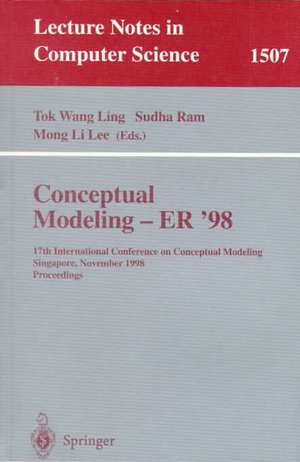
Conceptual Modeling - ER '98
Editat de Tok Wang Ling, Sudha Ramen Limba Engleză Paperback – 21 oct 1998
Preț: 332.60 lei
Preț vechi: 415.75 lei
-20%
Puncte Express: 499
Carte tipărită la comandă
Livrare economică 28 noiembrie-12 decembrie
Livrare prin curier în România Termenul estimat este afișat lângă disponibilitate.
Transport gratuit de la 400.00 lei Plată online sau ramburs, în funcție de opțiunile comenzii.
Retur gratuit în 14 zile Comandă securizată și suport în română.
Specificații
ISBN-13: 9783540651895
ISBN-10: 3540651896
Pagini: 504
Ilustrații: XVI, 482 p.
Dimensiuni: 155 x 235 x 28 mm
Greutate: 0.76 kg
Ediția:1998
Editura: Springer
Locul publicării:Berlin, Heidelberg, Germany
ISBN-10: 3540651896
Pagini: 504
Ilustrații: XVI, 482 p.
Dimensiuni: 155 x 235 x 28 mm
Greutate: 0.76 kg
Ediția:1998
Editura: Springer
Locul publicării:Berlin, Heidelberg, Germany
V-ar putea interesa
-
 Semistructured Database DesignTok Wang Ling-20%Preț: 666.97 lei833.71 lei
 -
 What's Inside My Computer?Christine Zuchora-Walske-18%Preț: 44.14 lei53.60 lei
 -
 Conceptual ModelingJuan C. Trujillo-20%Preț: 364.50 lei455.62 lei
 -
 Advances in Conceptual ModelingCarson Woo-20%Preț: 325.83 lei407.29 lei
 -
 Conceptual Modeling -- ER 2003Il-Yeol Song-20%Preț: 639.65 lei799.57 lei
 -
 -20%Preț: 641.25 lei801.56 lei
 -
 -20%Preț: 640.33 lei800.41 lei
 -
 -20%Preț: 333.68 lei417.09 lei
 -
 Conceptual ModelingPaolo Atzeni-20%Preț: 351.65 lei439.56 lei
 -
 -20%Preț: 334.63 lei418.29 lei
 -
 Making the History of Computing RelevantArthur Tatnall-20%Preț: 300.35 lei375.45 lei
 -
 Precision Assembly Technologies and SystemsSvetan Ratchev-60%Preț: 275.75 lei687.40 lei
 -
 Computer Aided Systems Theory -- EUROCAST 2013Roberto Moreno-Díaz-20%Preț: 348.02 lei435.02 lei
 -
 -20%Preț: 652.17 lei815.21 lei
 -
 Focus on Scientific VisualizationHans Hagen-20%Preț: 327.54 lei409.42 lei
 -
 Fundamentals of Digital Machine ComputingGuenter Hintze-20%Preț: 319.36 lei399.20 lei
 -
 Algorithmic Game TheoryRon Lavi-20%Preț: 335.69 lei419.60 lei
 -
 Bio-inspired Computing: Theories and ApplicationsLinqiang Pan-20%Preț: 348.35 lei435.44 lei
 -
 Simulation of Urban MobilityMichael Behrisch-20%Preț: 271.77 lei339.72 lei
Public țintă
ResearchCuprins
Keynote 1:.- The Rise, Fall and Return of Software Industry in Japan.- Session 1: Conceptual Modeling and Design.- Conceptual Design and Development of Information Services.- An EER-Based Conceptual Model and Query Language for Time-Series Data.- Chrono: A Conceptual Design Framework for Temporal Entities.- Session 2: User Interface Modeling.- Designing Well-Structured Websites: Lessons to Be Learned from Database Schema Methodology.- Formalizing the Informational Content of Database User Interfaces.- Session 3: Information Retrieval on the Web.- A Conceptual-Modeling Approach to Extracting Data from the Web.- Information Coupling in Web Databases.- Structure-Based Queries over the World Wide Web.- Session 4: Semantics and Constraints.- Integrated Approach for Modelling of Semantic and Pragmatic Dependencies of Information Systems.- Inference of Aggregate Relationships through Database Reverse Engineering.- On the Consistency of Int-cardinality Constraints.- Panel 1:.- Realizing Next Generation Internet Applications: Are There Genuine Research Problems, or Is It Advanced Product Development?.- Keynote 2:.- Web Sites Need Models and Schemes.- Session 5: Conceptual Modeling Tools.- ARTEMIS: A Process Modeling and Analysis Tool Environment.- From Object Oriented Conceptual Modeling to Automated Programming in Java.- An Evaluation of Two Approaches to Exploiting Real-World Knowledge by Intelligent Database Design Tools.- Session 6: Quality and Reliability Metrics.- Metrics for Evaluating the Quality of Entity Relationship Models.- A Transformational Approach to Correct Schema Refinements.- The Guidelines of Modeling – An Approach to Enhance the Quality in Information Models.- Industrial Session 1: Industrial Experiences in Conceptual Modeling.- Improving the Quality ofEntity Relationship Models—Experience in Research and Practice.- The Troll Approach to Conceptual Modelling: Syntax, Semantics, and Tools.- Process Failure in a Rapidly Changing High-Tech Organisation: A System Dynamics View.- Session 7: Object-Oriented Database Management Systems.- ROL2: A Real Deductive Object-Oriented Database Language.- Multiobjects to Ease Schema Evolution in an OODBMS.- Implementation of Automatic Lock Determination in C++-Based OODBMSs.- Panel 2:.- Do We Need Information Modeling for the Information Highway?.- Session 8: Data Warehousing.- Design and Analysis of Quality Information for Data Warehouses.- Data Warehouse Schema and Instance Design.- Reducing Algorithms for Materialized View Updates.- Industrial Session 2: Industrial Case Studies.- Reengineering Conventional Data and Process Models with Business Object Models: A Case Study Based on SAP R/3 and UML.- An Active Conceptual Model for Fixed Income Securities Analysis for Multiple Financial Institutions.- An Entomological Collections Database Model for INPA.- Session 9: Object-Oriented Approaches.- A Global Object Model for Accommodating Instance Heterogeneities.- On Formalizing the UML Object Constraint Language OCL.- Derived Horizontal Class Partitioning in OODBs: Design Strategies, Analytical Model, and Evaluation.