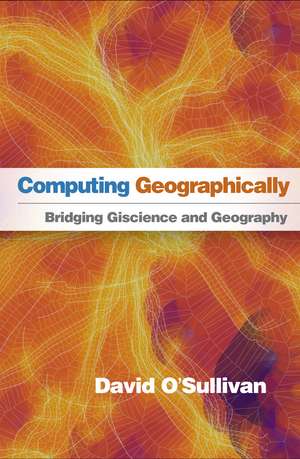
Computing Geographically: Bridging Giscience and Geography
Autor David O'Sullivanen Limba Engleză Hardback – 7 mar 2024
Preț: 460.29 lei
Preț vechi: 500.32 lei
-8%
Puncte Express: 690
Carte disponibilă
Livrare economică 05-19 noiembrie
Livrare express 21-27 octombrie pentru 36.80 lei
Livrare prin curier în România Termenul estimat este afișat lângă disponibilitate.
Transport gratuit pentru acest produs Plată online sau ramburs, în funcție de opțiunile comenzii.
Retur gratuit în 14 zile Comandă securizată și suport în română.
Specificații
ISBN-13: 9781462553938
ISBN-10: 1462553931
Pagini: 312
Dimensiuni: 152 x 229 x 21 mm
Greutate: 0.54 kg
Ediția:1
Editura: Guilford Publications
Colecția Guilford Press
ISBN-10: 1462553931
Pagini: 312
Dimensiuni: 152 x 229 x 21 mm
Greutate: 0.54 kg
Ediția:1
Editura: Guilford Publications
Colecția Guilford Press
V-ar putea interesa
-
 Four Points of the CompassJerry BrottonPreț: 92.56 lei
 -
 Human Geography: A Very Short IntroductionPatricia Daley-20%Preț: 57.12 lei71.12 lei
 -
 -27%Preț: 649.42 lei889.61 lei
 -
 Preț: 196.80 lei
 -
 Preț: 187.52 lei
 -
 -9%Preț: 550.34 lei604.77 lei
 -
 Preț: 486.82 lei
 -
 The Philosophy of Space and TimeHans Reichenbach-20%Preț: 116.91 lei146.73 lei
 -
 Preț: 393.63 lei
 -
 MapmaticsPaulina Rowinska-48%Preț: 49.02 lei93.56 lei
 -
 Geographic ThoughtTim CresswellPreț: 256.18 lei
 -
 GIS For DummiesJami DennisPreț: 166.20 lei
 -
 -8%Preț: 440.61 lei478.93 lei
 -
 The Space of the WorldNick CouldryPreț: 157.50 lei
 -
 Radical CartographyWilliam Rankin-44%Preț: 133.07 lei237.71 lei
 -
 The Power of WhereJack DangermondPreț: 390.08 lei
 -
 Telling Stories with MapsAllen CarrollPreț: 270.17 lei
 -
 Web and Wireless Geographical Information SystemsMiguel Félix Mata-Rivera-20%Preț: 758.24 lei947.80 lei
 -
 -20%Preț: 675.83 lei844.80 lei
 -
 -18%Preț: 1337.11 lei1630.62 lei
Cuprins
Preface
Acknowledgments
1. Building Bridges
- A History of My Spaces
- Plan of the Book
2. Location and Space
- The Nature of Space
- Space in Giscience
- Prospects for Relative/Relational Giscience
3. Scale and Projection
- Scale in Geographical Theory
- Scale in Giscience
- The Salience of Scale
4. Place and Meaning in Space
- From Space to Place-
- Place in Giscience
5. Lines and Areas
- Drawing Lines
- Territory and Territoriality
- When the Map Is and Is Not the Territory
- The Arbitrariness of Boundaries
- Moving On from Geometry
6. Relations, Networks, Flows
- Relations, Space, and Place
- Graph Drawings as (Possible) Projections
- Networks Are Flows Frozen in Place
7. Time and Dynamics
- Time and Space: A Coin with Two Sides
- Hägerstrand's Time Geography
- Limits to Time Geography
- Mobilities and Human Dynamics
- From Time to Dynamic Processes
8. Process and Pattern
- Process Philosophies
- The Place of Complexity Theory
- Simulation Models
- Process and Pattern Revisited
9. Doing Giscience Doing Geography
- Common Ground: A Space to Think
- Doing Giscience: Representation as a Process
- Toward Doing Differently
- Finally
References
Index
About the Author
Acknowledgments
1. Building Bridges
- A History of My Spaces
- Plan of the Book
2. Location and Space
- The Nature of Space
- Space in Giscience
- Prospects for Relative/Relational Giscience
3. Scale and Projection
- Scale in Geographical Theory
- Scale in Giscience
- The Salience of Scale
4. Place and Meaning in Space
- From Space to Place-
- Place in Giscience
5. Lines and Areas
- Drawing Lines
- Territory and Territoriality
- When the Map Is and Is Not the Territory
- The Arbitrariness of Boundaries
- Moving On from Geometry
6. Relations, Networks, Flows
- Relations, Space, and Place
- Graph Drawings as (Possible) Projections
- Networks Are Flows Frozen in Place
7. Time and Dynamics
- Time and Space: A Coin with Two Sides
- Hägerstrand's Time Geography
- Limits to Time Geography
- Mobilities and Human Dynamics
- From Time to Dynamic Processes
8. Process and Pattern
- Process Philosophies
- The Place of Complexity Theory
- Simulation Models
- Process and Pattern Revisited
9. Doing Giscience Doing Geography
- Common Ground: A Space to Think
- Doing Giscience: Representation as a Process
- Toward Doing Differently
- Finally
References
Index
About the Author
Recenzii
"A masterpiece--one of the greatest steps forward in computational geographic thinking since Waldo Tobler's and William Bunge's seminal work of the 1960s and 1970s. Beautifully illustrated and carefully constructed, this book offers both a panoramic view of past achievements and an accessible guide into future thinking."--Danny Dorling, PhD, Halford Mackinder Professor of Geography, University of Oxford, United Kingdom
"This book bridges a gap between geography and GISc that has vexed me and so many others for decades. O’Sullivan clearly illuminates the sometimes hidden ties between fundamental, 'raw' geography ideas and the discipline’s technical arm. He systematically shows both how GIS can be used to 'do' geographical work better and how geographic concepts have been--or could be--embedded in the computational techniques of GISc. O’Sullivan’s personable, witty, and direct writing style makes the book approachable and a joy to read. I felt almost like my questions were being answered in a face-to-face conversation. As both a GISer and a human geographer, I see this book as a useful text for upper-level undergraduate courses and graduate seminars. Indeed, geographers, giscientists, and our discipline as a whole are better off for having this book."--Rex J. Rowley, PhD, Department of Geography, Geology, and the Environment, Illinois State University
"Centering the concerns of geography in the work of GISc, this book is of great professional utility. The fact that the author is a GIScientist underlines the impact of the work. O'Sullivan's way of 'doing GIS' generously invites critical human geography into productive discussions with computational geography. His openness to allowing these fields to mingle and remain unsettled provides a welcome bridge."--Matthew W. Wilson, PhD, Chair and Professor of Geography, University of Kentucky
"Examples from different subdisciplines (geomorphology, biogeography, urban geography, critical social geography, and others) are included to promote understanding. Everyday examples that can be understood by an even broader audience are sprinkled in as well. The author delves into each topic by reviewing relevant literature from both geography and GISc. Quotations, personal reflections, and effective figures keep the reader engaged throughout."--John Kostelnick, PhD, Department of Geography, Geology, and the Environment, Illinois State University
"This book offers an exciting synthesis of major strands of thought in GISc and geography, centered on the analysis of space and place. It is comprehensive and authoritative, yet accessible and enjoyable to read. O'Sullivan weaves together abstract concepts and concrete examples in order to illuminate the gaps and the bridges between GISc and geography. A 'must read' for anyone working with spatial concepts."--Steven M. Manson, PhD, Department of Geography, Environment, and Society, University of Minnesota
-
"This book bridges a gap between geography and GISc that has vexed me and so many others for decades. O’Sullivan clearly illuminates the sometimes hidden ties between fundamental, 'raw' geography ideas and the discipline’s technical arm. He systematically shows both how GIS can be used to 'do' geographical work better and how geographic concepts have been--or could be--embedded in the computational techniques of GISc. O’Sullivan’s personable, witty, and direct writing style makes the book approachable and a joy to read. I felt almost like my questions were being answered in a face-to-face conversation. As both a GISer and a human geographer, I see this book as a useful text for upper-level undergraduate courses and graduate seminars. Indeed, geographers, giscientists, and our discipline as a whole are better off for having this book."--Rex J. Rowley, PhD, Department of Geography, Geology, and the Environment, Illinois State University
"Centering the concerns of geography in the work of GISc, this book is of great professional utility. The fact that the author is a GIScientist underlines the impact of the work. O'Sullivan's way of 'doing GIS' generously invites critical human geography into productive discussions with computational geography. His openness to allowing these fields to mingle and remain unsettled provides a welcome bridge."--Matthew W. Wilson, PhD, Chair and Professor of Geography, University of Kentucky
"Examples from different subdisciplines (geomorphology, biogeography, urban geography, critical social geography, and others) are included to promote understanding. Everyday examples that can be understood by an even broader audience are sprinkled in as well. The author delves into each topic by reviewing relevant literature from both geography and GISc. Quotations, personal reflections, and effective figures keep the reader engaged throughout."--John Kostelnick, PhD, Department of Geography, Geology, and the Environment, Illinois State University
"This book offers an exciting synthesis of major strands of thought in GISc and geography, centered on the analysis of space and place. It is comprehensive and authoritative, yet accessible and enjoyable to read. O'Sullivan weaves together abstract concepts and concrete examples in order to illuminate the gaps and the bridges between GISc and geography. A 'must read' for anyone working with spatial concepts."--Steven M. Manson, PhD, Department of Geography, Environment, and Society, University of Minnesota
-
Notă biografică
David O’Sullivan, PhD, is an independent scholar who has held positions at Te Herenga Waka--Victoria University of Wellington; the University of California, Berkeley; the University of Auckland; and Penn State. He has published extensively on novel approaches to the simulation of change in urban and ecological systems, and the implications of different representations in giscience in relation to wider currents in geographical thought.
Descriere
As geography's 'big ideas'--such as space, place, boundaries, scale, process, and relationality--have evolved, what does this mean for their computational representation? This book considers how key concepts have developed in geography and are represented (or not) in GISc, with a view to bridging gaps between the two.