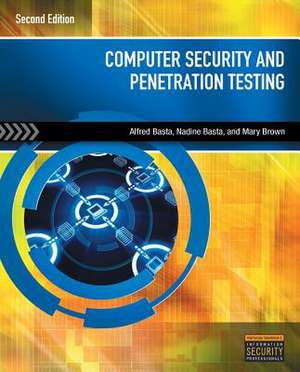
Computer Security and Penetration Testing
Autor Alfred Basta, Nadine Basta, Mary Brown Cissp Cisaen Limba Engleză Paperback – 8 aug 2013
Metodologia pe care se bazează Computer Security and Penetration Testing este una riguros aplicată, transformând securitatea dintr-un concept abstract într-o disciplină tehnică verificabilă. Autorii Alfred Basta, Nadine Basta și Brown propun o arhitectură de învățare care începe cu fundamentele etice, esențiale pentru orice specialist în testarea penetrării, și continuă spre zonele critice ale infrastructurii IT. Notăm cu interes modul în care cuprinsul este organizat pentru a reflecta etapele reale ale unui audit de securitate: faza de recunoaștere (reconnaissance), utilizarea instrumentelor de scanare, analiza pachetelor prin sniffere și identificarea vulnerabilităților de protocol în stiva TCP/IP. Subliniem abordarea practică a textului, care nu se limitează la teorie, ci plonjează în mecanica internă a amenințărilor precum Denial of Service, Session Hijacking și Buffer Overflows. Recomandăm atenția acordată programării de exploit-uri și vulnerabilităților specifice pentru sisteme de operare precum Windows și Linux, oferind cititorului un set complet de instrumente pentru diagnosticarea sistemelor. Cititorul care a aplicat ideile din Computer Security Fundamentals de William Easttom va găsi aici o aprofundare tehnică superioară, trecând de la terminologie la execuția efectivă a testelor de penetrare și la gestionarea incidentelor. Structura progresivă a cărții permite tranziția de la înțelegerea modului în care atacatorii gândesc la implementarea unor contramăsuri solide. Această a doua ediție, publicată de CENGAGE LEARNING INC, elimină miturile legate de hacking și se ancorează în fapte tehnice, oferind un ghid cuprinzător pentru oricine dorește să transforme „speranța în securitate” în „certitudinea securității”.
Preț: 688.38 lei
Preț vechi: 901.49 lei
-24%
Carte disponibilă
Livrare economică 04-18 noiembrie
Specificații
ISBN-10: 0840020937
Pagini: 512
Dimensiuni: 183 x 231 x 23 mm
Greutate: 0.66 kg
Ediția:2nd Revised edition
Editura: CENGAGE LEARNING
V-ar putea interesa
-
 Computer Security FundamentalsWilliam Easttom-20%Preț: 502.93 lei628.66 lei
 -
 Hands-On Ethical Hacking and Network DefenseMichael Simpson-24%Preț: 409.83 lei535.83 lei
 -
 -20%Preț: 223.35 lei279.20 lei
 -
 -20%Preț: 86.20 lei107.76 lei
 -
 -20%Preț: 249.11 lei311.39 lei
 -
 -20%Preț: 129.09 lei161.36 lei
 -
 Hands on HackingMatthew Hickey-20%Preț: 237.78 lei297.22 lei
 -
 CEH v11 Certified Ethical Hacker Study GuideRic MessierPreț: 299.74 lei
 -
 -28%Preț: 295.73 lei411.52 lei
 -
 HANDS-ON ETHICAL HACKING & NETNicholas Antill-25%Preț: 612.35 lei819.59 lei
 -
 Preț: 456.53 lei
 -
 Hacking: The Art of Exploitation, 2nd EditionJon Erickson-35%Preț: 256.17 lei394.85 lei
 -
 Penetration TestingGeorgia Weidman-35%Preț: 260.44 lei398.00 lei
 -
 Attacking Network ProtocolsJames Forshaw-36%Preț: 283.27 lei440.27 lei
 -
 Ethical Hacking: A Hands-on Introduction to Breaking InDaniel Graham-35%Preț: 239.87 lei370.11 lei
 -
 Metasploit, 2nd EditionDavid Kennedy-20%Preț: 295.28 lei369.11 lei
 -
 -20%Preț: 199.71 lei249.64 lei
De ce să citești această carte
Recomandăm această carte profesioniștilor IT și studenților care doresc să stăpânească arta testării penetrării printr-o metodologie structurată. Cititorul câștigă o înțelegere profundă a vulnerabilităților de rețea și a tehnicilor de exploatare, primind în același timp un cadru etic și legal solid. Este resursa ideală pentru a trece de la utilizarea unor simple unelte de scanare la înțelegerea codului din spatele atacurilor complexe.
Despre autor
Alfred Basta, PhD, este un expert recunoscut în matematică, criptografie și securitatea informației. Cu o vastă experiență academică și profesională, Dr. Basta este profesor și conferențiar pe teme de securitate Internet și rețele, fiind membru activ al Mathematical Association of America. Expertiza sa multidisciplinară este reflectată în publicații de referință precum „Mathematics for Information Technology” și „Database Security”. În volumul de față, el aduce rigoarea matematică în analiza vulnerabilităților cibernetice, oferind o perspectivă tehnică de înalt nivel asupra securității sistemelor informatice.