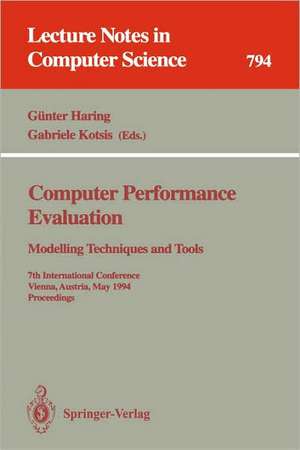
Computer Performance Evaluation: Modelling Techniques and Tools
Editat de Günter Haring, Gabriele Kotsisen Limba Engleză Paperback – 20 apr 1994
Preț: 331.38 lei
Preț vechi: 414.22 lei
-20%
Puncte Express: 497
Carte tipărită la comandă
Livrare economică 26 noiembrie-10 decembrie
Livrare prin curier în România Termenul estimat este afișat lângă disponibilitate.
Transport gratuit de la 400.00 lei Plată online sau ramburs, în funcție de opțiunile comenzii.
Retur gratuit în 14 zile Comandă securizată și suport în română.
Specificații
ISBN-13: 9783540580218
ISBN-10: 3540580212
Pagini: 480
Ilustrații: XI, 469 p.
Dimensiuni: 155 x 235 x 26 mm
Greutate: 0.72 kg
Ediția:1994
Editura: Springer
Locul publicării:Berlin, Heidelberg, Germany
ISBN-10: 3540580212
Pagini: 480
Ilustrații: XI, 469 p.
Dimensiuni: 155 x 235 x 26 mm
Greutate: 0.72 kg
Ediția:1994
Editura: Springer
Locul publicării:Berlin, Heidelberg, Germany
V-ar putea interesa
-
 Distributed and Parallel SystemsPéter Kacsuk-20%Preț: 1220.87 lei1526.08 lei
 -
 What's Inside My Computer?Christine Zuchora-Walske-18%Preț: 44.14 lei53.60 lei
 -
 -20%Preț: 332.26 lei415.32 lei
 -
 Trust, Privacy and Security in Digital BusinessStefanos Gritzalis-20%Preț: 332.26 lei415.32 lei
 -
 Database and Expert Systems ApplicationsGabriele Kotsis-20%Preț: 325.87 lei407.35 lei
 -
 Database and Expert Systems ApplicationsSven Hartmann-20%Preț: 343.12 lei428.90 lei
 -
 -20%Preț: 341.62 lei427.03 lei
 -
 Wireless Systems and Mobility in Next Generation InternetGabriele Kotsis-20%Preț: 333.13 lei416.42 lei
 -
 MultiBody System SIMulation: Numerical Methods, Algorithms, and SoftwareReinhold von Schwerin-20%Preț: 1116.07 lei1395.09 lei
 -
 Performance Evaluation: Origins and DirectionsGünter Haring-20%Preț: 636.36 lei795.46 lei
 -
 -20%Preț: 319.75 lei399.68 lei
 -
 Origins and Foundations of ComputingFriedrich L. Bauer-20%Preț: 183.44 lei229.29 lei
 -
 Shape Interrogation for Computer Aided Design and ManufacturingNicholas M. Patrikalakis-20%Preț: 364.46 lei455.58 lei
 -
 -20%Preț: 972.88 lei1216.10 lei
 -
 Der Computer - Mein LebenswerkKonrad Zuse-20%Preț: 336.83 lei421.03 lei
 -
 -54%Preț: 280.70 lei616.13 lei
 -
 Artificial Immune SystemsPietro Lió-20%Preț: 343.12 lei428.90 lei
 -
 Dependable and Historic ComputingCliff B. Jones-20%Preț: 347.60 lei434.50 lei
 -
 -20%Preț: 321.81 lei402.26 lei
Public țintă
ResearchCuprins
Techniques and tools for reliability and performance evaluation: Problems and perspectives.- Experimental analysis of parallel systems: Techniques and open problems.- Performance experiences of the Barcelona Olympic games computer system.- Performance tools on intel scalable high performance computing systems.- Modelling aspects of model-based dynamic QoS management by the Performability Manager.- Waiting time distributions for processor sharing queues with state-dependent arrival and service rates.- Queueing models of parallel applications: The Glamis methodology.- Automatic scalability analysis of parallel programs based on modeling techniques.- Simulation of ATM computer networks with CLASS.- NetSim — A tool for modeling the performance of circuit switched multicomputer networks.- ATMSWSIM An efficient, portable and expandable ATM SWitch SIMulator tool.- A model for performance estimation in a multistreamed superscalar processor.- Accelerating the evaluation of parallel program performance models using distributed simulation.- An algorithm for off-line detection of phases in execution profiles.- Experiences on SIMD massively parallel GSPN analysis.- PAPS — The parallel program performance prediction toolset.- qcomp: A tool for assessing online transaction processing scalability.- QPN-Tool for qualitative and quantitative analysis of queueing Petri nets.- Software architecture of the EPOCA integrated environment.- The PEPA workbench: A tool to support a process algebra-based approach to performance modelling.- On the accuracy of memory reference models.- Automatically estimating network contention of parallel programs.- Modelling of communication contention in multiprocessors.- Using Interval Timed Coloured Petri Nets to calculate performance bounds.- AnalyzingPICL trace data with MEDEA.