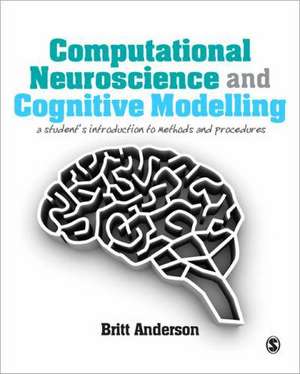
Computational Neuroscience and Cognitive Modelling
Autor Britt Andersonen Limba Engleză Paperback – 2014
Bazându-ne pe recomandările unor experți precum Anjan Chatterjee și pe structura cursurilor de metodologie psihologică, remarcăm în Computational Neuroscience and Cognitive Modelling o resursă rară: un manual care demistifică aparatul matematic pentru cercetătorul din științele vieții. Apreciem în mod deosebit curajul autorului Britt Anderson de a aborda subiecte complexe, precum ecuațiile diferențiale sau algebra liniară, nu ca bariere teoretice, ci ca instrumente practice explicate pas cu pas. Textul este organizat ingenios în patru părți fundamentale, alternând capitolele de teorie cu secțiuni de tip „Intermezzo” dedicate implementării tehnice. Această structură hibridă permite cititorului să treacă de la înțelegerea modelului de descărcare neuronală (Integrate & Fire) direct la scrierea codului necesar pentru simulare. Progresia este una logică și blândă: se începe cu familiarul format al tabelelor Excel pentru a ilustra concepte de bază, migrând treptat către limbaje de programare precum Python și Octave. Considerăm această lucrare o alternativă binevenită la Principles of Computational Modelling in Neuroscience de David Sterratt pentru cursurile de licență sau masterat în psihologie. În timp ce volumul lui Sterratt oferă o privire de ansamblu tehnică asupra sistemului nervos la toate nivelurile, cartea lui Anderson are avantajul de a fi „auto-conținută”, oferind explicații matematice și istorice integrate, reducând astfel anxietatea studenților în fața formalismului logic. De la modelul Hodgkin-Huxley la rețelele Hopfield și procesele de decizie de tip Random Walk, volumul acoperă un spectru larg, rămânând permanent ancorat în aplicații concrete, precum experimentele psihofizice.
Preț: 491.05 lei
Preț vechi: 606.24 lei
-19%
Carte tipărită la comandă
Livrare economică 16-30 noiembrie
Specificații
ISBN-10: 1446249301
Pagini: 242
Dimensiuni: 170 x 244 x 14 mm
Greutate: 0.41 kg
Ediția:New.
Editura: SAGE Publications Ltd
Locul publicării:London, United Kingdom
V-ar putea interesa
-
 Phenomenological PsychologyDarren Langdridge-13%Preț: 541.55 lei622.47 lei
 -
 Preț: 369.47 lei
 -
 InfluenceRobert CialdiniPreț: 374.96 lei
 -
 Making Sense of Data and Statistics in PsychologyGerry MulhernPreț: 352.51 lei
 -
 -25%Preț: 256.13 lei343.29 lei
 -
 Classic Experiments in PsychologyDouglas Mook-44%Preț: 396.33 lei707.15 lei
 -
 -15%Preț: 441.38 lei519.27 lei
 -
 Handbook of Professional Ethics for PsychologistsWilliam O'Donohue-18%Preț: 946.13 lei1153.82 lei
 -
 Understanding and Using Statistics in PsychologyJeremy Miles-14%Preț: 688.71 lei800.83 lei
 -
 Research Design and Statistical Analysis: Third EditionJerome L. Myers-9%Preț: 1097.73 lei1206.30 lei
 -
 Diary MethodsJohn B. Nezlek-15%Preț: 634.82 lei746.85 lei
 -
 Research Methods and Design in PsychologyPaul RichardsonPreț: 302.06 lei
 -
 Introducing Psychological ResearchPhilip Banyard-18%Preț: 340.53 lei414.52 lei
 -
 -5%Preț: 442.15 lei465.41 lei
De ce să citești această carte
Recomandăm această carte studenților și cercetătorilor din psihologie care doresc să treacă de la observația calitativă la modelarea computațională fără a fi experți în matematică. Veți câștiga o înțelegere practică a modului în care procesele cognitive pot fi simulate pe computer, transformând formulele abstracte în instrumente de lucru prin exerciții aplicate în Python. Este puntea ideală între neuroștiințele clinice și rigoarea informaticii.
Despre autor
Britt Anderson are o formare academică interdisciplinară remarcabilă, fiind absolvent al USC School of Medicine și specializat în Neurologie la University of Texas Southwestern Medical Center. Această bază clinică a fost completată de un doctorat în Brain Science la Brown University. În prezent, este membru al Departamentului de Psihologie și al Centrului de Neuroștiințe Teoretice de la Universitatea din Waterloo, Canada. Experiența sa dublă, medicală și computațională, îi permite să traducă limbajul arid al matematicii în concepte accesibile pentru studenții din domeniul bio-psihologic.
Descriere scurtă
- Anjan Chatterjee, Professor of Neurology, University of Pennsylvania
"Anderson provides a gentle introduction to computational aspects of psychological science, managing to respect the reader’s intelligence while also being completely unintimidating. Using carefully-selected computational demonstrations, he guides students through a wide array of important approaches and tools, with little in the way of prerequisites...I recommend it with enthusiasm."
- Asohan Amarasingham, The City University of New York
This unique, self-contained and accessible textbook provides an introduction to computational modelling neuroscience accessible to readers with little or no background in computing or mathematics. Organized into thematic sections, the book spans from modelling integrate and firing neurons to playing the game Rock, Paper, Scissors in ACT-R. This non-technical guide shows how basic knowledge and modern computers can be combined for interesting simulations, progressing from early exercises utilizing spreadsheets, to simple programs in Python. Key Features include:
- Interleaved chapters that show how traditional computing constructs are simply disguised versions of the spread sheet methods.
- Mathematical facts and notation needed to understand the modelling methods are presented at their most basic and are interleaved with biographical and historical notes for contex.
- Numerous worked examples to demonstrate the themes and procedures of cognitive modelling.
Recenzii
The neural and cognitive sciences are increasingly quantitative and computational subjects, and curriculums are now attempting to reflect this emerging reality. Accordingly, an important educational challenge is to inform undergraduate students of the significance of computational thinking, while also preparing them to appreciate and criticize it. An Invitation to Computational Neuroscience and Cognitive Modeling achieves this difficult goal wonderfully. Anderson provides a gentle introduction to computational aspects of psychological science, managing to respect the reader’s intelligence while also being completely unintimidating. Using carefully-selected computational demonstrations, he guides students through a wide array of important approaches and tools, with little in the way of prerequisites. As well as a very practical introduction to computer programming, there is impressive coverage of dynamical systems models of neurons, neural network models of memory, probabilistic models of decision-making, and mathematical models of thought. I recommend it with enthusiasm.
Cuprins
PART 1: Modeling Neurons
Chapter 2: What is a Differential Equation?
Chapter 3: Numerical Application of a Differential Equation
Chapter 4: Intermezzo: Computing With Loops
Chapter 5: Integrate & Fire
Chapter 6: Intermezzo: Computing With If Statements
Chapter 7: Hodgkin & Huxley: The Men and Their Model
Chapter 8: Intermezzo: Computing With Functions
PART 2: Neural Networks
Chapter 9: Neural Network Mathematics: Vectors and Matrices
Chapter 10: Intermezzo: Interactive Computing
Chapter 11: An Introduction to Neural Networks
Chapter 12: Intermezzo: Interactive Exploration of the Delta Rule with Octave
Chapter 13: Auto-associative Memory and the Hopfield Net
PART 3: Probability and Psychological Models
Chapter 14: What are the Odds?
Chapter 15: Decisions as Random Walks
Chapter 16: Intermezzo: Programming Psychophysical Experiments with Python
PART 4: Cognitive Modeling as Logic and Rules
Chapter 17: Boolean Logic
Chapter 18: Intermezzo: Computing With Functional Languages
Chapter 19: Production Rules and Cognition
Chapter 20: Intermezzo: Functional Coding of a Simple Production System
Chapter 21 ACT-R: A Cognitive Architecture
Chapter 22: Agent Based Modeling
Chapter 23: Concluding Remarks