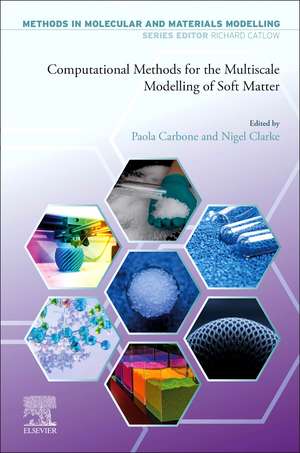
Computational Methods for the Multiscale Modeling of Soft Matter
Editat de Paola Carbone, Nigel Clarkeen Limba Engleză Paperback – 9 dec 2025
Bringing together all these modeling approaches and applications into one coherent volume, Computational Methods for the Multiscale Modeling of Soft Matter provides a one-stop resource that is written primarily for postgraduate students and researchers in materials science, computational physics, and chemists and chemical engineers interested in learning about simulation methods for soft materials such as polymers, surfactants, and colloids.
This is the first volume to publish in Elsevier's Methods in Molecular and Materials Modelling book series, curated by Sir Richard Catlow.
- Introduces the theoretical underpinnings of a broad range of soft matter modeling techniques
- Demonstrates the critical assessment of the strengths and weaknesses of each of the techniques, including comparisons with experimental data when possible
- Provides example applications to guide the reader through how techniques can be used in practice
Preț: 1013.99 lei
Preț vechi: 1489.31 lei
-32%
Puncte Express: 1521
Carte tipărită la comandă
Livrare economică 23 noiembrie-07 decembrie
Livrare prin curier în România Termenul estimat este afișat lângă disponibilitate.
Transport gratuit pentru acest produs Plată online sau ramburs, în funcție de opțiunile comenzii.
Retur gratuit în 14 zile Comandă securizată și suport în română.
Specificații
ISBN-13: 9780443273148
ISBN-10: 0443273146
Pagini: 482
Dimensiuni: 152 x 229 mm
Greutate: 0.82 kg
Editura: ELSEVIER SCIENCE
ISBN-10: 0443273146
Pagini: 482
Dimensiuni: 152 x 229 mm
Greutate: 0.82 kg
Editura: ELSEVIER SCIENCE
Cuprins
Foreword by Sir Richard Catlow
Preface by Paola Carbone and Nigel Clarke
Part I: Soft Matter Modelling Methods
1. Using Dissipative Particles Dynamics to Model Polymeric Systems
2. Self Consistent Field Theory and Field Theoretic Simulations for Predicting Microphase Separation in Block Copolymers
3. Simulations of Colloidal Systems
4. Methods to Model Ionic Systems
5. Capturing Atomistic Dynamics of Macromolecules via Coarse-Grained Modeling
6. Mixing Atoms and Coarse-Grained Beads in Modeling Polymers
Part II: Applications
7. Monte Carlo Simulations of Packings of Colloidal Systems
8. Insights into Morphology and Ion Transport from Simulations of Ionic Polymers
9. Modelling charge transfer in polymers
10. The Fascinating Behavior of Polymers at Interfaces
11. Polymer Field Theory Calculations of Grafted Nanoparticles
12. Nanocomposites. Applying MD to Determine Polymer Structure and Dynamics in the Presence of Nanoparticles
13. Free Volume Elements in Polymer Membranes: Theory, Characterization, Functional Significance, and Design Strategy
14. Polymer Composites Modeling in the Tyre Industry
Preface by Paola Carbone and Nigel Clarke
Part I: Soft Matter Modelling Methods
1. Using Dissipative Particles Dynamics to Model Polymeric Systems
2. Self Consistent Field Theory and Field Theoretic Simulations for Predicting Microphase Separation in Block Copolymers
3. Simulations of Colloidal Systems
4. Methods to Model Ionic Systems
5. Capturing Atomistic Dynamics of Macromolecules via Coarse-Grained Modeling
6. Mixing Atoms and Coarse-Grained Beads in Modeling Polymers
Part II: Applications
7. Monte Carlo Simulations of Packings of Colloidal Systems
8. Insights into Morphology and Ion Transport from Simulations of Ionic Polymers
9. Modelling charge transfer in polymers
10. The Fascinating Behavior of Polymers at Interfaces
11. Polymer Field Theory Calculations of Grafted Nanoparticles
12. Nanocomposites. Applying MD to Determine Polymer Structure and Dynamics in the Presence of Nanoparticles
13. Free Volume Elements in Polymer Membranes: Theory, Characterization, Functional Significance, and Design Strategy
14. Polymer Composites Modeling in the Tyre Industry