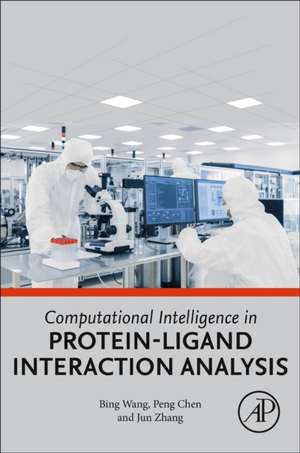
Computational Intelligence in Protein-Ligand Interaction Analysis
Autor Bing Wang, Peng Chen, Jun Zhangen Limba Engleză Paperback – 26 mar 2024
- Presents a guide to computational techniques for protein-ligand interaction analysis
- Guides researchers in developing advanced computational intelligence methods for the protein-ligand problem
- Identifies appropriate computational tools for various problems
- Demonstrates the use of advanced techniques such as vector machine, neural networks, and machine learning
- Offers the computational, mathematical and statistical skills researchers need
Preț: 982.83 lei
Preț vechi: 1333.25 lei
-26%
Puncte Express: 1474
Carte tipărită la comandă
Livrare economică 20 noiembrie-04 decembrie
Livrare prin curier în România Termenul estimat este afișat lângă disponibilitate.
Transport gratuit pentru acest produs Plată online sau ramburs, în funcție de opțiunile comenzii.
Retur gratuit în 14 zile Comandă securizată și suport în română.
Specificații
ISBN-13: 9780128243862
ISBN-10: 0128243864
Pagini: 278
Ilustrații: 60 illustrations (30 in full color)
Dimensiuni: 152 x 229 mm
Greutate: 0.46 kg
Editura: ELSEVIER SCIENCE
ISBN-10: 0128243864
Pagini: 278
Ilustrații: 60 illustrations (30 in full color)
Dimensiuni: 152 x 229 mm
Greutate: 0.46 kg
Editura: ELSEVIER SCIENCE
V-ar putea interesa
-
 Molecular Genetics, Gene Transfer, and TherapyW. Jean Dodds-5%Preț: 1086.55 lei1143.73 lei
 -
 Nitric Oxide, Part B: Physiological and Pathological ProcessesJohn N. Abelson-27%Preț: 744.57 lei1019.96 lei
 -
 Molecular ChaperonesJohn N. Abelson-27%Preț: 744.08 lei1019.29 lei
 -
 -8%Preț: 435.41 lei473.27 lei
 -
 Molecular EpidemiologySchulte-5%Preț: 569.40 lei599.37 lei
 -
 The Molecular Origins of LifeAndre Brack-14%Preț: 904.99 lei1052.32 lei
 -
 Classical Chinese Poetry in SingaporeBing Wang-32%Preț: 553.00 lei817.46 lei
 -
 -23%Preț: 732.44 lei951.23 lei
 -
 Advances in Lipobiology, Volume 1R.W. Gross-23%Preț: 734.88 lei954.39 lei
 -
 -20%Preț: 612.61 lei765.76 lei
 -
 The Growing Plant Cell Wall: Chemical and Metabolic AnalysisStephen C. FryPreț: 396.80 lei
 -
 Preț: 474.01 lei
 -
 Bio-Inspired Information and Communications TechnologiesTadashi Nakano-15%Preț: 501.53 lei590.03 lei
 -
 Algorithms and Architectures for Parallel ProcessingRocco Aversa-20%Preț: 324.41 lei405.51 lei
 -
 Advances in Web-Based Learning -- ICWL 2015Frederick W. B. LiPreț: 395.47 lei
 -
 Multiple Sequence AlignmentsTheodor Sperlea-15%Preț: 436.13 lei513.10 lei
 -
 -5%Preț: 714.43 lei752.03 lei
 -
 Low-overhead Communications in IoT NetworksYuanming Shi-18%Preț: 596.35 lei727.25 lei
 -
 -18%Preț: 1551.67 lei1892.28 lei
 -
 Protein-Protein InteractionsKrishna Mohan Poluri-18%Preț: 1273.24 lei1552.72 lei
 -
 Bioinformatics in Rice ResearchManoj Kumar Gupta-18%Preț: 1458.37 lei1778.50 lei
 -
 Applications of Bioinformatics in Rice ResearchManoj Kumar Gupta-18%Preț: 1160.99 lei1415.85 lei
 -
 Preț: 394.75 lei
 -
 Bioinformatics for agriculture: High-throughput approachesAtul Kumar Upadhyay-24%Preț: 924.43 lei1216.35 lei
Cuprins
1. Computational intelligence methods in protein-ligand interactions
2. Random forest method for predicting protein ligand-binding residues
3. Encoders of protein residues for identifying protein-protein interacting residues
4. Identification of hot spot residues in protein interfaces from protein sequences and ensemble methods
5. Semi-supervised prediction of protein interaction sites from unlabeled sample information
6. Developing computational model to predict protein-protein interaction sites based on XGBoost algorithm
7. Evolutional algorithms and their applications in protein long-range contact prediction
8. A novel robust geometric approach for modelling protein-protein interaction networks
9. Prediction of protein-protein interactions from amino acid sequences with ensemble extreme learning machines and principal component analysis
10. Ensemble learning-based prediction on drug-target interactions
11. Convolutional neural networks for drug-target interaction prediction
12. Ensemble learning methods for drug-induced liver injury identification
13. Database construction for mutant protein interactions
14. A linear programming computational framework integrates phosphor-proteomics and prior knowledge to predict drug efficacy
2. Random forest method for predicting protein ligand-binding residues
3. Encoders of protein residues for identifying protein-protein interacting residues
4. Identification of hot spot residues in protein interfaces from protein sequences and ensemble methods
5. Semi-supervised prediction of protein interaction sites from unlabeled sample information
6. Developing computational model to predict protein-protein interaction sites based on XGBoost algorithm
7. Evolutional algorithms and their applications in protein long-range contact prediction
8. A novel robust geometric approach for modelling protein-protein interaction networks
9. Prediction of protein-protein interactions from amino acid sequences with ensemble extreme learning machines and principal component analysis
10. Ensemble learning-based prediction on drug-target interactions
11. Convolutional neural networks for drug-target interaction prediction
12. Ensemble learning methods for drug-induced liver injury identification
13. Database construction for mutant protein interactions
14. A linear programming computational framework integrates phosphor-proteomics and prior knowledge to predict drug efficacy