Cantitate/Preț
Produs

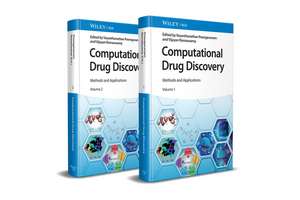
Computational Drug Discovery – Methods and Applications

Autor V Poongavanam
en Limba Engleză Hardback – 20 feb 2024

În contextul actual al cercetării farmaceutice, unde viteza de identificare a compușilor activi este critică, Computational Drug Discovery – Methods and Applications se poziționează ca o resursă academică și tehnică de referință. Considerăm că această lucrare în două volume reprezintă un pilon esențial pentru curriculumul de chimie computațională și design de medicamente, oferind o sinteză între bazele teoretice și aplicațiile industriale recente. Ne-a atras atenția în mod deosebit modul în care V Poongavanam integrează progresele din inteligența artificială, precum predicția structurii proteinelor și screening-ul virtual generativ, cu infrastructura modernă de calcul de tip cloud și quantum.

Lucrarea acoperă aceeași arie tematică precum Computational Drug Discovery and Design de Mohini Gore, dar se distinge printr-o abordare mult mai extinsă asupra noilor modalități terapeutice. În timp ce volumul lui Gore se concentrează pe metodele clasice de optimizare a lead-urilor, ediția de față explorează frontierele designului de tip PROTACs și al „molecular glues”, oferind soluții pentru ținte biologice considerate anterior inaccesibile. De asemenea, spre deosebire de Quantum Mechanics in Drug Discovery, care este focalizat strict pe metodele QM, acest tratat oferă o perspectivă interdisciplinară, legând mecanica cuantică de dinamica moleculară și big data.

Structura celor opt secțiuni tematice ghidează cititorul de la fundamentele termodinamicii solvării și cinetica legării drug-target, către aplicații complexe de deep learning. Progresia editorială este logică: primele volume așază fundamentul fizico-chimic prin QM/MM, urmând ca secțiunile ulterioare să abordeze navigarea în spațiul chimic și predicțiile ADMET in silico, esențiale pentru reducerea ratei de eșec în studiile clinice.

Citește tot Restrânge

Preț: 166680 lei

Preț vechi: 216467 lei
-23%

Puncte Express: 2500

Carte disponibilă

Livrare economică 06-12 mai
Livrare express 24-30 aprilie pentru 8924 lei


Specificații

ISBN-13: 9783527351664
ISBN-10: 3527351663
Pagini: 736
Dimensiuni: 182 x 253 x 47 mm
Greutate: 1.69 kg
Ediția:2 Volumes
Editura: Wiley Vch
Locul publicării:Weinheim, Germany

De ce să citești această carte

Recomandăm această lucrare profesioniștilor din industria biotech și cercetătorilor care doresc să stăpânească instrumentele de AI și quantum computing aplicate în farmacologie. Cititorul câștigă acces la metodologii de ultimă oră pentru screening virtual la scară ultra-largă și design de inhibitori covalenți, beneficiind de expertiza combinată a mediului academic și a furnizorilor de software de top. Este o investiție necesară pentru orice laborator modern de design rațional al medicamentelor.


Cuprins

Preface Volume 1: PART I. MOLECULAR DYNAMICS AND RELATED METHODS IN DRUG DISCOVERY Binding Free Energy Calculations in Drug Discovery Gaussian Accelerated Molecular Dynamics in Drug Discovery MD Simulations for Drug-Target (Un)Binding Kinetics Solvation Thermodynamics and its Competitive Saturation as a Paradigm of Co-Solvent Methods PART II. QUANTUM MECHANICS APPLICATION FOR DRUG DISCOVERY QM/MM Approaches for Structure Based Drug Design: Techniques and Applications Recent Advances in Practical Quantum Mechanics and Mixed-QM/MM Driven X-Ray Crystallography and Cryo-Electron Microscopy (Cryo-EM) and their Impact on Structure-Based Drug Discovery Quantum-Mechanical Analyses of Interactions for Biochemical Applications PART III. ARTIFICIAL INTELLIGENCE IN PRE-CLINICAL DRUG DISCOVERY The Role of Computer Aided Drug Design in Drug Discovery - An Introduction AI-Based Protein Structure Predictions and their Implications in Drug Discovery Deep Learning for the Structure-Based Binding Free Energy Prediction of Small Molecule Ligands Using Artificial Intelligence for the De Novo Drug Design and Retrosynthesis Reliability and Applicability Assessment for Machine Learning Models Volume 2: PART IV. CHEMICAL SPACE AND KNOWLEDGE BASED DRUG DISCOVERY Enumerable Libraries and Accessible Chemical Space Navigating Chemical Space Visualization, Exploration, and Screening of Chemical Space in Drug Discovery SAR Knowledge Based for Driving Drug Discovery Cambridge Structural Database (CSD) - Drug Discovery through Data Mining and Knowledge Based Tools PART V. STRUCTURE-BASED VIRTUAL SCREENING USING DOCKING Structure-Based Ultra-Large Scale Virtual Screenings Community Benchmarking Exercises for Docking and Scoring PART VI. IN SILICO ADMET MODELLING Advances in the Application of In Silico ADMET Models - An Industry Perspective PART VII. COMPUTATIONAL APPROACHES FOR NEW THERAPEUTIC MODALITIES Modelling the Structures of Ternary Complexes Mediated by Molecular Glues Free Energy Calculations in Covalent Drug Design PART VIII. COMPUTING TECHNOLOGIES DRIVING DRUG DISCOVERY Orion® A Cloud-Native Molecular Design Platform Cloud-Native Rendering Platform and GPUs Aid Drug Discovery The Quantum Computing Paradigm

Descriere scurtă

Provide readers with an overview of modern technologies, emphasizing AI for drug discovery.

Descriere

Computational Drug Discovery A comprehensive resource that explains a wide array of computational technologies and methods driving innovation in drug discovery Computational Drug Discovery: Methods and Applications (2 volume set) covers a wide range of cutting-edge computational technologies and computational chemistry methods that are transforming drug discovery. The book delves into recent advances, particularly focusing on artificial intelligence (AI) and its application for protein structure prediction, AI-enabled virtual screening, and generative modeling for compound design. Additionally, it covers key technological advancements in computing such as quantum and cloud computing that are driving innovations in drug discovery. Furthermore, dedicated chapters that addresses the recent trends in the field of computer aided drug design, including ultra-large-scale virtual screening for hit identification, computational strategies for designing new therapeutic modalities like PROTACs and covalent inhibitors that target residues beyond cysteine are also presented. To offer the most up-to-date information on computational methods utilized in Computational Drug Discovery, it covers chapters highlighting the use of molecular dynamics and other related methods, application of QM and QM/MM methods in computational drug design, and techniques for navigating and visualizing the chemical space, as well as leveraging big data to drive drug discovery efforts. The book is thoughtfully organized into eight thematic sections, each focusing on a specific computational method or technology applied to drug discovery. Authored by renowned experts from academia, pharmaceutical industry, and major drug discovery software providers, it offers an overview of the latest advances in computational drug discovery. Key topics covered in the book include: Application of molecular dynamics simulations and related approaches in drug discovery The application of QM, hybrid approaches such as QM/MM, and fragment molecular orbital framework for understanding protein-ligand interactions Adoption of artificial intelligence in pre-clinical drug discovery, encompassing protein structure prediction, generative modeling for de novo design, and virtual screening. Techniques for navigating and visualizing the chemical space, along with harnessing big data to drive drug discovery efforts. Methods for performing ultra-large-scale virtual screening for hit identification. Computational strategies for designing new therapeutic models, including PROTACs and molecular glues. In silico ADMET approaches for predicting a variety of pharmacokinetic and physicochemical endpoints. The role of computing technologies like quantum computing and cloud computing in accelerating drug discovery This book will provide readers an overview of the latest advancements in Computational Drug Discovery and serve as a valuable resource for professionals engaged in drug discovery.