Cantitate/Preț
Produs

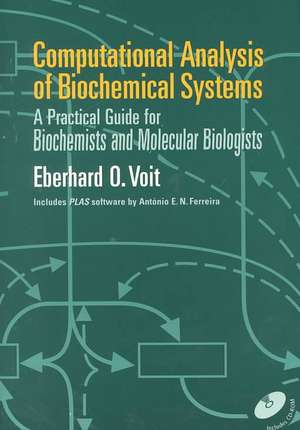
COMPUTATIONAL ANALYSIS OF BIOC

Autor Eberhard O. Voit
en Paperback – 31 aug 2000

Recomandăm această lucrare biochimiștilor și biologilor moleculari care doresc să treacă de la intuiție la rigoarea analizei matematice, fără a fi neapărat experți în calcul avansat. Într-o eră dominată de rezultatele Proiectului Genomului Uman, COMPUTATIONAL ANALYSIS OF BIOC devine un instrument esențial pentru înțelegerea modului în care manipularea genelor și a proceselor biochimice poate revoluționa dezvoltarea medicamentelor și tratamentele personalizate.

Cine a apreciat Systems Biology and Bioinformatics de Kayvan Najarian va găsi aici o abordare similară în utilizarea metodelor computaționale pentru date biomedicale, dar cu un accent mult mai pronunțat pe construirea efectivă a modelelor de la zero și pe aplicarea lor în căi metabolice specifice. Structura cărții, semnată de Eberhard O. Voit, este remarcabil de didactică: începe cu reprezentarea grafică a sistemelor, progresează spre formularea ecuațiilor și culminează cu tehnici de simulare și estimare a parametrilor.

Elementul distinctiv al acestui volum publicat de Cambridge University Pr. este componenta sa practică masivă. Cu 235 de exerciții și patru studii de caz aprofundate — de la ciclul acidului tricarboxilic la metabolismul purinelor — textul nu rămâne la nivel teoretic, ci ancorează conceptele în literatura modernă de specialitate. Ritmul este unul progresiv, asigurându-se că fiecare pas este ilustrat prin exemple clare și susținut de software-ul însoțitor, transformând complexitatea sistemelor biomedicale într-un proces de învățare logic și structurat.

Citește tot Restrânge

Preț: 37528 lei

Preț vechi: 43248 lei
-13%

Puncte Express: 563

Carte tipărită la comandă

Livrare economică 29 mai-03 iunie


Specificații

ISBN-13: 9780521785792
ISBN-10: 0521785790
Pagini: 544
Ilustrații: 182 b/w illus. 37 tables 235 exercises
Dimensiuni: 178 x 252 x 27 mm
Greutate: 0.98 kg
Ediția:1
Editura: Cambridge University Pr.
Locul publicării:New York, United States

De ce să citești această carte

Această carte este ideală pentru cercetătorii care vor să stăpânească biologia sistemelor fără a fi copleșiți de formalism matematic excesiv. Cititorul câștigă capacitatea de a construi și analiza modele computaționale proprii, esențiale în biotehnologia modernă. Este o resursă rară care face legătura între hărțile biochimice vizuale și simulările pe calculator, oferind soluții concrete prin cele peste 200 de exerciții incluse.


Descriere scurtă

Throughout the foreseeable future, research in medicine, molecular biology, and biotechnology will be dominated by scientific advances resulting from the Human Genome Project. Knowledge of genomes will elucidate disease patterns and promise improved and personalized treatments. Food and drug development will be revolutionized by focused manipulation of genes and biochemical processes. Researchers will begin to construct metabolic pathways from scratch. A true understanding of genetic and metabolic function and design will depend on mathematical and computational methods for analyzing biochemical systems. It will require new ways of thinking and novel approaches of integrative analysis. This book teaches biochemists and molecular biologists the use of modern computational methods for the analysis of complex biomedical systems without assuming more than a modest background in mathematics. The book begins with representations of biochemical systems, provides guidelines for setting up models, discusses in detail mathematical and computational methods of parameter estimation and model analysis, and ultimately connects to the modern literature with four detailed case studies. Every step is illustrated with examples and explored with accompanying software.

Cuprins

Preface; Introduction; 1. Graphical representation of biochemical systems; 2. Models of biochemical systems; 3. From maps to equations; 4. Computer simulation; 5. Parameter estimation; 6. Analytical steady-state evaluation; 7. Sensitivity analysis; 8. Case study 1 - Anaerobic fermentation pathway in Saccharomyces cerevisiae; 9. Case study 2 - diagnosis and refinement of a model of the tricarboxylic acid cycle in Dictyostelium discoideum; 10. Case study 3 - A sequence of models describing purine metabolism; 11. Case study 4 - Algebraic analysis of the initial steps of the Glycolytic-Glycogenolytic pathway in perfused rat liver; 12. Epilogue-Canonical modeling beyond biochemistry; Appendix; Hints and solutions; References; Author index; Subject index.

Recenzii

'… is not only a fine, but a long overdue, book … this is an excellent introduction to a complex field, which I am happy to recommend to anyone.' Darren Flower, Chemistry in Britain

Descriere

A true understanding of genetic and metabolic function and design is facilitated by mathematical and computational methods for analyzing biochemical systems. This hands-on reference teaches biochemists and molecular biologists the use of modern computational methods for the analysis of complex biomedical systems requiring a modest mathematical background. The book begins with representations of biochemical systems, provides guidelines for setting up models, details mathematical and computational methods of parameter estimation and model analysis, and connects to the modern literature with four detailed case studies. Every step is illustrated with examples and explored with accompanying PLAS software. The volume also features over 250 exercises with about one quarter fully or partially solved.