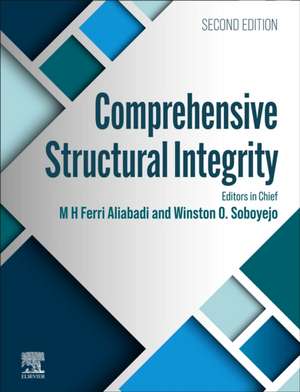
Comprehensive Structural Integrity
Ferri M.H. Aliabadi, Winston (Wole) Soboyejoen Limba Engleză Hardback – 28 apr 2023
Structural Integrity is the ability of a component, structure or asset to operate properly under the pressure of a load, including the weight of the asset itself. It’s a vital consideration for structural engineering: essentially the science and technology which can prevent disaster.
- Provides a one-stop resource for researchers with its comprehensive coverage of theoretical and practical aspects of structural integrity
- Covers detailed information that will benefit a wide range of readers in this multidisciplinary field
- Presents case studies that are important for practical applications and industries such as construction/engineering, aircraft, energy (nuclear, oil and gas, power engineering)
- Includes new chapters that focus on recent developments in materials engineering e.g., advanced composite materials, bio/bio-medical engineering, nano- and micro- structured materials
Preț: 19638.41 lei
Preț vechi: 27031.37 lei
-27%
Puncte Express: 29458
Carte tipărită la comandă
Livrare economică 28 noiembrie-12 decembrie
Livrare prin curier în România Termenul estimat este afișat lângă disponibilitate.
Transport gratuit pentru acest produs Plată online sau ramburs, în funcție de opțiunile comenzii.
Retur gratuit în 14 zile Comandă securizată și suport în română.
Specificații
ISBN-13: 9780128229446
ISBN-10: 0128229446
Pagini: 4923
Ilustrații: Approx. 420 illustrations (420 in full color)
Dimensiuni: 216 x 276 mm
Ediția:2
Editura: ELSEVIER SCIENCE
ISBN-10: 0128229446
Pagini: 4923
Ilustrații: Approx. 420 illustrations (420 in full color)
Dimensiuni: 216 x 276 mm
Ediția:2
Editura: ELSEVIER SCIENCE
V-ar putea interesa
-
 -23%Preț: 369.34 lei480.57 lei
 -
 Materials: Engineering, Science, Processing and DesignMichael F. Ashby-30%Preț: 421.47 lei600.65 lei
 -
 Mechanical Behavior of Materials: Deformation and DesignRajiv S. Mishra-32%Preț: 529.24 lei777.61 lei
 -
 Aircraft Structures for Engineering StudentsT. H. G. Megson-30%Preț: 482.03 lei692.90 lei
 -
 Williams, D: Structural MechanicsD. Williams-11%Preț: 652.66 lei733.32 lei
 -
 StructuresJ. E. GordonPreț: 108.04 lei
 -
 -18%Preț: 527.45 lei646.10 lei
 -
 Structural Engineering: A Very Short IntroductionDavid Blockley-28%Preț: 50.96 lei70.82 lei
 -
 FragilitiesFernando Dominguez Rubio-14%Preț: 452.10 lei525.70 lei
 -
 Structural Design for Fire SafetyAndrew H. Buchanan-19%Preț: 407.96 lei503.65 lei
 -
 -21%Preț: 207.24 lei261.48 lei
 -
 Applied Mechanics of SolidsAllan F. Bower-14%Preț: 792.43 lei921.43 lei
 -
 Practical Reliability EngineeringAndre V. Kleyner-23%Preț: 815.99 lei1059.74 lei
 -
 Handbook of Damage MechanicsGeorge Z. Voyiadjis-23%Preț: 3294.42 lei4278.47 lei
 -
 -30%Preț: 97.81 lei139.80 lei
 -
 -18%Preț: 1453.87 lei1773.00 lei
 -
 The Structural Integrity of Carbon Fiber CompositesPeter W. R Beaumont-18%Preț: 2214.02 lei2700.02 lei
 -
 Recent Developments in Structural Engineering, Volume 4Manmohan Dass Goel-18%Preț: 1457.90 lei1777.92 lei
Cuprins
Section 1: Structural Integrity Assessment - Examples and Case Studies
Section 2: Fundamental Theories and Mechanisms of Failure
Section 3: Numerical and Computational Methods
Section 4: Cyclic Loading and Fatigue
Section 5: Creep and High-temperature Failure
Section 6: Environmentally Assisted Fatigue
Section 7: Practical Failure Assessment Methods
Section 8: Interfacial and Nanoscale Fracture
Section 9: Bioengineering
Section 10: Mechanical Characterisation of Materials
Section 2: Fundamental Theories and Mechanisms of Failure
Section 3: Numerical and Computational Methods
Section 4: Cyclic Loading and Fatigue
Section 5: Creep and High-temperature Failure
Section 6: Environmentally Assisted Fatigue
Section 7: Practical Failure Assessment Methods
Section 8: Interfacial and Nanoscale Fracture
Section 9: Bioengineering
Section 10: Mechanical Characterisation of Materials