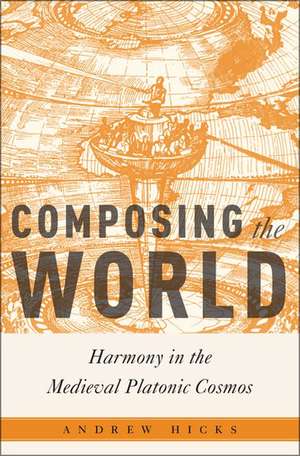
Composing the World: Harmony in the Medieval Platonic Cosmos: Critical Conjunctures in Music and Sound
Autor Andrew Hicksen Limba Engleză Hardback – 9 feb 2017



Preț: 415.45 lei
Preț vechi: 577.33 lei
-28%
Puncte Express: 623
Carte tipărită la comandă
Livrare economică 27 noiembrie-02 decembrie
Livrare prin curier în România Termenul estimat este afișat lângă disponibilitate.
Transport gratuit pentru acest produs Plată online sau ramburs, în funcție de opțiunile comenzii.
Retur gratuit în 14 zile Comandă securizată și suport în română.
Specificații
ISBN-13: 9780190658205
ISBN-10: 0190658207
Pagini: 344
Dimensiuni: 155 x 239 x 33 mm
Greutate: 0.59 kg
Editura: Oxford University Press
Colecția OUP USA
Seria Critical Conjunctures in Music and Sound
Locul publicării:New York, United States
ISBN-10: 0190658207
Pagini: 344
Dimensiuni: 155 x 239 x 33 mm
Greutate: 0.59 kg
Editura: Oxford University Press
Colecția OUP USA
Seria Critical Conjunctures in Music and Sound
Locul publicării:New York, United States
V-ar putea interesa
-
 Sound BitesAlex KapranosPreț: 90.85 lei
 -
 In the Midnight Hour: The Life & Soul of Wilson PickettTony Fletcher-8%Preț: 144.83 lei157.92 lei
 -
 -19%Preț: 87.07 lei106.84 lei
 -
 Serial CompositionReginald Smith Brindle-19%Preț: 504.56 lei622.92 lei
 -
 Conducting a ChoirImogen HolstPreț: 427.33 lei
 -
 Oboe TechniqueEvelyn Rothwell-29%Preț: 347.66 lei488.77 lei
 -
 -18%Preț: 12260.70 lei14952.08 lei
 -
 Authenticity and Early Music: A SymposiumNicholas Kenyon-29%Preț: 416.42 lei583.36 lei
 -
 Playing Recorder Sonatas: Interpretation and TechniqueAnthony Rowland-Jones-28%Preț: 427.29 lei595.17 lei
 -
 Johnny Cash: The BiographyMichael StreissguthPreț: 135.18 lei
 -
 Analytical Methods of Electroacoustic MusicMary Simoni-18%Preț: 1400.81 lei1708.30 lei
 -
 Gospel's Greatest (Fake Book)Hal Leonard CorpPreț: 257.99 lei
 -
 Liverpool - Wondrous PlacePaul Du NoyerPreț: 116.21 lei
 -
 The Pocket DJSarah Lewitinn-41%Preț: 119.00 lei201.09 lei
 -
 UKULELE CHORDSRon MiddlebrookPreț: 30.36 lei
Recenzii
The main objective of this volume is highly innovative and stimulating... Hicks' essay is a very accurate study of Harmony in the Medieval Platonic Cosmos, and is going to become a must for future researchers in a field that includes a number of disciplines with different epistemological statutes.
written from a multidisciplinary perspective that includes musicology, philosophy, and history of science ... the inspiration Hicks's book provides to reflect on the place of music in historical and contemporary ways of world-making.
Composing the World is itself well-composed -- its chapters flow, despite their many long citations from the works under discussion. As the book is very much about these texts, most readers will be glad of this florilegium ... Hicks has done a wonderful job of making a complex subject and its somewhat forbidding texts accessible and of drawing out their importance and relevance to manifold wider concerns.
Andrew Hicks has been so bold as to add a new book about world harmony, the music of the spheres, and the medieval reception of the Pythagorean concept of a creation organised according to musical principles to the already existing wealth of scholarship ... Hicks has chosen an approach which is new and refreshing, and which goes far beyond the boundaries of what already exists on the subject.
Andrew H's Composing the World is a well-written and informative work. It was undoubtedly a courageous and imaginative decision to embark on a study of the notion of cosmic harmony in twelfth-century Latin sources, since a successful outcome could only be achieved by someone who combines many skills including not only musicology but medieval Latin philology and paleography, not without some acquaintance with the histories of philosophy and science ... Andrew H. is obviously a person of great intelligence and already of considerable learning. It seems to me that with his range of expertise he is adding greatly, and could presumably so add in the future, to medieval musicology and medieval studies more generally.
This ambitious book opens a new window onto twelfth-century philosophical thought, and successfully shows how deeply Platonic conceptions of harmony were embedded within it. As well as becoming essential reading for medievalists who want to develop their knowledge of speculative music theory, it is also worth the attention of early modernists and scholars who focus on present-day philosophical and scientific thought.
Hicks writes towards the beginning of his book that, if we neglect the natural philosophers of the twelfth century, 'we have done ourselves and the discipline of musicology a grand disservice' (p. 8). By bringing a musicological perspective to his engagement with these natural philosophers, he enriches our understanding of the twelfth century's musical speculation and raises new questions that broaden musicology itself.
There is no other work on this topic that can compare in terms of depth, scope, and complexity. This book is likely to become an indispensable point of reference for the study of both medieval musical theory and the school of Chartres.
fascinating insights into the way the medieval mind worked as it tried to develop the notion of "a cosmos animated and choreographed according to a specifically musical aesthetic".
written from a multidisciplinary perspective that includes musicology, philosophy, and history of science ... the inspiration Hicks's book provides to reflect on the place of music in historical and contemporary ways of world-making.
Composing the World is itself well-composed -- its chapters flow, despite their many long citations from the works under discussion. As the book is very much about these texts, most readers will be glad of this florilegium ... Hicks has done a wonderful job of making a complex subject and its somewhat forbidding texts accessible and of drawing out their importance and relevance to manifold wider concerns.
Andrew Hicks has been so bold as to add a new book about world harmony, the music of the spheres, and the medieval reception of the Pythagorean concept of a creation organised according to musical principles to the already existing wealth of scholarship ... Hicks has chosen an approach which is new and refreshing, and which goes far beyond the boundaries of what already exists on the subject.
Andrew H's Composing the World is a well-written and informative work. It was undoubtedly a courageous and imaginative decision to embark on a study of the notion of cosmic harmony in twelfth-century Latin sources, since a successful outcome could only be achieved by someone who combines many skills including not only musicology but medieval Latin philology and paleography, not without some acquaintance with the histories of philosophy and science ... Andrew H. is obviously a person of great intelligence and already of considerable learning. It seems to me that with his range of expertise he is adding greatly, and could presumably so add in the future, to medieval musicology and medieval studies more generally.
This ambitious book opens a new window onto twelfth-century philosophical thought, and successfully shows how deeply Platonic conceptions of harmony were embedded within it. As well as becoming essential reading for medievalists who want to develop their knowledge of speculative music theory, it is also worth the attention of early modernists and scholars who focus on present-day philosophical and scientific thought.
Hicks writes towards the beginning of his book that, if we neglect the natural philosophers of the twelfth century, 'we have done ourselves and the discipline of musicology a grand disservice' (p. 8). By bringing a musicological perspective to his engagement with these natural philosophers, he enriches our understanding of the twelfth century's musical speculation and raises new questions that broaden musicology itself.
There is no other work on this topic that can compare in terms of depth, scope, and complexity. This book is likely to become an indispensable point of reference for the study of both medieval musical theory and the school of Chartres.
fascinating insights into the way the medieval mind worked as it tried to develop the notion of "a cosmos animated and choreographed according to a specifically musical aesthetic".
Notă biografică
Andrew Hicks is an Assistant Professor of Music and Medieval Studies at Cornell University, a member of the graduate fields of Classics and Near Eastern Studies, and a faculty affiliate in Religious Studies. His scholarship clusters around the intellectual history of musical thought from a cross-disciplinary perspective that embraces philosophical, cosmological, scientific, and grammatical discourse in Late Antiquity and the Middle Ages, and spans the linguistic and cultural spheres of Latin, Greek, Persian, and Arabic.