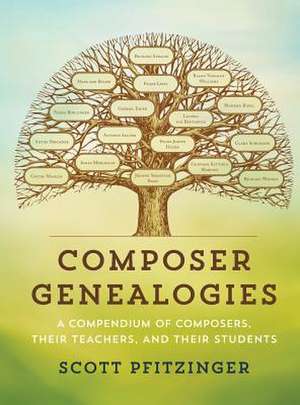
Composer Genealogies: A Compendium of Composers, Their Teachers, and Their Students
Autor Scott Pfitzingeren Limba Engleză Hardback – mar 2017
Functioning as its own fully cross-referenced index, this volume lists composers and their dates, followed by their teachers and notable students. A short introduction presents the parameters by which composers were selected and provides a survey of the literature available for further study. Gathering records and information from reference books, university websites, obituaries, articles, composers' websites, and even direct contact with some composers, Pfitzinger creates a valuable resource for music researchers, composers, and performers.
Preț: 943.16 lei
Preț vechi: 1404.29 lei
-33%
Puncte Express: 1415
Carte tipărită la comandă
Livrare economică 30 mai-13 iunie
Specificații
ISBN-13: 9781442272248
ISBN-10: 1442272244
Pagini: 628
Dimensiuni: 224 x 292 x 38 mm
Greutate: 1.95 kg
Editura: Bloomsbury Publishing
Colecția Rowman & Littlefield
Locul publicării:New York, United States
ISBN-10: 1442272244
Pagini: 628
Dimensiuni: 224 x 292 x 38 mm
Greutate: 1.95 kg
Editura: Bloomsbury Publishing
Colecția Rowman & Littlefield
Locul publicării:New York, United States
V-ar putea interesa
-
 -15%Preț: 660.67 lei777.26 lei
 -
 Phonetic Readings of Brahms LiederCandace A. Magner-15%Preț: 539.86 lei635.13 lei
 -
 Septimus Winner: Two Lives in MusicMichael K. Remson-34%Preț: 556.55 lei837.85 lei
 -
 An Index to Music Published in The Etude Magazine, 1883-1957Douglas E. Bomberger-35%Preț: 1156.09 lei1770.23 lei
 -
 Reminiscences of an American Composer and PianistGeorge Walker-33%Preț: 344.67 lei515.36 lei
 -
 -36%Preț: 360.41 lei560.15 lei
 -
 The Mélodies of Francis Poulenc: A Study GuideAlissa Deeter-30%Preț: 592.57 lei845.69 lei
 -
 Georges Bizet: A BiographyChristoph Schwandt-36%Preț: 535.13 lei835.77 lei
 -
 Experiencing Leonard Bernstein: A Listener's CompanionKenneth LaFave-22%Preț: 350.86 lei448.33 lei
 -
 Preț: 51.22 lei
 -
 -28%Preț: 271.07 lei376.27 lei
 -
 WHYJohn SchlittPreț: 98.93 lei
 -
 Believe Your Ears: Life of a Lyric ComposerKirke Mechem-28%Preț: 264.57 lei367.25 lei
 -
 The Who: 50Ben MarshallPreț: 245.27 lei
 -
 Richard Wagners ,Das Judentum in der Musik'Jens Malte FischerPreț: 243.37 lei
 -
 El Régimen laboral en la inversión extranjera en CubaGuillermo Ferriol MolinaPreț: 127.58 lei
 -
 Alles oder NixXatarPreț: 130.18 lei
Recenzii
This unique reference tool by Pfitzinger (Univ. of Wisconsin-La Crosse) consists entirely of an alphabetical list of more than 17,300 composers' teachers and notable students, giving dates and country of origin (and for some, primary countries of association). The entry for American composer John Knowles Paine (1839-1906), for example, lists three teachers and 16 students; one can readily discover here that his teachers were German and his students mostly American-some of whom achieved modest renown. Other composers' entries show more teachers and, in many cases, dozens more students; those for Aaron Copland and Howard Hanson feature extensive listings of students. These social network and genealogical connections are important insofar as they trace the special influence composers can have on their students through time. Coverage is limited to composers of classical works (or in some cases, stretching the definition to include "cross-over" composers such as Herbie Hancock). Some known primarily for their stature in performance rather than composition also appear in these pages. The internationally known Austrian pianist Artur Schnabel (1884-1951), for instance, is shown to have had two teachers and no fewer than 20 students in composition, some of whom were also performers. An essential addition for all libraries maintaining comprehensive music collections. Summing Up: Essential. Undergraduates through professionals/practitioners; general readers.
Scott Pfitzinger's massive book is a thoroughly surprising release, not least because it seems as if such an encyclopaedic examination of teachers and followers in Western art music should have been produced long ago.... Pfitzinger's book...is an invaluable resource for anyone curious of the rawest data of Western art music history.
This large volume documents the genealogies or pedigrees of musical composers from the 18th century to the present. One of the ways that musicians establish credibility and public interest in their music is through the teachers under whom they studied, as well as those teachers under whom their teachers studied. The author of this book has documented, as much as possible, the genealogies of musical composers who have taught other composers; it thus does not try to be comprehensive regarding other musical disciplines or instruments and their pedigrees. Just focusing on musical composers has produced a book of over 600 pages. The entries are listed alphabetically, starting with the composer's name and dates, the primary countries where they lived, their teachers, and their notable students. The book serves as an index with comprehensive cross-referencing. One can follow a composer's musical pedigree both backwards through their teachers and forwards through their students, so this volume is a fantastic quick reference source for learning who influenced whom in the musical composition world in the last 350 years.
What a marvelous resource! With Scott Pfitzinger's excellent work, research that once took weeks can now be accomplished in a couple of hours or less. Researchers can easily trace with whom a particular composer has studied and make connections as to why a stylistic shift occurred in their music.
This book will be a joy for any readers interested in genealogy or family trees. It's wonderful to trace the various threads of influence and development throughout the centuries.
Scott Pfitzinger's massive book is a thoroughly surprising release, not least because it seems as if such an encyclopaedic examination of teachers and followers in Western art music should have been produced long ago.... Pfitzinger's book...is an invaluable resource for anyone curious of the rawest data of Western art music history.
This large volume documents the genealogies or pedigrees of musical composers from the 18th century to the present. One of the ways that musicians establish credibility and public interest in their music is through the teachers under whom they studied, as well as those teachers under whom their teachers studied. The author of this book has documented, as much as possible, the genealogies of musical composers who have taught other composers; it thus does not try to be comprehensive regarding other musical disciplines or instruments and their pedigrees. Just focusing on musical composers has produced a book of over 600 pages. The entries are listed alphabetically, starting with the composer's name and dates, the primary countries where they lived, their teachers, and their notable students. The book serves as an index with comprehensive cross-referencing. One can follow a composer's musical pedigree both backwards through their teachers and forwards through their students, so this volume is a fantastic quick reference source for learning who influenced whom in the musical composition world in the last 350 years.
What a marvelous resource! With Scott Pfitzinger's excellent work, research that once took weeks can now be accomplished in a couple of hours or less. Researchers can easily trace with whom a particular composer has studied and make connections as to why a stylistic shift occurred in their music.
This book will be a joy for any readers interested in genealogy or family trees. It's wonderful to trace the various threads of influence and development throughout the centuries.