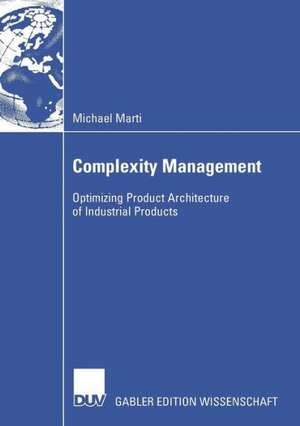
Complexity Management
Autor Michael Martien Limba Engleză Paperback – 25 sep 2007
Preț: 387.31 lei
Puncte Express: 581
Carte tipărită la comandă
Livrare economică 26 noiembrie-10 decembrie
Livrare prin curier în România Termenul estimat este afișat lângă disponibilitate.
Transport gratuit de la 400.00 lei Plată online sau ramburs, în funcție de opțiunile comenzii.
Retur gratuit în 14 zile Comandă securizată și suport în română.
Specificații
ISBN-13: 9783835008663
ISBN-10: 3835008668
Pagini: 280
Ilustrații: XXVIII, 248 p.
Dimensiuni: 148 x 210 x 16 mm
Greutate: 0.37 kg
Ediția:2007
Editura: Deutscher Universitätsverlag
Locul publicării:Wiesbaden, Germany
ISBN-10: 3835008668
Pagini: 280
Ilustrații: XXVIII, 248 p.
Dimensiuni: 148 x 210 x 16 mm
Greutate: 0.37 kg
Ediția:2007
Editura: Deutscher Universitätsverlag
Locul publicării:Wiesbaden, Germany
V-ar putea interesa
-
 -19%Preț: 319.07 lei394.80 lei
 -
 Delivering Excellence In Health And Social CareMax Moullin-29%Preț: 183.38 lei258.26 lei
 -
 Preț: 374.31 lei
 -
 Developing Products in Half the TimePreston G SmithPreț: 276.85 lei
 -
 Improving Production with Lean ThinkingJavier Santos-9%Preț: 853.92 lei938.37 lei
 -
 Service OrientationPaul AllenPreț: 467.42 lei
 -
 Leading GeeksPaul GlenPreț: 150.80 lei
 -
 Being Agile in BusinessBelinda WaldockPreț: 93.47 lei
 -
 Global Logistics Management 2eGourdinPreț: 364.27 lei
 -
 Cellular Manufacturing: One-Piece Flow for WorkteamsProductivity Development TeamPreț: 337.32 lei
 -
 Towards Innovative Freight and LogisticsCorinne Blanquart-9%Preț: 1029.39 lei1131.20 lei
Public țintă
ResearchCuprins
Background and Fundamental Concepts.- Literature Review: Existing Concepts.- Complexity Management Model.- Case Studies.- Conclusion.
Notă biografică
Dr. Michael Marti promovierte bei Prof. Dr. Fritz Fahrni am Institut für Technologiemanagement der Universität St. Gallen. Er ist als Produktmanager bei Siemens tätig.
Textul de pe ultima copertă
The task of managing complexity in enterprises receives special attention from theorists and practitioners alike. Creating products that fulfill the market requirements but do not cause excessive complexity costs poses a major challenge to managers.
Michael Marti presents a complexity management model that is based on the reasoning that product architecture determines to a considerable extent how external complexity is translated into physical products. The model demonstrates a procedure to optimize a product’s architecture and is applied to several industrial products. It is able to shed light on the sources of complexity within a product’s architecture, and the same or even increased customer benefit can be delivered while causing less internal complexity.
Michael Marti presents a complexity management model that is based on the reasoning that product architecture determines to a considerable extent how external complexity is translated into physical products. The model demonstrates a procedure to optimize a product’s architecture and is applied to several industrial products. It is able to shed light on the sources of complexity within a product’s architecture, and the same or even increased customer benefit can be delivered while causing less internal complexity.