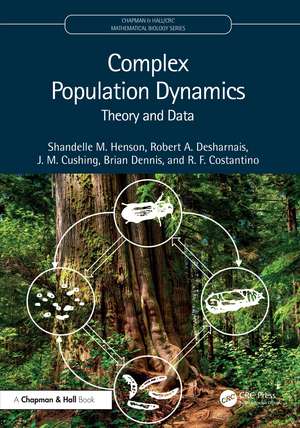
Complex Population Dynamics: Theory and Data: Chapman & Hall/CRC Mathematical Biology Series
Autor Shandelle M. Henson, Robert A. Desharnais, J. M. Cushing, Brian Dennis, R. F. Costantinoen Limba Engleză Hardback – 28 mai 2026
The book offers an invaluable resource to professional ecologists and applied mathematicians. Although primarily a reference text, it is written to be accessible and engaging to a student audience and could be used as supplementary reading in an advanced ecological modeling class.
Features
- Written in an engaging style with minimal mathematical prerequisites, making it accessible to an audience of general ecologists as well as a more specialized mathematical audience
- A complete accompanying data set from all experiments is freely available on Dryad
- Readers can conveniently explore the model dynamics under discussion with an online LPA simulator.
Din seria Chapman & Hall/CRC Mathematical Biology Series
- 9%
 Preț: 1328.60 lei
 - 9%
 Preț: 973.30 lei
 - 15%
 Preț: 530.47 lei
 - 18%
 Preț: 733.23 lei
 - 11%
 Preț: 483.39 lei
 -
 Preț: 503.68 lei
 -
 Preț: 483.70 lei
 -
 Preț: 448.35 lei
 - 15%
 Preț: 561.92 lei
 - 18%
 Preț: 1045.38 lei
 - 5%
 Preț: 463.38 lei
 - 15%
 Preț: 452.13 lei
 - 24%
 Preț: 559.82 lei
 - 25%
 Preț: 1339.77 lei
 - 10%
 Preț: 391.26 lei
 - 24%
 Preț: 827.73 lei
Preț: 805.35 lei
Preț vechi: 982.14 lei
-18%
Puncte Express: 1208
Carte tipărită la comandă
Livrare economică 30 noiembrie-14 decembrie
Livrare prin curier în România Termenul estimat este afișat lângă disponibilitate.
Transport gratuit pentru acest produs Plată online sau ramburs, în funcție de opțiunile comenzii.
Retur gratuit în 14 zile Comandă securizată și suport în română.
Specificații
ISBN-13: 9781032736594
ISBN-10: 1032736593
Pagini: 338
Ilustrații: 236
Dimensiuni: 178 x 254 mm
Greutate: 0.8 kg
Ediția:1
Editura: CRC Press
Colecția Chapman and Hall/CRC
Seria Chapman & Hall/CRC Mathematical Biology Series
ISBN-10: 1032736593
Pagini: 338
Ilustrații: 236
Dimensiuni: 178 x 254 mm
Greutate: 0.8 kg
Ediția:1
Editura: CRC Press
Colecția Chapman and Hall/CRC
Seria Chapman & Hall/CRC Mathematical Biology Series
Public țintă
Academic, Postgraduate, and Professional ReferenceCuprins
Part 1: Introduction 1. Sources of Patterns in Population Dynamics 2. Connecting Models with Data 3. Exploring State Space Part 2: Population Data and Models 4. The Tribolium Laboratory Model 5. The LPA Model Part 3: Models as Scientific Hypotheses 6. Transitions between Attractors 7. A Route to Chaos 8. Lattice Effects 9. How Is Chaos Manifest in Noisy Populations? 10. Demographic Stochasticity 11. Controlling Chaos Part 4: Recognizing Nonlinear Phenomena in Ecology 12. Saddles and Manifolds 13. Cycles and Phase Switching 14. Resonance, Attenuance, and Multiple Attractors in Fluctuating Habitats Part 5: Further Exploration 15. Competition: Park Revisited 16. Spectral Analyses of Population Dynamics 17. Time Scales of Ecological Synchrony 18. Dynamics of Natural Selection 19. Continuous-time LPA Model 20. Life Stages: Interactions and Spatial Patterns 21. In Summary
Notă biografică
Shandelle M. Henson is an emeritus Professor of Mathematics and Professor of Ecology at Andrews University. She uses dynamical systems theory and bifurcation theory to study nonlinear population dynamics. She also studies the effects of climate change on the behavior of marine organisms.
Robert A. Desharnais is an emeritus Professor of Biological Sciences at the California State University, Los Angeles. He conducts both theoretical and experiment research focused on nonlinear models in ecology and population genetics. He has also collaborated with colleagues at Cal State LA to develop and test spatially-explicit models of marine mussel beds. In addition, he develops innovative web-based applications for science education that are widely used in high schools, colleges, and universities.
J. M. Cushing is an emeritus Professor at the University of Arizona, affiliated with the Department of Mathematics and the Interdisciplinary Program in Applied Mathematics. He uses dynamical systems theory and bifurcation theory to study nonlinear population, ecological, and evolutionary dynamics. He has authored and co-authored over 180 journal articles and 7 books. He is a Fellow of the American Mathematical Society and winner of the 2021 Bernd Aubach Prize for contributions to discrete dynamical systems and their applications.
Brian Dennis is an emeritus Professor of Wildlife and Statistics at the University of Idaho, Moscow, ID. He received his master’s degree in statistics and PhD in ecology at Pennsylvania State University (G Evelyn Hutchinson is his professional grandfather). His research and teaching career has been devoted to improving ways in which ecological models could be connected to ecological data, and to studying how stochastic modelling could enhance ecological theory. His scientific papers have been cited over 10,000 times; recently, two of his papers were selected by a panel of ecological editors for inclusion in volume 2 of the Foundations of Ecology series.
R. F. Costantino is an emeritus Professor of Zoology from the University of Rhode Island. His research interests are experimental and theoretical ecology. He designs and conducts laboratory tests of nonlinear dynamics theory. He also teaches honors courses in nonlinear dynamics at the University of Arizona.
Robert A. Desharnais is an emeritus Professor of Biological Sciences at the California State University, Los Angeles. He conducts both theoretical and experiment research focused on nonlinear models in ecology and population genetics. He has also collaborated with colleagues at Cal State LA to develop and test spatially-explicit models of marine mussel beds. In addition, he develops innovative web-based applications for science education that are widely used in high schools, colleges, and universities.
J. M. Cushing is an emeritus Professor at the University of Arizona, affiliated with the Department of Mathematics and the Interdisciplinary Program in Applied Mathematics. He uses dynamical systems theory and bifurcation theory to study nonlinear population, ecological, and evolutionary dynamics. He has authored and co-authored over 180 journal articles and 7 books. He is a Fellow of the American Mathematical Society and winner of the 2021 Bernd Aubach Prize for contributions to discrete dynamical systems and their applications.
Brian Dennis is an emeritus Professor of Wildlife and Statistics at the University of Idaho, Moscow, ID. He received his master’s degree in statistics and PhD in ecology at Pennsylvania State University (G Evelyn Hutchinson is his professional grandfather). His research and teaching career has been devoted to improving ways in which ecological models could be connected to ecological data, and to studying how stochastic modelling could enhance ecological theory. His scientific papers have been cited over 10,000 times; recently, two of his papers were selected by a panel of ecological editors for inclusion in volume 2 of the Foundations of Ecology series.
R. F. Costantino is an emeritus Professor of Zoology from the University of Rhode Island. His research interests are experimental and theoretical ecology. He designs and conducts laboratory tests of nonlinear dynamics theory. He also teaches honors courses in nonlinear dynamics at the University of Arizona.
Descriere
This book brings together over two decades of research and reflection on experimental nonlinear population dynamics. It offers an invaluable resource to professional ecologists and applied mathematicians, but is also oriented to a student audience and can be used as supplementary reading in an advanced ecological modeling class.