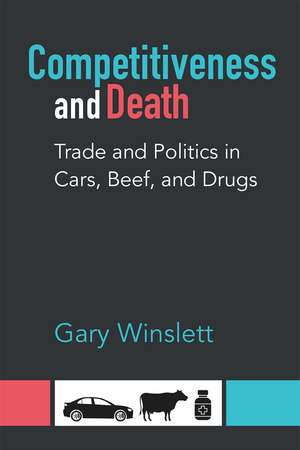
Competitiveness and Death: Trade and Politics in Cars, Beef, and Drugs
Autor Gary Winsletten Limba Engleză Hardback – 9 mar 2021
Gary Winslett builds on new trade theories to explain when and why businesses are most likely to lobby governments to reduce these regulatory trade barriers. He argues that businesses prevail when they can connect with broader concerns about national economic competitiveness. He examines how activist organizations overcome collective action problems and defend regulatory differences, arguing that they succeed when they can link their desire for barriers with preventing needless death. Competitiveness and Death provides a political companion to new trade theories in economics, questioning cleavage-based explanations of trade politics, demonstrating the underappreciated importance of activists, suggesting the limits of globalization, providing in-depth examination of previously ignored trade negotiations, qualifying the California Effect (the shift toward stricter regulatory standards), and showing the relative rarity of regulations used as disguised protectionism.
Preț: 519.56 lei
Preț vechi: 641.42 lei
-19%
Puncte Express: 779
Carte indisponibilă temporar
Doresc să fiu notificat când acest titlu va fi disponibil:
Se trimite...
Specificații
ISBN-13: 9780472132270
ISBN-10: 047213227X
Pagini: 340
Ilustrații: 4 figures, 6 tables
Dimensiuni: 152 x 229 x 20 mm
Greutate: 0.57 kg
Editura: UNIVERSITY OF MICHIGAN PRESS
Colecția University of Michigan Press
ISBN-10: 047213227X
Pagini: 340
Ilustrații: 4 figures, 6 tables
Dimensiuni: 152 x 229 x 20 mm
Greutate: 0.57 kg
Editura: UNIVERSITY OF MICHIGAN PRESS
Colecția University of Michigan Press
Notă biografică
Gary Winslett is Assistant Professor of Political Science at Middlebury College
Recenzii
"Both constructivist scholars studying endogenous legitimation dynamics at work and rational thinkers focused on the interplay of interests will appreciate Competitiveness and Death for the depth of analysis and its focus on how intersubjective processes lead to policy outcomes."
—World Trade Review
—World Trade Review